What did T. rex eat? Each other
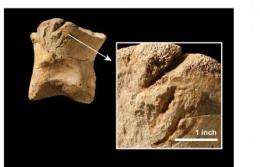
T. rex was the only big carnivore in western North America 65 million years ago that was capable of making such large gouges, such as the ones seen here on a toe bone. Credit: Nicholas Longrich/Yale University
It turns out that the undisputed king of the dinosaurs, Tyrannosaurus rex, didn't just eat other dinosaurs but also each other. Paleontologists from the United States and Canada have found bite marks on the giants' bones that were made by other T. rex, according to a new study published online Oct. 15 in the journal PLoS ONE.
While searching through dinosaur fossil collections for another study on dinosaur bones with mammal tooth marks, Yale researcher Nick Longrich discovered a bone with especially large gouges in them. Given the age and location of the fossil, the marks had to be made by T. rex, Longrich said. "They're the kind of marks that any big carnivore could have made, but T. rex was the only big carnivore in western North America 65 million years ago."
It was only after discovering the bite marks were from a T. rex that Longrich realized the bone itself also belonged to the behemoth. After searching through a few dozen T. rex bones from several different museum fossil collections, he discovered a total of three foot bones (including two toes) and one arm bone that showed evidence of T. rex cannibalism, representing a significant percentage.
"It's surprising how frequent it appears to have been," Longrich said. "We're not exactly sure what that means."
The marks are definitely the result of feeding, although scientists aren't sure whether they are the result of scavengers or the end result of fighting, Longrich said, adding that if two T. rex fought to the death, the victor might have made a meal out of his adversary. "Modern big carnivores do this all the time," he said. "It's a convenient way to take out the competition and get a bit of food at the same time."
However, the marks appear to have been made some time after death, Longrich said, meaning that if one dinosaur killed another, it might have eaten most of the meat off the more accessible parts of the carcass before returning to pick at the smaller foot and arm bones.
While only one other dinosaur species, Majungatholus, is known to have been a cannibal, Longrich said the practice was likely more common than we think and that closer examination of fossil bones could turn up more evidence that other species also preyed on one another.
The finding is a big clue into the obscure eating habits of these enormous predators. While today's large carnivores often hunt together in packs, T. rex likely acted on their own, Longrich said. "These animals were some of the largest terrestrial carnivores of all time, and the way they approached eating was fundamentally different from modern species," he said. "There's a big mystery around what and how they ate, and this research helps to uncover one piece of the puzzle."
More information: Citation: http://dx.plos.org … pone.0013419
Provided by
Yale University
-
From lemons to lemonade: Reaction uses carbon dioxide to make carbon-based semiconductor,
28 comments
-
Every black hole contains a new universe: A physicist presents a solution to present-day cosmic mysteries,
215 comments
-
New silicon memory chip developed,
16 comments
-
Thioridazine kills cancer stem cells in human while avoiding toxic side-effects of conventional cancer treatments,
2 comments
-
SpaceX private rocket blasts off for space station (Update),
41 comments
-
What does exophillic and endophillic mean in terms of mosquito and their control?
17 hours ago
-
Semen stains glows under black lights (uv light)?
May 23, 2012
-
Question on Human Chromosome 2
May 23, 2012
-
How important is composition of TBST in diluting antibodies and Western Blotting?
May 22, 2012
-
Does the medulla monitor blood pH
May 20, 2012
-
What physically constitutes memory?
May 17, 2012
- More from Physics Forums - Biology
More news stories
Dinosaur with tiny arms unearthed in Argentina
Argentine experts have discovered the near-complete remains of a new species of Jurassic-era dinosaur that stood on its rear legs and had tiny arms, according to a leading paleontologist.
Other Sciences / Archaeology & Fossils
2 hours ago |
5 / 5 (1) |
0
Social welfare cuts ultimately come with heavy price, researchers say
(Phys.org) -- Slashing government funding for Medicaid, food stamps and other programs that serve the poor while politically popular with some lawmakers and many conservatives may do more harm ...
Other Sciences / Social Sciences
22 hours ago |
4.5 / 5 (8) |
69
Relatively speaking: Researchers identify principles that shape kinship categories across languages
Different languages refer to family relationships in different ways. For example, English speakers use two terms grandmother and grandfather to refer to grandparents, while Mandarin Chinese uses four terms. ...
Other Sciences / Social Sciences
15 hours ago |
4 / 5 (4) |
0
|
Oldest art even older
New dates from Geißenklösterle Cave in Southwest Germany document the early arrival of modern humans and early appearance of art and music.
Other Sciences / Archaeology & Fossils
10 hours ago |
5 / 5 (2) |
1
Psychologists examine how race affects juvenile sentencing
When it comes to holding children accountable for crimes they commit, race matters.
Other Sciences / Social Sciences
13 hours ago |
3 / 5 (2) |
1
Computers excel at identifying smiles of frustration (w/ Video)
(Phys.org) -- Researchers at the Massachusetts Institute of Technology (MIT) in the US have trained computers to recognize smiles, and they have turned out to be more adept at recognizing smiles of frustration ...
Is a classical electrodynamics law incompatible with special relativity?
(Phys.org) -- The laws of classical electromagnetism that were developed in the 19th century are the same laws that scientists use today. They include Maxwell’s four equations along with the Lorentz la ...
Solar plane ends first leg of intercontinental bid
The Swiss sun-powered aircraft Solar Impulse landed safely in Madrid early Friday at the end of the first leg of its attempt at an intercontinental flight without using a drop of fuel.
HyperSolar shows dirty water no barrier to power world
(Phys.org) -- The Santa Barbara, California, company, HyperSolar, is set to transparently share the ups and downs of its research experiences toward the companys ultimate vision, successfully producing ...
Organic carbon from Mars, but not biological
(Phys.org) -- Molecules containing large chains of carbon and hydrogen--the building blocks of all life on Earth--have been the targets of missions to Mars from Viking to the present day. While these molecules ...
In nanorod crystal growth, nanoparticles seen as artificial atoms
In the growth of crystals, do nanoparticles act as "artificial atoms" forming molecular-type building blocks that can assemble into complex structures? This is the contention of a major but controversial theory ...
Oct 16, 2010
Rank: not rated yet
I suspect the real answer is, "anything that want".
Oct 16, 2010
Rank: 5 / 5 (4)
Oct 16, 2010
Rank: 2.3 / 5 (3)
I'm also interested in what evidence we have of behaviour.
I realize that we can surmise all kinds of scenarios, but we have no real evidence of any kind of behaviour.
This is not science.
Oct 16, 2010
Rank: not rated yet
Oct 16, 2010
Rank: not rated yet
Oct 16, 2010
Rank: 1 / 5 (1)
Love bites on bone? Sounds like they were doing it wrong!
Oct 16, 2010
Rank: not rated yet
Oct 17, 2010
Rank: not rated yet
Who are you to determine that this is not science? I assume you're a scientist, have read the actual article, and are willing to put your professional reputation on the line to back that assertion.
This isn't even remotely related to my field and I can tell you it's not that difficult to distinguish between feeding traces (marks left by gnawing, picking the meat off the bones, etc.) and normal injuries.
I imagine post-mortem is also fairly simple to determine since we've had that capability in forensic criminal investigations for quite some time. Just looking at some of those pictures, I can tell you it's quite unlikely they were made to an animal that was conscious and able to defend itself... these aren't little bites.
Of course, if you're so "interested", you could just read the full text article directly linked after the words "More information:"
Oct 17, 2010
Rank: not rated yet
Oct 18, 2010
Rank: 5 / 5 (1)
Maybe food was scarce or something.
Maybe, as already pointed out, the creatures were fighting over a mate.
Predatory animals often have self-destructive reproductive behavior.
Male cats of all sizes have been known to kill their own young, presumably so they can mate with the female again.