'Reaper' protein strikes at mitochondria to kill cells
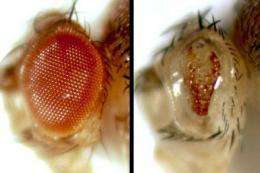
The results could be plainly seen in the how the eyes developed. Here is a normal eye (left) beside one that's almost completely destroyed by apoptosis (right).
Our cells live ever on the verge of suicide, requiring the close attention of a team of molecules to prevent the cells from pulling the trigger. This self-destructive tendency can be a very good thing, as when dangerous precancerous cells are permitted to kill themselves, but it can also go horribly wrong, destroying brain cells that store memories, for instance. Rockefeller University scientists are parsing this perilous arrangement in ever finer detail in hopes that understanding the basic mechanisms of programmed cell death, or apoptosis, will enable them eventually to manipulate the process to kill the cells we want to kill and protect the ones we dont.
In experiments published last month in the Journal of Cell Biology, researchers led by postdoctoral associate Cristinel Sandu in Hermann Stellers Strang Laboratory of Apoptosis and Cancer Biology drilled down on a protein aptly named Reaper, which was first described in a 1994 paper by Steller in Science. Under the right conditions, Reaper interferes with molecules called inhibitor of apoptosis proteins (IAPs), which prevent the cell from irrevocably initiating its autodestruct sequence. By inhibiting these inhibitors, Reaper essentially takes the brakes off the process of apoptosis, pronouncing a cells death sentence. Other molecules called caspases then carry that sentence out.
Like the grim reaper, Reaper is an announcer of death, but not the executioner, says Steller, who is also a Howard Hughes Medical Institute investigator. Its like the key that starts the engine.
Reaper and the other Drosophila IAP antagonists Hid and Grim are known to trigger apoptosis in flies, and related proteins serve a similar function in humans and other mammals. But exactly how and where Reaper initiates apoptosis has not been well understood. Sandu and colleagues bred genetically modified strains of flies that expressed variations on the Reaper protein specifically in flies eyes. This allowed them to assess the contribution of individual protein motifs to Reapers apoptosis inducing powers, and what they found was that a particular helical domain was crucial for the formation of Reaper complexes, and could be modified to be even more powerful than the regular protein. The more deadly Reaper variants were obvious by the damage caused to the flies eyes.
In a series of biochemical experiments, the researchers also found that Reaper must travel to the mitochondria, the cells energy factories, to effectively deliver its death sentence, and that to get there, it must hitch a ride on the Hid protein, with which it interacts. By tagging Hid and Reaper fluorescently, Sandu could visualize Hid and Reaper acting in a complex and gathering at the membrane of the mitochondria. When Reaper was engineered to go directly to the mitochondrial membrane, it resulted in a molecule that is far superior at triggering cell death than regular Reaper. Further experiments suggested that in a complex with Hid, Reaper is protected from degradation as the cells began to die.
So now we have Hid and Reaper working very closely together, Sandu says. And the localization to the mitochondria is crucial to the initiation of apoptosis. Drugs that mimic a small part of the function of Reaper are already in clinical trials. The discovery of a way to make Reaper a much better killer, namely by targeting it directly to the mitochondria, provides new avenues to explore for improving cancer therapies. Adding this element that takes Reaper directly to the mitochondria is not something people would have thought of before this, Steller says.
More information: Journal of Cell Biology 190: 10391052 (September 20, 2010) Drosophila IAP antagonists form multimeric complexes to promote cell death Cristinel Sandu, et al.
Provided by
Rockefeller University
-
From lemons to lemonade: Reaction uses carbon dioxide to make carbon-based semiconductor,
28 comments
-
Every black hole contains a new universe: A physicist presents a solution to present-day cosmic mysteries,
214 comments
-
New silicon memory chip developed,
16 comments
-
Computing experts unveil superefficient 'inexact' chip,
45 comments
-
SpaceX private rocket blasts off for space station (Update),
41 comments
-
What does exophillic and endophillic mean in terms of mosquito and their control?
12 hours ago
-
Semen stains glows under black lights (uv light)?
May 23, 2012
-
Question on Human Chromosome 2
May 23, 2012
-
How important is composition of TBST in diluting antibodies and Western Blotting?
May 22, 2012
-
Does the medulla monitor blood pH
May 20, 2012
-
What physically constitutes memory?
May 17, 2012
- More from Physics Forums - Biology
More news stories
Global warming winner: Once rare butterfly thrives
(AP) -- Global warming is rescuing the once-rare brown Argus butterfly, scientists say.
8 hours ago |
4 / 5 (2) |
3
Gourmet butterflies speed north: study
A new study led by scientists in the Department of Biology at the University of York has shown how a butterfly has changed its diet, and consequently has sped northwards in response to climate change. Their study is published ...
10 hours ago |
5 / 5 (3) |
1
|
Researchers find a way to delay aging of stem cells
Stem cells are essential building blocks for all organisms, from plants to humans. They can divide and renew themselves throughout life, differentiating into the specialized tissues needed during development, ...
14 hours ago |
5 / 5 (4) |
0
|
Fungi shifted plant balance of power
Cooperating with fungi didn't just help the earliest plants spread across a barren, rocky landscape; it also played a decisive role in the rise of more complex plants with roots and leaves that make up most ...
15 hours ago |
5 / 5 (1) |
0
|
Brightly colored bird bills indicate good health
Troy Murphy has found female bill colour reflects the health of the bird. Females with more colourful bills have higher antibody levels, indicating greater strength and the ability to fight off invaders.
8 hours ago |
not rated yet |
0
Is a classical electrodynamics law incompatible with special relativity?
(Phys.org) -- The laws of classical electromagnetism that were developed in the 19th century are the same laws that scientists use today. They include Maxwell’s four equations along with the Lorentz la ...
HyperSolar shows dirty water no barrier to power world
(Phys.org) -- The Santa Barbara, California, company, HyperSolar, is set to transparently share the ups and downs of its research experiences toward the companys ultimate vision, successfully producing ...
Organic carbon from Mars, but not biological
Molecules containing large chains of carbon and hydrogen--the building blocks of all life on Earth--have been the targets of missions to Mars from Viking to the present day. While these molecules have previously ...
In nanorod crystal growth, nanoparticles seen as artificial atoms
In the growth of crystals, do nanoparticles act as "artificial atoms" forming molecular-type building blocks that can assemble into complex structures? This is the contention of a major but controversial theory ...
First direct observation of oriented attachment in nanocrystal growth
Berkeley Lab researchers have reported the first direct observation of nanoparticles undergoing oriented attachment, the critical step in biomineralization and the growth of nanocrystals. A better understanding ...
Asteroid nudged by sunlight: Most precise measurement of Yarkovsky effect
Scientists on NASA's asteroid sample return mission, Origins, Spectral Interpretation, Resource Identification, Security, Regolith Explorer (OSIRIS-REx), have measured the orbit of their destination asteroid, ...
Oct 20, 2010
Rank: 5 / 5 (2)