Intricate, curving 3-D nanostructures created using capillary action forces
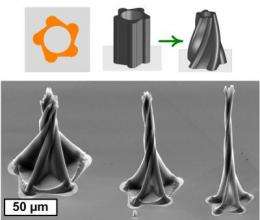
Twisting spires are one of the 3-D shapes researchers at the University of Michigan were able to develop using a new manufacturing process. Credit: A. John Hart
ANN ARBOR, Mich.---Twisting spires, concentric rings, and gracefully bending petals are a few of the new three-dimensional shapes that University of Michigan engineers can make from carbon nanotubes using a new manufacturing process.
The process is called "capillary forming," and it takes advantage of capillary action, the phenomenon at work when liquids seem to defy gravity and travel up a drinking straw of their own accord.
The new miniature shapes, which are difficult if not impossible to build using any material, have the potential to harness the exceptional mechanical, thermal, electrical, and chemical properties of carbon nanotubes in a scalable fashion, said A. John Hart, an assistant professor in the Department of Mechanical Engineering and in the School of Art & Design.
They could lead to probes that can interface with individual cells and tissues, novel microfluidic devices, and new materials with a custom patchwork of surface textures and properties.
A paper on the research is published in the October edition of Advanced Materials, and is featured on the cover.
"It's easy to make carbon nanotubes straight and vertical like buildings," Hart said. "It hasn't been possible to make them into more complex shapes. Assembling nanostructures into three-dimensional shapes is one of the major goals of nanotechnology. The method of capillary forming could be applied to many types of nanotubes and nanowires, and its scalability is very attractive for manufacturing."
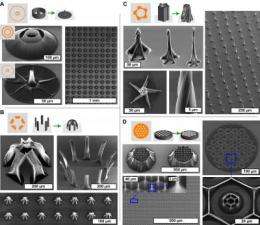
By using unique two-dimensional templates, researchers at the University of Michigan could coax carbon nanotubes to grow in intricate, curving three-dimensional structures. Credit: A. John Hart
Hart's method starts by stamping patterns on a silicon wafer. His ink in this case is the iron catalyst that facilitates the vertical growth of the carbon nanotubes in the patterned shapes. Rather than stamp a traditional, uniform grid of circles, Hart stamp hollow circles, half circles and circles with smaller ones cut from their centers. The shapes are arranged in different orientations and groupings. One such grouping is a pentagon of half circles with their flat sides facing outward.He uses the traditional "chemical vapor deposition" process to grow the nanotubes in the prescribed patterns. Then he suspends the silicon wafer with its nanotube forest over a beaker of a boiling solvent, such as acetone. He lets the acetone condense on the nanotubes, and then lets the acetone evaporate.
As the liquid condenses, capillary action forces kick in and transform the vertical nanotubes into the intricate three-dimensional structures. For example, tall half-cylinders of nanotubes bend backwards to form a shape resembling a three-dimensional flower.
"We program the formation of 3D shapes with these 2D patterns," Hart said. "We've discovered that the starting shape influences how the capillary forces change the structures' geometry. Some bend, others twist, and we can combine them any way we want."
The capillary forming process allows the researchers to create large batches of 3D microstructures---all much smaller than a cubic millimeter---over essentially limitless areas, Hart said. In addition, the researchers show that their 3D structures are up to 10 times stiffer than typical polymers used in microfabrication. Thus, they can be used as molds for manufacturing of the same 3D shapes in other materials.
"We'd like to think this opens up the idea of creating custom nanostructured surfaces and materials with locally varying geometries and properties, " Hart said. "Now, we think of materials as having the same properties everywhere, but with this new technique we can dream of designing the structure and properties of a material together."
More information: The paper is called "Diverse 3D Microarchitectures Made by Capillary Forming of Carbon Nanotubes."
Provided by
University of Michigan
-
From lemons to lemonade: Reaction uses carbon dioxide to make carbon-based semiconductor,
28 comments
-
Every black hole contains a new universe: A physicist presents a solution to present-day cosmic mysteries,
214 comments
-
New silicon memory chip developed,
16 comments
-
Computing experts unveil superefficient 'inexact' chip,
45 comments
-
SpaceX private rocket blasts off for space station (Update),
41 comments
-
Density question
10 hours ago
-
Mass transport originating from a point source at a solid gas interface
May 22, 2012
-
Ammonia dispersion in Air
May 22, 2012
-
Multi Choice Help
May 21, 2012
-
index of refraction and thickness of materials
May 18, 2012
-
Solar battery maintainer for car
May 17, 2012
- More from Physics Forums - Materials & Chemical Engineering
More news stories
Scientists evaluate different antimicrobial metals for use in water filters
Porous ceramic water filters are often coated with colloidal silver, which prevents the growth of microbes trapped in the micro- and nano-scale pores of the filter. Other metals such as copper and zinc have also been shown ...
Nanotechnology / Bio & Medicine
52 minutes ago |
not rated yet |
0
A nanoclutch for nanobots
Chinese researchers have designed and tested simulations of a "nanoclutch," a speed regulation tool for nanomotors.
31 minutes ago |
not rated yet |
0
In nanorod crystal growth, nanoparticles seen as artificial atoms
In the growth of crystals, do nanoparticles act as "artificial atoms" forming molecular-type building blocks that can assemble into complex structures? This is the contention of a major but controversial theory ...
4 hours ago |
5 / 5 (2) |
0
|
First direct observation of oriented attachment in nanocrystal growth
Berkeley Lab researchers have reported the first direct observation of nanoparticles undergoing oriented attachment, the critical step in biomineralization and the growth of nanocrystals. A better understanding ...
4 hours ago |
5 / 5 (1) |
0
|
'Metamaterials,' quantum dots show promise for new technologies
(Phys.org) -- Researchers are edging toward the creation of new optical technologies using "nanostructured metamaterials" capable of ultra-efficient transmission of light, with potential applications including ...
3 hours ago |
5 / 5 (1) |
0
|
Asteroid nudged by sunlight: Most precise measurement of Yarkovsky effect
Scientists on NASA's asteroid sample return mission, Origins, Spectral Interpretation, Resource Identification, Security, Regolith Explorer (OSIRIS-REx), have measured the orbit of their destination asteroid, ...
Study provides compelling evidence for an effective new treatment for tinnitus
According to new research, a multidisciplinary approach to treating tinnitus that combines cognitive behaviour therapy with sound-based tinnitus retraining therapy is significantly more effective than currently available ...
'Personality genes' may help account for longevity
"It's in their genes" is a common refrain from scientists when asked about factors that allow centenarians to reach age 100 and beyond. Up until now, research has focused on genetic variations that offer a physiological advantage ...
Tiny planet-finding mirrors borrow from Webb Telescope playbook
NASA's next flagship mission the James Webb Space Telescope will carry the largest primary mirror ever deployed. This segmented behemoth will unfold to 21.3 feet in diameter once the observatory ...
Slip-and-slide power generators
Researchers from Vestfold University College in Norway have created a simple, efficient energy harvesting device that uses the motion of a single droplet to generate electrical power.
Brentuximab vedotin effective in large-cell lymphoma
(HealthDay) -- More than half of patients with relapsed or refractory systemic anaplastic large-cell lymphoma (ALCL) treated with the CD30-directed antibody-drug conjugate brentuximab vedotin achieve a complete ...

Oct 21, 2010
Rank: not rated yet
Adrian Miller
Advanced Materials
Oct 25, 2010
Rank: not rated yet