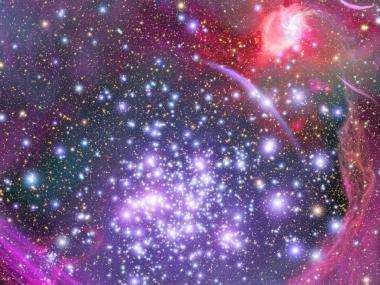
Image: Deep inside the Milky Way
Oct 26, 2010
Image Credit: Artist's Concept/NASA/ESA/STScI

This artist's impression shows how the Arches star cluster appears from deep inside the hub of our Milky Way Galaxy.

Hidden from our direct view, the massive cluster lies 25,000 light-years away and is the densest known gathering of in our galaxy.

The illustration is based on infrared observations from Hubble and with ground-based telescopes, which pierced our galaxy's dusty core and snapped images of the luminous cluster of about 2,000 stars.

Explore further: Three centaurs follow Uranus through the solar system

add to favorites email to friend print save as pdf

Related Stories

Hubble Sees Star Cluster 'Infant Mortality'

Jan 10, 2007

Astronomers have long known that young or "open" star clusters must eventually disrupt and dissolve into the host galaxy. They simply don't have enough gravity to hold them together, unlike their much more ...

Chandra Lifts the Veil on Milky Way 'Hotspot'

Jan 23, 2008

NASA's Chandra X-ray Observatory is helping to demystify Westerlund 2, a young star cluster with an estimated age of about one- or two-million years. Heavily obscured by dust and gas, Westerlund 2 has been ...

Recommended for you

Three centaurs follow Uranus through the solar system

22 hours ago

Astrophysicists from the Complutense University of Madrid have confirmed that Crantor, a large asteroid with a diameter of 70 km has an orbit similar to that of Uranus and takes the same amount of time to ...

Final curtain for Europe's deep-space telescope

Jun 17, 2013

The deep-space telescope Herschel took its final bow on Monday, climaxing a successful four-year mission to observe the birth of stars and galaxies, the European Space Agency (ESA) said.

Hubble spots a very bright contortionist

Jun 17, 2013

(Phys.org) —The contorted object captured by Hubble in this picture is IRAS 22491-1808, also known as the South America Galaxy. It is an ultra-luminous infrared galaxy (ULIRG) that emits a huge amount of ...

Study explains decades of black hole observations

Jun 14, 2013

(Phys.org) —A new study by astronomers at NASA, Johns Hopkins University and Rochester Institute of Technology confirms long-held suspicions about how stellar-mass black holes produce their highest-energy ...

User comments : 3

Adjust slider to filter visible comments by rank

Display comments: newest first

Honor
not rated yet Oct 26, 2010
wow great article :p~
TDK
1 / 5 (12) Oct 26, 2010
just another photoshop, please...
Skeptic_Heretic
not rated yet Oct 27, 2010
There's a mistake in the article, the image was compiled using IR and Xray imaging, not solely IR.

More news stories

Diabetes key to transplant success, research finds

(Medical Xpress)—Better management of diabetes could dramatically improve outcomes for lung transplant patients, with new research showing that those without diabetes lived twice as long as transplant recipients ...