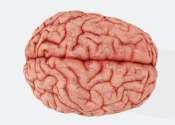
The brain is the center of the nervous system in all vertebrate, and most invertebrate, animals. Some primitive animals such as jellyfish and starfish have a decentralized nervous system without a brain, while sponges lack any nervous system at all. In vertebrates, the brain is located in the head, protected by the skull and close to the primary sensory apparatus of vision, hearing, balance, taste, and smell.
Brains can be extremely complex. The cerebral cortex of the human brain contains roughly 15-33 billion neurons depending on gender and age, linked with up to 10,000 synaptic connections each. Each cubic millimeter of cerebral cortex contains roughly one billion synapses. These neurons communicate with one another by means of long protoplasmic fibers called axons, which carry trains of signal pulses called action potentials to distant parts of the brain or body and target them to specific recipient cells.
The most important biological function of the brain is to generate behaviors that promote the welfare of an animal. Brains control behavior either by activating muscles, or by causing secretion of chemicals such as hormones. Even single-celled organisms may be capable of extracting information from the environment and acting in response to it. Sponges, which lack a central nervous system, are capable of coordinated body contractions and even locomotion. In vertebrates, the spinal cord by itself contains neural circuitry capable of generating reflex responses as well as simple motor patterns such as swimming or walking. However, sophisticated control of behavior on the basis of complex sensory input requires the information-integrating capabilities of a centralized brain.
Despite rapid scientific progress, much about how brains work remains a mystery. The operations of individual neurons and synapses are now understood in considerable detail, but the way they cooperate in ensembles of thousands or millions has been very difficult to decipher. Methods of observation such as EEG recording and functional brain imaging tell us that brain operations are highly organized, but these methods do not have the resolution to reveal the activity of individual neurons.