Nanoscale pasta: Toward nanoscale electronics
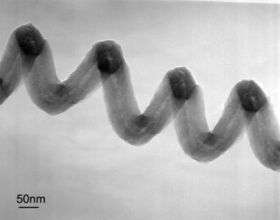
Pasta tastes like pasta – with or without a spiral. But when you jump to the nanoscale, everything changes: carbon nanotubes and nanofibers that look like nanoscale spiral pasta have completely different electronic properties than their non-spiraling cousins. Engineers at UC San Diego, and Clemson University are studying these differences in the hopes of creating new kinds of components for nanoscale electronics.
"We are looking at spiraling, bent and helical carbon nanotubes from the point of view of new functionality. Can we get something totally different from these nonlinear nanotubes?" asked Prab School of Engineering.
For example, spiral shaped nanotubes could turn out to be important for new kinds of nanoscale switching and memory storage devices.
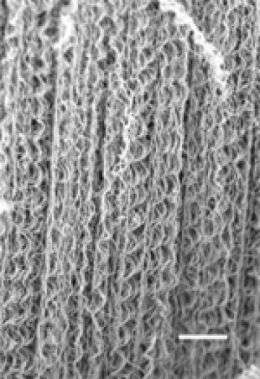
Recently, Bandaru won a National Science Foundation CAREER award for the study of nonlinear nanotubes. Bandaru's award carries with it a 5-year, $400,000 grant to support research aimed at developing Bandaru, a mechanical and aerospace engineering professor at the UC San Diego Jacobs new types of nanoelectronic components including electrical switches, logic elements, frequency mixers and nanoscale inductors. Such devices could some day outperform conventional silicon technologies on a number of levels, such as power consumption, radiation hardness, and heat dissipation.
Bandaru collaborates with Apparao Rao, of Clemson University, on the controlled synthesis of carbon nanotubes with a variety of shapes, including Y-junctions and nanohelices, through chemical vapor deposition processes. Once they are grown, transmission electron microscopy is used to perform structural analyses of the nonlinear nanotubes. The engineers are also investigating nanotube growth mechanisms, defects, nanoscale electrical conduction mechanisms and device modeling. In addition, they are exploring both the layout of electrical and optoelectronic circuits, and the limits of device operation through high frequency measurements.
"Because nanotubes are so small, you need to work at the atomic level to understand and manipulate them," explained Bandaru. The presence or absence of single carbon atoms at strategic locations within nanotubes determines whether they have a linear or spiral shape.
Work on nonlinear nanowires is already well underway at UCSD and around the world. Bandaru, for example, is the first author on a paper recently published in the Journal of Applied Physics that outlines a mechanism for how carbon nanotubes and nanofibers grow. In particular, the model predicts conditions under which coiling will happen.
"Now that we know the exact conditions under which the helical nanostructures grow, we can exert greater control over the electronic and other properties of nonlinear nanotubes," said Bandaru.
Exactly where, when and how linear and nonlinear nanotubes will make the leap from the laboratory to the real world is still unclear. Scientists have more to learn about their basic properties, about how to control their growth, and about how to integrate them into devices.
In August 2005, Bandaru made headlines around the world when his work on Y-shaped nanotubes appeared in the journal Nature Materials. Bandaru and colleagues at UCSD's Jacobs School and Clemson University demonstrated that Y-shaped nanotubes can behave as electronic switches similar to conventional transistors, which are the workhorses of modern microprocessors, digital memory, and application-specific integrated circuits.
Nanotubes, of course, are not the only tiny spiraling structures. DNA and proteins also have helical structures. "It's gratifying to encounter connections at the nanoscale between biological structures and helices and coils synthesized via chemical vapor deposition," said Bandaru. "Our future work might improve our understanding of why helices abound in nature."
Reference: P.R. Bandaru et al, Journal of Applied Physics, vol. 101, no. 9, p 094307, 2007
Source: University of California - San Diego


