Magnetic tweezers unravel cellular mechanics
May 14, 2007
Magnetic tweezers unravel cellular mechanics
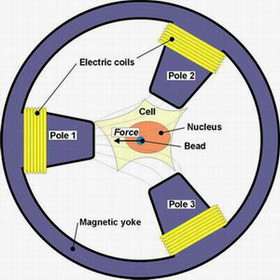
Scheme of the micromechanical experiments. Magnetic poles (6 µm wide, 20 µm separation) generate a force on a paramagnetic bead positioned in the nucleus of a HeLa cell. Electric coils allow the control of amplitude and direction of the force. Magnetic yoke and electric coils are not to scale. Credit: University of Twente

By injecting tiny magnetic beads into a living cell and manipulating them with a magnetic ‘tweezer’, scientists of the University of Twente, The Netherlands, succeed in getting to know more about the mechanics of the cell nucleus.

The way DNA is ‘translated’ into the specific functions of the cell strongly depends on the mechanics, so this information is of great value. Scientists Anthony de Vries, Hans Kanger and Vinod Subramaniam of the Biophysical Engineering Group present their results in Nano Letters.

The spatial organization in a living cell tells a lot about the way the cell works and the molecular processes within. It is clearly indicated that the mechanical properties of DNA and chromatin –the complex of DNA and proteins- play a major role in the activity of thousands of genes. Gene expression, in which DNA expresses itself in functional proteins, seems to depend highly on these mechanical properties. Until now, only individual chromosomes have been investigated: the new method allows scientists to monitor the mechanical properties of chromatin within the cell and investigate the internal structure of the cell nucleus.

Three magnets

The UT-scientists therefore inject a bead into the cell nucleus using a micro pipette. The bead is about 1 micron in diameter. The cell is placed in the centre of three tiny magnets (micron dimensions). Each of them can generate a force on the bead. From the nanometer distances the bead is allowed to move, the elasticity and viscosity of the chromatin can be determined. Using an intuitive polymer model of chromatin, the organization of chromatin within the cell can then be predicted: they organize themselves within domains not entirely filling the nucleus.

The scientists say that their technique is a crucial step towards magnetic nanodevices that can be implanted in a living cell, functioning as biosensors for monitoring chemical and physical processes in cell and tissue. It will also become possible to interact with these processes using the magnetic technique.

The research has been conducted within the Biophysical Engineering Group (bpe.tnw.utwente.nl), part of the BMTI Institute for Biomedical Technology and the MESA+ Institute for Nanotechnology, both at the University of Twente.

Source: University of Twente

Explore further: Carbon nanotube harpoon catches individual brain-cell signals

add to favorites email to friend print save as pdf

Related Stories

Snowden's life surrounded by spycraft (Update)

18 hours ago

In the suburbs edged by woods midway between Baltimore and Washington, residents long joked that the government spy shop next door was so ultra-secretive its initials stood for "No Such Agency." But when ...

Winners and losers at this week's E3

18 hours ago

Since the first battles over "Pong" machines in local arcades four decades ago, video gamers have loved good competition. And this year's Electronic Entertainment Expo—the industry's largest annual gathering—presented ...

Europe's space truck docks with ISS

18 hours ago

A robot freighter bearing 6.6 tonnes of cargo docked with the International Space Station (ISS) on Saturday, the European Space Agency (ESA) said.

Secret to Prism program: Even bigger data seizure

18 hours ago

In the months and early years after the Sept. 11, 2001, terrorist attacks, FBI agents began showing up at Microsoft Corp. more frequently than before, armed with court orders demanding information on customers.

New app helping Venezuelans find scarce items

Jun 09, 2013

Harried Venezuelans who devote hours scouring supermarkets for increasingly scarce food basics and toilet paper have just received some digital help thanks to a young software developer.

Recommended for you

Sweet solutions for detecting disease

Jun 19, 2013

Based at the Institute of Chemistry in the Slovak Academy of Sciences, Ján Tkáč's research combines glycomics – the study of sugars in organisms – with biochip sensors based on nanoparticles and nanotubes. ...

Nanoparticles for controlled drug release

Jun 13, 2013

Scientists from CIC bioGUNE and the Laboratoire de Chimie des Polymères Organiques (LCPO) in Bordeaux have jointly undertaken a project to develop "smart" nanoparticles. These polymeric particles act as "nanomissiles" against ...

User comments : 0

More news stories

Danish chemists in molecular chip breakthrough

Electronic components built from single molecules using chemical synthesis could pave the way for smaller, faster and more green and sustainable electronic devices. Now for the first time, a transistor made ...

Sound waves precisely position nanowires

(Phys.org) —The smaller components become, the more difficult it is to create patterns in an economical and reproducible way, according to an interdisciplinary team of Penn State researchers who, using ...

Has motorization in the US reached its peak?

(Phys.org) —Fewer light vehicles are on America's roads today than five years ago, thanks possibly to increases in telecommuting and public transportation, says a University of Michigan researcher.