Construction strategies to avoid progressive collapse
Mar 16, 2007
Construction strategies to avoid progressive collapse
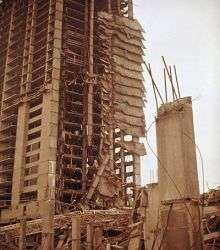
The Skyline Plaza Apartments in Fairfax County, Va after a 1973 progressive collapse that occured during construction of the 24th floor. The collapse involved the full height of the tower, and falling debris also caused the horizontal progressive collapse of an entire parking garage under construction adjacent to the tower. Fourteen workers were killed, 34 workers were injured. Credit: Hai S. Lew/NIST

The 1995 terrorist attack on the Oklahoma City Alfred P. Murrah Federal Building heightened concern on the vulnerability of multi-story buildings to “progressive collapse,” the spread of an initial local structural failure by chain reaction that results in the collapse of an entire structure or a disproportionately large part of it. The National Institute of Standards and Technology recently issued a guide to help owners, engineers and building officials avoid such collapses through prudent planning and design of structures. The guide also summarizes national and international best practices for designing buildings resistant to progressive collapse of buildings.

The report, Best Practices for Reducing the Potential for Progressive Collapse in Buildings, argues that although no building system can be engineered and constructed to be absolutely risk-free, risk-informed assessment and decision-making can reduce the risk of progressive collapse. According to the researchers, engineers must not simply work to the minimum requirements of the building code; they need to consider ways to improve structural integrity and robustness to accommodate local failures.

According to NIST engineers, hazards that increase the risk of local structural failures that, in turn, can lead to a partial or complete progressive collapse include design and construction errors, fire, gas explosion, the transport and storage of hazardous materials, vehicular collision, and bomb explosions.

The NIST report cites a lack of continuity of support within a building system, a lack of ductility in structural materials, members and connections, and lack of structural redundancy in providing alternate load paths as critical factors that limit structural integrity. The use of large-paneled or bearing wall construction, for example, can limit continuity and ductility. Such systems may be poorly suited to absorb or dissipate energy resulting from unforeseen events such as gas explosion and sabotage.

The guide catalogs a number of cost-effective engineering solutions for retrofitting existing structures.

The document summarizes “existing knowledge” for use by engineers in making risk-informed planning and design decisions. It is not intended to provide step-by-step guidance. Appendix A describes applicable design standards from around the world. Appendix B identifies research needs relevant to progressive collapse. Appendix C provides case studies of progressive collapse.

Source: National Institute of Standards and Technology

Explore further: Sensitive bomb detector to rove in search of danger

add to favorites email to friend print save as pdf

Related Stories

Glasses begin to reveal their high pressure secrets

Jan 08, 2013

The structural changes in glasses and liquids induced by high-pressure conditions can substantially alter their dynamical and transport properties. Unravelling the mechanisms behind these transformations ...

Why things fall apart

Aug 24, 2012

Chunks of concrete tumble from the Gardiner Expressway, the Algo Centre Mall collapses in Elliot Lake, shards of glass fall from Toronto condos, and a Radiohead stage gives way at Downsview Park.

Microbes, sponges, and worms add to coral reef woes

Aug 06, 2012

Microbes, sponges, and worms—the side effects of pollution and heavy fishing—are adding insult to injury in Kenya's imperiled reef systems, according to a recent study by the Wildlife Conservation ...

Recommended for you

Sensitive bomb detector to rove in search of danger

17 hours ago

European researchers have developed and tested a light-weight device capable of detecting extremely minute quantities of explosives from up to 20 metres away, providing an invaluable law-enforcement tool ...

How soon could car seats enter the 3-D comfort zone?

May 23, 2013

New 3D textiles made of recyclable polyester fibres could contribute help cars be easier to recycle. But recycling technology has yet to progress in separating seat material from other car components.

NASA: Austin, calling Austin. 3-D pizzas to go

May 22, 2013

(Phys.org) —The idea of living with 3-D printed food is neither unthinkable nor new; designers and futurists have been looking to 3-D printing as food's next frontier. In 2012, there was news that the Thiel ...

User comments : 0

More news stories

Google eyes emerging markets networks

Google has become deeply involved in a series of projects to build and operate wireless networks in emerging markets including sub-Saharan Africa and Southeast Asia, a report said Friday.

Facial-recognition technology proves its mettle

(Phys.org) —In a study that evaluated some of the latest in automatic facial recognition technology, researchers at Michigan State University were able to quickly identify one of the Boston Marathon bombing ...

Drones may violate international law

(Phys.org) —As President Obama gives a speech on national security—including defending U.S. use of drones to combat terrorism—Leila Sadat, JD, international law expert and professor of law at Washington University in ...

Galaxies fed by funnels of fuel

(Phys.org) —Computer simulations of galaxies growing over billions of years have revealed a likely scenario for how they feed: a cosmic version of swirly straws.