Panasonic develops White Color Power LEDs by employing GaN Substrates
Mar 05, 2007
Panasonic develops White Color Power LEDs by employing GaN Substrates

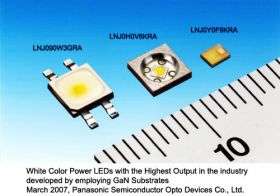
Panasonic today announced that it has developed a blue LED element by employing GaN substrates for the first time in the industry.

From middle of March 2007, the company will mass-produce a white high-power LED series using these elements. Use of a GaN substrates, which has very high thermal and electrical conductivity, substantially improves the performance of this LED in the high current area, and achieves the industry's top-level output. The emitted light wavelength is 460 nm, the total radiation flux 355 mW at a forward current of 350 mA, with an external quantum efficiency of 38%.

Its marked crystal stability gives it high reliability as a device, and since the substrates and light-emitting layer have the same refractive index, the result is light delivery efficiency over 1.5 times that of the conventional company sapphire-based LED element.

The blue LED element covered with a uniform fluorescent layer results in a compact white high-power LED with little color variation. Application of this technology is likely to bring forward the development of new applications, such as LED-based lighting and camera flashes.

An LED produced on a sapphire substrates based on current primary technology suffers problems with light emission efficiency due to the difference in refractive index between the substrates and the light-emitting layer. Poor heat dissipation properties tend to result in saturation of output at high currents. The conventional fluorescence application process generates unevenness in the white color, and the large volume of the white light-emitting body limits the optical design possibilities of the lens.

Source: Panasonic

Explore further: Google eyes emerging markets networks

add to favorites email to friend print save as pdf

Related Stories

New material for warm-white LEDs invented

Jan 18, 2013

Light emitting diodes, more commonly called LEDs, are known for their energy efficiency and durability, but the bluish, cold light of current white LEDs has precluded their widespread use for indoor lighting.

LEDs on silicon can reduce production costs

May 21, 2012

A new manufacturing technology is expected to greatly reduce the cost of light-emitting diodes (LEDs) in the future. For the first time ever, researchers at the Siemens subsidiary Osram Opto Semiconductors ...

Recommended for you

Yahoo, pay-TV operators among Hulu bidders

9 hours ago

Online video site Hulu is again up for sale, with Yahoo and pay TV operators DirecTV and Time Warner Cable among the seven bidders, according to a person with direct knowledge of the matter.

Radiation leak at Japan lab; small impact expected

9 hours ago

An atomic research lab in northern Japan has reported a radiation leak that may have affected about 50 people, though none were hospitalized and no impact was expected outside the facility, the lab's operator ...

Google eyes emerging markets networks

23 hours ago

Google has become deeply involved in a series of projects to build and operate wireless networks in emerging markets including sub-Saharan Africa and Southeast Asia, a report said Friday.

User comments : 1

Adjust slider to filter visible comments by rank

Display comments: newest first

bfreewithrp
not rated yet Apr 08, 2008
I would like to input my opinions along with a short article I've written on the future of the LED lighting technology.
At the end of the 19th century, man was awakened with a fabulous new lighting for all to enjoy. The incandescent light bulb was born. Thanks to the inventiveness and perseverance of one of the most famous inventors of our times, Thomas a. Edison, we are able to still enjoy its benefits, but can we still enjoy its luxuries?
http://www.quazen...er.17178
Led Lighting, The World's Final Frontier

More news stories

Yahoo, pay-TV operators among Hulu bidders

Online video site Hulu is again up for sale, with Yahoo and pay TV operators DirecTV and Time Warner Cable among the seven bidders, according to a person with direct knowledge of the matter.

Radiation leak at Japan lab; small impact expected

An atomic research lab in northern Japan has reported a radiation leak that may have affected about 50 people, though none were hospitalized and no impact was expected outside the facility, the lab's operator ...

Google eyes emerging markets networks

Google has become deeply involved in a series of projects to build and operate wireless networks in emerging markets including sub-Saharan Africa and Southeast Asia, a report said Friday.

Galaxies fed by funnels of fuel

(Phys.org) —Computer simulations of galaxies growing over billions of years have revealed a likely scenario for how they feed: a cosmic version of swirly straws.