January 29, 2007 feature
Inflatable Habitats for Polar and Space Colonists
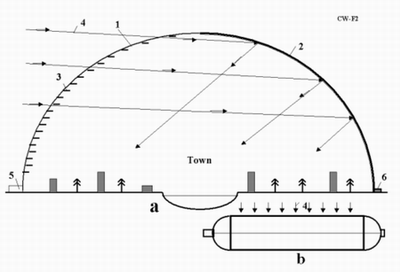
Humanity has long since established a foothold in the Artic and Antarctic, but extensive colonization of these regions may soon become economically viable. If we can learn to build self-sufficient habitats in these extreme environments, similar technology could be used to live on the Moon or Mars.
The average temperature of the Antarctic coast in winter is about –20 °C. As if this weren't enough, the region suffers from heavy snowfall, strong winds, and six-month nights. How can humanity possibly survive in such a hostile environment?
So far we seem to have managed well; Antarctica has almost forty permanently staffed research stations (with several more scheduled to open by 2008). These installations are far from self-sufficient, however; the USA alone spent 125 million dollars in 1995 on maintenance and operations.[1] All vital resources must be imported—construction materials, food, and especially fuel for generating electricity and heat.
Modern technology and construction techniques may soon permit the long-term, self-sufficient colonization of such extreme environments.
Why would anyone want to live there? Exceptional scientific research aside, the Arctic is though to be rich in mineral resources (oil in particular). The Antarctic is covered by an ice sheet over a mile thick, making any mineral resources it may have difficult to access. Its biological resources, however, have great potential. Many organisms adapted to extreme cold have evolved unusual biochemical processes, which can be leveraged into valuable industrial or medical techniques.[2] Alexander Bolonkin and Richard Cathcart are firm believers in the value of this chilling territory. "Many people worldwide, especially in the Temperate Zones, muse on the possibility of humans someday inhabiting orbiting Space Settlements and Moon Bases, or a terraformed Mars" Bolonkin points out, "but few seem to contemplate an increased use of ~25% of Earth’s surface—the Polar Regions."
Indeed, the question of space exploration is intriguing. We would all like to know whether there is life on Mars, but robot probes can only perform the experiments they take along with them. Only humans are flexible enough to explore a new territory in detail and determine whether there are enough resources to sustain a long-term presence. Does modern technology really permit the design of lightweight, energy-efficient habitats suitable for other worlds?
Greenhouse Living
The Sun provides the Earth and Moon with about 1400 Watts per square meter, which is ample energy to warm a habitat even when the angle of the incident light and losses due to reflection are taken into account. On Mars, the sunshine is a little less than half as strong—which means that the equator of Mars receives about as much solar energy as the higher latitudes of Earth (Iceland, for example).
The most efficient way to generate heat from sunlight is, of course, the well-known "greenhouse" effect. Given a transparent or translucent roof, any structure can hold onto the energy of sunlight long enough to transform it into heat. Glass works well for this, but glass is heavy and expensive to transport.
Some good alternatives to glass are now available, however, and more options are on the way. Innovative manufacturing techniques have created many useful composite materials, including translucent, flexible membranes such as Saint-Gobain’s Sheerfill®. While these materials are certainly more expensive than glass, very little is required to construct a useful shelter.
In a recent article submitted to arXiv.org [3], Bolonkin and Cathcart have designed an inflatable, translucent dome that can heat its interior to comfortable temperatures using only the weak sunlight of high latitudes. While many details remain to be worked out, the essential concept is sound. To improve the energy efficiency of the structure, they propose adding multiple insulating layers, aluminum-coated shutters, and a fine electrical network to sense damage to the structure. The dome would be supported entirely by the pressure of the air inside, which can be adjusted to compensate for the added buoyancy caused by high winds.
The principle advantages of this design are the low weight and flexibility of the material. If only a few people at a time need shelter, an enclosure the size of a small house would weigh only about 65 kg, or as much as a person. This is light enough even for a space mission, and setting up would be as easy as turning on an air pump. For large colonies, enough membrane to enclose 200 hectares would weigh only 145 tons. The interior would be warm and sheltered, a safe environment for the construction of more traditional buildings and gardens.
Bolonkin and Cathcart have attracted attention with their proposal, but a prototype has not yet been constructed.
Notes:
[1] Source: 1996 report on the U.S. Antarctic Program by the National Science and Technology Council; www.nsf.gov/pubs/1996/nstc96rp/chiv.htm
[2] Source: Sam Johnston, “Recent Trends in Biological Prospecting”, UN University Institute for Advanced Studies; www.ias.unu.edu/sub_page.aspx?catID=35&ddlID=20
[3] xxx.arxiv.org/abs/physics/0701098
By Ben Mathiesen, Copyright 2007 PhysOrg.com.
All rights reserved. This material may not be published, broadcast, rewritten or redistributed in whole or part without the express written permission of PhysOrg.com.


