Soho prepares for comet McNaught
Jan 12, 2007
Soho prepares for comet McNaught
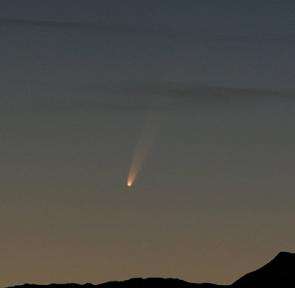
Comet McNaught is plunging toward the Sun and brightening dramatically. The image was taken by Roger Johansen, Hammerfest, Norway, on 6 January 2007. Credits: Roger Johansen

Recently, sky watchers in the Northern Hemisphere have been enjoying the sight of Comet McNaught in the twilight sky. Now, solar physicists using the ESA-NASA SOHO spacecraft are getting ready for their view. For four days in January, the comet will pass through SOHO's line of sight and could be the brightest comet SOHO has ever seen.

As Comet McNaught heads towards its closest approach to the Sun on 12 January 2007, it will disappear from view for earthbound observers, becoming lost in the Sun's glare. That's where SOHO comes in. Poised in space between the Earth and Sun, SOHO ceaselessly watches the Sun and objects that pass nearby.

Comet McNaught will pass within a fifth of the distance between the Earth and the Sun. As the comet approaches the Sun, the amount of dust and gas it releases will increase dramatically, causing the comet to become extremely bright. "This might become the brightest comet SOHO has ever seen," says Bernhard Fleck, SOHO Project Scientist.

The material ejected from the comet forms the tails. There are two tails, the dust tail and the gas – or ion – tail. The dust tail is the brighter and is formed by the intense sunlight forcing dust particles away from the comet. The solar wind, a constant stream of material flowing from the Sun, drags ionized gas from the comet to create the ion-tail.

Researchers Karl Battams and Jeff Morrill at the Naval Research Laboratory in Washington, DC are planning colour filter observations of these two comet tails. "Close to the Sun the ion and dust tails move apart, a phenomenon that is often difficult to observe from the Earth. By measuring the ion-tail angle we can get information about the solar wind speed very close to the Sun," says Morrill.

Comet McNaught is moving through space on an inclined orbit. This will carry it above the Sun's north pole and across the Sun's equator, a place where there is a reversal of the magnetic properties of the solar wind. Crossing this boundary could cause the comet's ion-tail to fragment. Observations of such events are generally very rare, so SOHO's images of comet McNaught constitute an exciting opportunity for scientists.

After SOHO's work is finished, the comet will emerge from the Sun's glare and become visible again to earthbound sky watchers in the Southern Hemisphere. "It could become a really bright object in the twilight sky," says Fleck. The ghostly veils of a bright comet are amongst the most spectacular of sights that can be seen in the night sky.

Between 12 and 15 January, Comet McNaught will not be visible from Earth but everyone can still track the comet's passage near the Sun by looking at the SOHO images at soho.esac.esa.int/hotshots/ .

Source: ESA

Explore further: Hubble reveals the ring nebula's true shape

add to favorites email to friend print save as pdf

Related Stories

Comet Lemmon, Now in STEREO

Apr 25, 2013

An icy interloper was in the sights of a NASA spacecraft this past weekend. Comet 2012 F6 Lemmon passed through the field of view of NASA's HI2A camera as seen from its solar observing STEREO Ahead spacecraft. ...

Did a comet hit cause an explosion on the sun?

Oct 05, 2011

This amazing video from the SOHO mission (Solar and Heliospheric Observatory) shows a sun-diving comet hitting the solar surface on October 1, 2011 and unexpectedly a huge explosion occurs shortly after. Are the two events ...

Heliophysics nugget: Sungrazing comets as solar probes

Dec 06, 2012

(Phys.org)—Heliophysics nuggets are a collection of early science results, new research techniques and instrument updates that further our attempt to understand the sun and the dynamic space weather system that surrounds ...

Recommended for you

Hubble reveals the ring nebula's true shape

3 hours ago

(Phys.org) —The Ring Nebula's distinctive shape makes it a popular illustration for astronomy books. But new observations by NASA's Hubble Space Telescope of the glowing gas shroud around an old, dying, ...

A hidden population of exotic neutron stars

7 hours ago

(Phys.org) —Magnetars – the dense remains of dead stars that erupt sporadically with bursts of high-energy radiation - are some of the most extreme objects known in the Universe. A major campaign using ...

Very Large Telescope celebrates 15 years of success

13 hours ago

(Phys.org) —With this new view of a spectacular stellar nursery ESO is celebrating 15 years of the Very Large Telescope—the world's most advanced optical instrument. This picture reveals thick clumps ...

Fragile mega-galaxy is missing link in history of cosmos

May 22, 2013

Two hungry young galaxies that collided 11 billion years ago are rapidly forming a massive galaxy about 10 times the size of the Milky Way, according to UC Irvine-led research published Wednesday in the journal ...

User comments : 0

More news stories

Hubble reveals the ring nebula's true shape

(Phys.org) —The Ring Nebula's distinctive shape makes it a popular illustration for astronomy books. But new observations by NASA's Hubble Space Telescope of the glowing gas shroud around an old, dying, ...

NASA head views progress on asteroid lasso mission

Surrounded by engineers, NASA chief Charles Bolden inspected a prototype spacecraft engine that could power an audacious mission to lasso an asteroid and tow it closer to Earth for astronauts to explore.

A hidden population of exotic neutron stars

(Phys.org) —Magnetars – the dense remains of dead stars that erupt sporadically with bursts of high-energy radiation - are some of the most extreme objects known in the Universe. A major campaign using ...