Method could help carbon nanotubes become commercially viable
Oct 04, 2006
Method could help carbon nanotubes become commercially viable
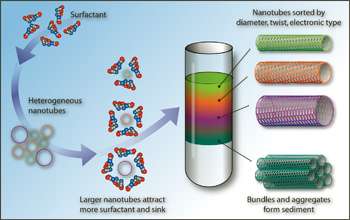
Single-walled carbon nanotubes are coated in soap-like molecules called surfactants, then spun at tens of thousands of rotations per minute in an ultracentrifuge. The resulting density gradient sorts the nanotubes according to diameter, twist and electronic structure. Credit: Zina Deretsky (adapted from Arnold et al.), NSF

Carbon nanotubes are intriguing new materials which have been highly touted for their exceptional mechanical, thermal, optical and electrical properties.

Researchers worldwide are striving to apply these nanostructures in electronics, high-resolution displays, high-strength composites and biosensors. A fundamental problem relating to their synthesis, however, has limited their widespread use.

Current methods for synthesizing carbon nanotubes produce mixtures of tubes that differ in their diameter and twist. Variations in electronic properties arise from these structural differences, resulting in carbon nanotubes that are unsuitable for most proposed applications.

Now, a new method developed at Northwestern University for sorting single-walled carbon nanotubes promises to overcome this problem. The method works by exploiting subtle differences in the buoyant densities of carbon nanotubes as a function of their size and electronic behavior. The results will be published online Wednesday, Oct. 4, in the inaugural issue of the journal Nature Nanotechnology (October 2006).

"Carbon nanotubes, because of their ultra-small size and excellent materials properties, have excited the scientific community for the last decade," said Mark Hersam, professor of materials science and engineering at Northwestern's McCormick School of Engineering and Applied Science, who led the research team.

"However, due to their inherent heterogeneity, they have not yet realized their full commercial potential," he said. "A scalable and economical method for producing monodisperse carbon nanotubes will enable the proposed applications for these nanomaterials to be explored at an industrially relevant scale."

Using the Northwestern method, carbon nanotubes first are encapsulated in water by soap-like molecules called surfactants. Next, the surfactant-coated nanotubes are sorted in density gradients which are spun at tens of thousands of rotations per minute in an ultracentrifuge. By carefully choosing the surfactants utilized during ultracentrifugation, the researchers found that carbon nanotubes could be sorted by diameter and electronic structure.

As a part of their study, the researchers demonstrated the fabrication of electrical devices that displayed either semiconducting or metallic behavior, depending on the sorted nanotubes used. The researchers also maintain that their technique can be translated to an industrial scale.

"The technique is especially promising for commercial applications," said Hersam, "because large-scale ultracentrifuges have already been developed and shown to be economically viable in the pharmaceutical industry. We anticipate that this precedent can be straightforwardly translated to the production of monodisperse carbon nanotubes."

Source: Northwestern University

Explore further: Building 3-D fractals on a nanoscale: Structure repeats itself from micro to nano

add to favorites email to friend print save as pdf

Related Stories

Unzipped nanotubes unlock potential for batteries

Jun 13, 2013

(Phys.org) —Researchers at Rice University have come up with a new way to boost the efficiency of the ubiquitous lithium ion (LI) battery by employing ribbons of graphene that start as carbon nanotubes.

Hybrid carbon nanotube yarn muscle

May 30, 2013

Professor Seon Jeong Kim of Hanyang University has created a high capacity yarn muscle that does not require electrolytes or special packaging. It will have a big impact in the motor, biological and robot ...

Recommended for you

Hybrid material as gold-leaf substitute

Jun 18, 2013

(Phys.org) —A team of researchers headed by Professor Raffaele Mezzenga has created a hybrid material out of gold and milk proteins that looks like a wafer-thin gold leaf. Thanks to its properties, it could ...

Antioxidant with a long shelf life

Jun 17, 2013

(Phys.org) —Scientists from ETH Zurich have developed a nanomaterial that protects other molecules from oxidation. Unlike many such active substances in the past, the ETH-Zurich researchers' antioxidant ...

Fast pollutant degradation by nanosheets

Jun 17, 2013

(Phys.org) —Waste from textile and paint industries often contains organic dyes such as methylene blue as pollutants. Photocatalysis is an efficient means of reducing such pollution, and molybdenum trioxide ...

Unzipped nanotubes unlock potential for batteries

Jun 13, 2013

(Phys.org) —Researchers at Rice University have come up with a new way to boost the efficiency of the ubiquitous lithium ion (LI) battery by employing ribbons of graphene that start as carbon nanotubes.

Nanoparticle opens the door to clean-energy alternatives

Jun 13, 2013

(Phys.org) —Cheaper clean-energy technologies could be made possible thanks to a new discovery. Research team members led by Raymond Schaak, a professor of chemistry at Penn State University, have found ...

User comments : 0

More news stories

Sound waves precisely position nanowires

(Phys.org) —The smaller components become, the more difficult it is to create patterns in an economical and reproducible way, according to an interdisciplinary team of Penn State researchers who, using ...

An environmentally friendly battery made from wood

Taking inspiration from trees, scientists have developed a battery made from a sliver of wood coated with tin that shows promise for becoming a tiny, long-lasting, efficient and environmentally friendly energy ...

Hybrid nanostructures: Getting to the core

Material scientists expect the new multifunctional properties of hybrid nanostructures will transform the development of high-performance devices, including batteries, high-sensitivity sensors and solar cells. ...

Sweet solutions for detecting disease

Based at the Institute of Chemistry in the Slovak Academy of Sciences, Ján Tkáč's research combines glycomics – the study of sugars in organisms – with biochip sensors based on nanoparticles and nanotubes. ...

Metamorphosis of moon's water ice explained

Using data gathered by NASA's Lunar Reconnaissance Orbiter (LRO) mission, scientists believe they have solved a mystery from one of the solar system's coldest regions—a permanently shadowed crater on the ...