Rice's single-pixel camera takes high-res images
For all their ease and convenience, there are few things more wasteful than digital cameras. They're loaded with pricy microprocessors that chew through batteries at a breakneck pace, crunching millions of numbers per second in order to throw out up to 99 percent of the information flowing through the lens.
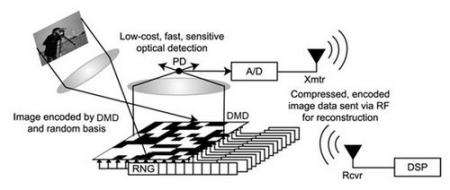
Using some new mathematics and a silicon chip covered with hundreds of thousands of mirrors the size of a single bacterium, engineers at Rice University have come up with a more efficient design. Unlike a one megapixel camera that captures one million points of light for every frame, Rice's camera creates an image by capturing just one point of light, or pixel, several thousands of times in rapid succession. The new mathematics comes into play in assembling the high-resolution image – equal in quality to the one-megapixel image – from the thousands of single-pixel snapshots.
The research will be presented Oct. 11 at the Optical Society of America's 90th annual meeting, Frontiers in Optics 2006, in Rochester, New York.
The oddest part about Rice's camera may be that it works best when the light from the scene under view is scattered at random and turned into noise that looks like television tuned to a dead channel.
"White noise is the key," said Richard Baraniuk, the Victor E. Cameron Professor of Electrical and Computer Engineering. "Thanks to some deep new mathematics developed just a couple of years ago, we're able to get a useful, coherent image out of the randomly scattered measurements."
Baraniuk's collaborator Kevin Kelly, assistant professor of electrical and computer engineering, built a working prototype camera using a digital micromirror device, or DMD, and a single photodiode, which turns light into electrical signals. Today's typical retail digital camera has millions of photodiodes, or megapixels, on a single chip.
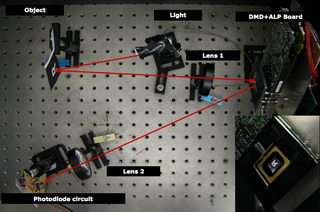
DMDs, which are fabricated by Texas Instruments and today used primarily in digital televisions and projectors, are devices capable of converting digital information to light and vice versa. Built on a microchip chassis, a DMD is covered with tiny mirrors, each about the size of a microbe, that are capable of facing only two directions. They appear bright when facing one way and dark when facing the other, so when a computer views them, it sees them as 1's or 0's.
In a regular camera, a lens focuses light, for a brief instant, onto a piece of film or a photodiode array called a CCD. In the single-pixel camera, the image from the lens is shined onto the DMD and bounced from there though a second lens that focuses the light reflected by the DMD onto a single photodiode. The mirrors on the DMD are shuffled at random for each new sample. Each time the mirrors shift, a new pixel value is recorded by the photodiode. In effect, the lens and DMD do what the power-hungry microchip in the digital camera usually does; they compress the data from the larger picture into a more compact form. This is why the technique goes by the name "compressive sensing."
Today, it takes about five minutes to take a picture with Rice's prototype camera, which fills an entire corner of one of the table's in Kelly's laboratory. So far, only stationary objects have been photographed, but Kelly and Baraniuk say they should be able to adapt the "time-multiplexed" photographic technique to produce images similar to a home snapshot because the mirrors inside DMDs can alter their position millions of times per second. However, their initial efforts are aimed at developing the camera for scientific applications where digital photography is unavailable.
"For some wavelengths outside the visible spectrum, it's often too expensive to produce large arrays of detectors," Kelly said. "One of the beauties of our system is that it only requires one detector. We think this same methodology could be a real advantage in terahertz imaging and other areas."
More information: www.dsp.ece.rice.edu/cs/cscamera/
Source: Rice University


