How modern were European Neandertals?
Neandertals were much more like modern humans than had been previously thought, according to a re-examination of finds from one of the most famous palaeolithic sites in Europe by Bristol University archaeologist, Professor Joao Zilhao, and his French colleagues.
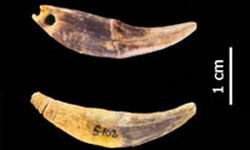
Professor Zilhao has been able to show that sophisticated artefacts such as decorated bone points and personal ornaments found in the Châtelperronian culture of France and Spain were genuinely associated with Neandertals around 44,000 years ago, rather than acquired from modern humans who might have been living nearby. His findings are published in the Proceedings of the National Academy of Sciences (PNAS) USA.
The site from which this Neandertal culture derives its name is the Grotte de Fées at Châtelperron in Central France, first excavated in the 1840s. It has been one of the most important and controversial places to understand how modern humans that had previously moved out of Africa replaced the Neandertals, often portrayed as more ‘primitive’.
In the conventional interpretation of the rock strata of the site, the cave was thought to have evidence of both modern human and Neandertal occupation in interleaved layers. The fact that Neandertals came back to the site after modern humans had lived in it for quite some time would prove the long-term contemporaneity of the two groups, and validate the notion that the cultural novelties seen among the latest Neandertals represented immitation or borrowing, not innovation.
Now archaeologists can show that the Grotte des Fées stratigraphic pattern is illusory because the supposedly Neandertal levels overlying those belonging to the modern human Aurignacian culture are in fact backdirt from nineteenth-century fossil hunting. According to Professor Zilhao and his team, this adds to the evidence from other sites in the region that the Neandertals already had the capacity for symbolic thinking before the arrival of the modern humans into western Europe, which has been radiocarbon dated to around 40,000 years ago.
Professor Zilhao said: “This discovery, along with research on the rock strata at other cave sites, has huge implications for how we view the European Neandertals and, more widely, human evolution. The differences between Neandertals and modern humans may be much less than had been previously thought, suggesting that human cognition and symbolic thinking may date back to before the two sub-species split around 400,000 years ago.”
Source: University of Bristol


