UW Mathematician to Study Tornado Turbulence
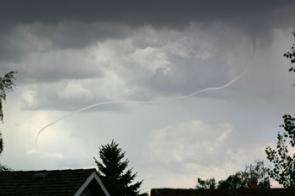
Anyone who has seen a tornado has noticed its snake-like core weaving from an imaginary hole in the sky to threaten the ground below. However, not everyone who has witnessed a tornado calls it a "vortex filament" and views it as a window to advance energy science.
The National Science Foundation has awarded a highly-competitive single investigator grant to University of Wyoming Mathematics Professor Hakima Bessaih, who will determine how to use these mysterious vortex filaments to possibly uncover fundamental questions in engineering and energy science.
"Professor Bessaih's research involves modeling the highly-swirling nature of turbulent fields such as tornadoes in the presence of random disturbances," says Sri Sritharan, UW professor of mathematics. He says vortex filaments also can be seen coming off from airplane wing tips, propeller blade tips and windmill blades.
"Understanding the intricate dynamics of such vortex filaments is of fundamental importance in engineering and in energy sciences," he adds.
Earning the grant is a major accomplishment for Bessaih, who just finished her second year at an American university.
"For an early career scientist, winning a single investigator NSF grant in mathematical science is considered a major recognition by scientific peers," Sritharan says.
She received $115,000 for the three-year grant. The money will fund two summer undergraduate researcher positions each year and the research likely will have positive ramifications for the state of Wyoming.
"Given the importance of renewable energy science to the state of Wyoming, it is expected that Professor Bessaih's fundamental contributions to the understanding of vortex filaments will someday help engineers to design windmill blades resistant to damage by turbulent gusts," Sritharan notes.
Bessaih, who considers herself a traditional mathematical theorist, hopes to shed more light on the scientific community's understanding of turbulence.
"The aim of this research is to understand a little bit more about turbulence from the mathematical point of view," she says. "Fluid mechanics represents turbulence models with differential equations, but we don't yet know how to quantify them mathematically.
"The big idea is to be able to communicate more thoroughly with people in fluid mechanics. Combining our model (determined through Bessaih's forthcoming research) with those of fluid mechanics, should help us have a better overall understanding of turbulence," she adds.
Source: University of Wyoming


