Sales method pays off for materials scientists
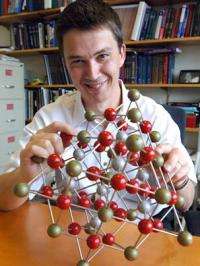
The same computer methods used by online sales sites to suggest books to customers can help predict the crystal structures of materials, MIT researchers have found.
These structures are key to designing new materials and improving existing ones, which means that everything from batteries to airplane wings could be influenced by the new method.
The scientists report their findings in the July 9 online edition of Nature Materials.
Using a technique called data mining, the MIT team preloaded the entire body of historical knowledge of crystal structures into a computer algorithm, or program, which they had designed to make correlations among the data based on the underlying rules of physics.
Harnessing this knowledge, the program then delivers a list of possible crystal structures for any mixture of elements whose structure is unknown. The team can then run that list of possibilities through a second algorithm that uses quantum mechanics to calculate precisely which structure is the most stable energetically -- a standard technique in the computer modeling of materials.
"We had at our disposal all of what is known about nature," said Professor Gerbrand Ceder of the Department of Materials Science and Engineering, leader of the research team. Ceder compared the database of crystal structures to the user database of an online bookseller, which can make correlations among millions of customers with similar interests. "If you tell me you've read these 10 books in the last year and you rate them, can I make some prediction about the next book you're going to like?"
The data-mining algorithm captures the physics of crystal structures in nature (provided by the preloaded database) and makes sophisticated correlations to generate an informed list of candidate structures based on historical knowledge. These candidate structures were previously assembled by scientists manually in a time-consuming and subjective process that often amounted to guesswork. The new algorithm, combined with a quantum mechanics algorithm, forms a two-pronged strategy that will make the process faster and more accurate.
Ceder's team of computational modelers can already determine, in the space of just a few days, atomic structures that might take months or even years to elucidate in the lab. In testing on known structures of just two elements, Ceder's group found the new algorithm could select five structures from 3,000-4,000 possibilities with a 90 percent chance of having the true structure among the five.
"It's all about probability and correlations," Ceder said. "Our algorithm gives us the crystal structure with a certain probability. The key was realizing we didn't need more than that. With a short list of candidate structures, I can solve the problem precisely with quantum mechanics."
According to Ceder, the new technique will enable a big leap forward in true computational design of materials with specific properties. For example, "If somebody wants to know whether a material is going to have the right bandgap to be a solar cell, I can't calculate the bandgap if I don't know the structure," he said. (Bandgap determines many properties such as electrical conductivity.) "And if I calculate the bandgap using the wrong structure, I may have a totally irrelevant answer. Properties depend on structure."
Contributing to the work were graduate students Christopher Fischer and Kevin Tibbetts, both of materials science and engineering, and former postdoctoral associate Dane Morgan, now at the University of Wisconsin at Madison.
Source: MIT


