Epson Develops A6-Size Electronic Paper with World's Highest Resolution Using Plastic Substrate
Jun 12, 2006
Epson Develops A6-Size Electronic Paper with World's Highest Resolution Using Plastic Substrate

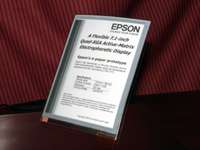
Seiko Epson Corp. has successfully developed A6-size (7.1 inches on the diagonal) electronic paper using a plastic substrate. Drawing on Epson's original SUFTLA technology, the new electronic paper achieves Quad-XGA resolution (1536 x 2048 pixels) – the world's highest – and shows the potential for increasing screen size. The development was announced on June 9 at the Society for Information Display (SID) international symposium held in San Francisco.

Epson has long been working to develop and manufacture low-power-consumption, space-saving electronic devices. At the cutting edge of these efforts, R&D has focused on thin, light and flexible devices that can be reshaped as needed, and that can become the technology that drives electronic equipment for a ubiquitous networked society. In the course of such development, Epson has amassed a range of proprietary technologies including low temperature polysilicon thin film transistors (LTPS-TFT) and SUFTLA, which enables the transfer of TFT circuits to flexible substrates.

As outlined below, the new electronic paper draws on a number of original Epson technologies and has a range of features suited to portable displays.

1. World's highest resolution
LTPS-TFT formed on a plastic substrate using SUFTLA technology gives this electronic paper Quad-XGA resolution – the highest in the world. This ensures that even the smallest letters on a portable display are fully visible.

2. High contrast guaranteeing high-quality display
With a contrast ratio of 10:1, the new technology achieves the same levels of visibility as images printed on ordinary paper.

3. Narrow border and simple interface
Forming peripheral drive circuits with LTPS-TFT creates a simple structure with very few external terminals, that result in a borderless flexible display, even with the drive circuits included.

4. Low power consumption
Data display does not require power – a memory function ensures that information does not disappear even if the power is turned off. Maximum drive voltage even for editing information is just 6 volts, showing that the display itself consumes very little power.

5. Larger screen
The expanded screen size, from around 2 inches in existing models to A6 size (7.1 inches on the diagonal), is evidence of potential for even bigger screens in the future.

Epson will examine the potential of a range of applications for the technology and conduct further research and development with a view to its practical use.

Source: Seiko Epson

Explore further: Congress gets mixed advice on regulating drones

add to favorites email to friend print save as pdf

Related Stories

300-dpi: Epson, E-ink give ePaper a resolution boost

May 18, 2011

(PhysOrg.com) -- For the most part when we think about E-Ink technology high resolution are not the words that come to mind. We all love our e-readers, such as the Nook and the Kindle, because they give us ...

Recommended for you

Congress gets mixed advice on regulating drones

May 17, 2013

(AP)—The growing use of unmanned surveillance "eyes in the sky" aircraft raises a thicket of privacy concerns, but the U.S. Congress is getting mixed advice on what, if anything, to do about it.

Makr Shakr uses three arms for drink-recipe collabs

May 15, 2013

(Phys.org) —We're told it's the wave of the future. Design, make, enjoy. Beyond home-based 3-D printers, there will be new machines and display screens and apps that will invite you to have day to day products ...

Nokia unveils metallic smartphone, stock tumbles (Update)

May 14, 2013

Nokia Corp. on Tuesday unveiled its first Lumia smartphone with a metal cover, low-light camera features and new social network apps. But the new model failed to impress investors, who sent the company's stock down more than ...

User comments : 0

More news stories

Congress gets mixed advice on regulating drones

(AP)—The growing use of unmanned surveillance "eyes in the sky" aircraft raises a thicket of privacy concerns, but the U.S. Congress is getting mixed advice on what, if anything, to do about it.

Makr Shakr uses three arms for drink-recipe collabs

(Phys.org) —We're told it's the wave of the future. Design, make, enjoy. Beyond home-based 3-D printers, there will be new machines and display screens and apps that will invite you to have day to day products ...

RIM unveils cheaper BlackBerry (Update 2)

Research In Motion unveiled a lower-cost BlackBerry aimed at consumers in emerging markets on Tuesday, and said it will offer its once-popular BlackBerry Messenger service on iPhones and devices running Google's ...

Russia retrieves mice, newts from space

A Russian capsule filled with 45 mice and 15 newts along with other small animals returned from a month's mission in orbit on Sunday with data scientists hope will pave the way for a manned flight to Mars.

German energy shift faces headwinds

Tense engineers have their eyes peeled on complex colour-coded diagrams on a wall-sized screen that makes their control room look like the inside of a spaceship.

Honeybees trained in Croatia to find land mines

(AP)—Mirjana Filipovic is still haunted by the land mine blast that killed her boyfriend and blew off her left leg while on a fishing trip nearly a decade ago. It happened in a field that was supposedly ...