Designer Gradients Speed Surface Science Experiments
Jun 08, 2006
Designer Gradients Speed Surface Science Experiments

Researchers from the National Institute of Standards and Technology have demonstrated an elegantly simple technique for synthesizing a wide variety of complex surfaces that vary in a controlled fashion across a test strip. The new technique is so flexible that it can be applied to surface science experiments ranging from developing better paints to exploring the bonding of proteins to cell membranes.

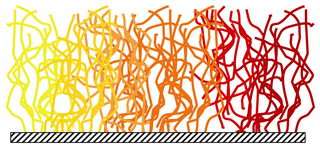
So-called “gradient composition surfaces”—their chemical composition changes gradually across the surface—have been shown to be powerful research tools for rapid, high-throughput testing of complicated surface properties, but they can be tricky to build. The new NIST technique described in a recent paper in Advanced Materials coats a silicon wafer with a brush-like copolymer surface, varying the relative concentration of two components, or monomers, of the polymer along the length of the substrate. The dense polymer brush provides a controlled interaction surface at the top while effectively masking the underlying substrate.

The heart of the NIST technique is a combined microfluidic mixer and reaction chamber. The two components are injected into the mixer with gradually changing flow rates and mix thoroughly before filling a thin reaction chamber holding the silicon wafer substrate. Once the solution leaves the mixing region, the narrow dimensions of the reaction chamber inhibit further mixing, so the varying composition ratios through the chamber remain stable while the solution polymerizes on the substrate.

Because it keeps the fluid mixture concentrations stable for long periods, the new technique is unique in its ability to accommodate a wide variety of materials, potentially producing test surfaces for studying surface phenomena ranging from nanoscale interactions of biomolecules—critical for improving the performance of tissue-engineered medical products or for identifying the fundamental mechanisms key to cell/surface adhesion—to the performance of new products like paints or adhesives. The specific polymer used in these proof-of-concept experiments, for example, is typical of a temperature- or acidity-sensitive polymer that might be used in a drug delivery system.

Citation: C. Xu, S.E. Barnes, T. Wu, D.A. Fischer, D.M. DeLongchamp, J.D. Batteas, and K.L. Beers. Solution and surface composition gradients via microfluidics confinement: fabrication of a statistical-copolymer-brush composition gradient. Adv. Mater. 2006, 18, 1427-1430.

Source: NIST

Explore further: Study provides better understanding of water's freezing behavior at nanoscale

add to favorites email to friend print save as pdf

Related Stories

Engineers' nanoantennas improve infrared sensing

May 20, 2013

(Phys.org) —A team of University of Pennsylvania engineers has used a pattern of nanoantennas to develop a new way of turning infrared light into mechanical action, opening the door to more sensitive infrared ...

Doubt over 'volcanic winter' after Toba super-eruption

May 01, 2013

(Phys.org) —New research from Oxford University casts doubt on the theory that the Mount Toba super-eruption, which took place at the Indonesian island of Sumatra 75,000 years ago, could have plunged the ...

X-rays paint a picture of Picasso's pigments

May 01, 2013

(Phys.org) —Pablo Picasso is widely regarded as one of the most influential artists of the twentieth century, having pioneered a variety of new styles in painting, sculpture, and other artistic forms. Besides ...

NASA's HyspIRI: Seeing the forest and the trees and more

Apr 22, 2013

To Robert Green, light contains more than meets the eye: It contains fingerprints of materials that can be detected by sensors that capture the unique set of reflected wavelengths. Scientists have used the ...

Recommended for you

Promising doped zirconia

May 17, 2013

Materials belonging to the family of dilute magnetic oxides (DMOs)—an oxide-based variant of the dilute magnetic semiconductors—are good candidates for spintronics applications. This is the object of ...

Nanocrystals grow from liquid interface

May 17, 2013

An international collaboration of scientists has discovered a unique crystalizing behavior at the interface between two immiscible liquids that could aid in sustainable energy development.

User comments : 0

More news stories

Theorists weigh in on where to hunt dark matter

(Phys.org) —Now that it looks like the hunt for the Higgs boson is over, particles of dark matter are at the top of the physics "Most Wanted" list. Dozens of experiments have been searching for them, but ...

Hydrogen atoms under the magnifying glass

To describe the microscopic properties of matter and its interaction with the external world, quantum mechanics uses wave functions, whose structure and time dependence is governed by the Schrödinger equation. ...

Forecast for Titan: Wild weather could be ahead

(Phys.org) —Saturn's moon Titan might be in for some wild weather as it heads into its spring and summer, if two new models are correct. Scientists think that as the seasons change in Titan's northern hemisphere, ...