Sony commercializes 16.41 megapixel 'Exmor R' back-illuminated CMOS image sensors for mobile phones
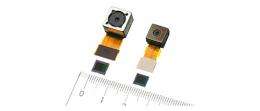
Sony today announced the commercialization of two new "Exmor R" back-illuminated CMOS image sensors with dramatically improved photographic performance including significantly high sensitivity and low noise. In addition, Sony will launch two new lens modules equipped with these image sensors, which also include the smallest and thinnest model for mobile phones. This is also the first time that "Exmor R" is commercialized for the use in mobile phones.
IMX081PQ is world's first type 1/2.8 back-illuminated CMOS image sensor which realizes 16.41 effective megapixel resolution, and adopts the industry's smallest unit pixel size of 1.12μm. In theory, when a unit pixel size is made smaller, there are also some issues such as color mixture among smaller unit pixels. Sony solved this problem by implementing a unique formation of photo diodes optimally designed for fine pixel structure to realize a CMOS image sensor with high resolution, high sensitivity and low noise.
IMX105PQ is a type 1/3.2 back-illuminated CMOS image sensor which realizes 8.13 effective megapixel resolutions for higher sensitivity and adopts a unit pixel size of 1.4μm. By embedding these highly sensitive sensors into mobile phones, including those without camera flash, users can capture high quality photos and videos even in low light settings.
Furthermore, Sony will commercialize IU081F and IU105F2 compact auto-focus lens modules which include the two new "Exmor R" back-illuminated CMOS image sensors. These down-sized modules are suitable and efficient for mobile phones with relatively limited space and are equipped with high performance lens which maximize the image sensors' respective performances. IU081F is the industry's smallest and thinnest auto-focus lens module (W10.5 X D10.5 X H7.9mm) and is equipped with the 16.41 effective megapixel*2 CMOS image sensor. IU105F2 adopts the 8.13 effective megapixel CMOS image sensor, and belongs in the industry's smallest and thinnest size class (W8.5 X D8.5 X H5.67mm).
-

Sample image generated by "IMX081PQ", type 1/2.8 back-illuminated CMOS image sensor with 16.41 effective megapixels (left) -

Sample image under low illumination (20 lux), generated by "IU105F2", type 1/3.2 Lens module with 8.13 effective megapixels back-illuminated CMOS image sensor
Through its proprietary fine pixel fabrication process technology, Sony will proactively continue the development of "Exmor R" which adopts the 1.12μm unit pixel size for mobile phones. Accordingly, Sony aims to address customer demand by providing appropriately small lens modules especially for smartphones with large displays and limited space for components.
Since 2009, Sony has been mass producing "Exmor R" for Digital Still Cameras and Digital Video Camcorders on wafer lines (with diameter of 200mm) at Sony Semiconductor Kyushu Corporation's Nagasaki Technology Center. At the end of 2010, Sony plans to start the mass production of "Exmor R," including those for mobile phones announced today, at Sony Semiconductor Kyushu Corporation's Kumamoto Technology Center, on cutting-edge wafer lines (with diameter of 300mm). Sony already announced the investment of approximately 40 billion yen in Kumamoto Technology Center to increase production capacity for CMOS image sensors.
Sony first announced the development of "Exmor R" on Jun, 2008. "Exmor R" has been incorporated in Sony's digital imaging products since 2009, and its use in other products has continued to expand. "Exmor R" CMOS image sensor features Sony's independently developed back-illuminated structure, realizing significantly higher sensitivity as well as lower noise. In this back-illuminated CMOS image sensor, light is directed onto the silicon substrate from behind, allowing light to be used with a level of efficiency not possible with conventional front-illuminated structures.
Source: Sony


