Long-distance communication, microbial style
Oct 06, 2010
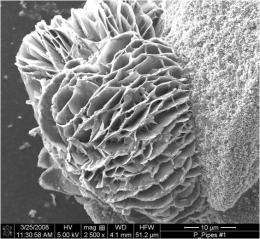
Shewanella oneidensis produced rosettes of iron(II) phosphate in the simulated soil. The bacteria produced these structures without directly contacting the iron oxides.

Scientists knew that the microbe Shewanella oneidensis transformed the electronic structure of the iron oxide it touched in the ground as well as without direct contact. Scientists from Pacific Northwest National Laboratory have now developed a model system that allows the study of this indirect transformation. They also discovered previously unseen iron(II) phosphate rosettes precipitated during bioreduction process. These blooms grew on the surface and within the grains of sand and were intensely colonized by the microbes.

This research provides a greater understanding of redox transformations of iron(III) hydroxides, which influence the fate of pollutants and nutrients in certain soils, sediments, and subsurface materials. "These findings were both fascinating and unexpected," said Dr. Tanya Peretyazhko, who led the PNNL team.

To do this study, the team devised a new that mimics the real world where iron oxides are commonly embedded in microscopic pores between grains of sand and other matter or in microfractures in the subsurface. The team simulated intragrain pores and microfractures by mixing a solution of with highly porous silica grains. They tested the grains to verify that when in contact with water, the iron oxides would remain embedded within the pores.

Then, the S. oneidensis was introduced. Bioreduction was encouraged in oxygen-free conditions and with the introduction of chemicals, such as phosphate. With ideal conditions established, the team developed techniques to preserve the samples for x-ray diffraction and scanning and , which were performed in EMSL, a Department of Energy national scientific user facility at PNNL. This analysis answered questions about shape and of iron precipitates and the proximity of the microbes.

With the simulation technique established, the team studied the mechanism that microbes use to transform iron oxides without direct contact, as well as mechanisms of precipitate formation.

The researchers are now looking to understand how the microbes accomplish their long-distance electron transfer. Some researchers suggest "electron shuttles," in which microbes release molecules that carry electrons to the iron oxides. Others posit that organic molecules are released to the iron oxides and dissolve them without reduction.

Explore further: Scientists develop advanced biological computer

More information: Peretyazhko TS, JM Zachara, DW Kennedy, JK Fredrickson, BW Arey, JP McKinley, CM Wang, AC Dohnalkova, and Y Xia. 2010. "Ferrous phosphate surface precipitates resulting from the reduction of intragrain 6-line ferrihydrite by Shewanella oneidensis MR-1." Geochimica et Cosmochimica Acta 74(12):3751-3767.

add to favorites email to friend print save as pdf

Related Stories

Progress Toward a Biological Fuel Cell?

Dec 30, 2008

(PhysOrg.com) -- Biological fuel cells use enzymes or whole microorganisms as biocatalysts for the direct conversion of chemical energy to electrical energy. One type of microbial fuel cell uses anodes (positive electrodes) ...

Recommended for you

Scientists develop advanced biological computer

23 hours ago

(Phys.org) —Using only biomolecules (such as DNA and enzymes), scientists at the Technion-Israel Institute of Technology have developed and constructed an advanced biological transducer, a computing machine capable of manipulating ...

Research aims to fix long-held, inaccurate insect model

May 24, 2013

(Phys.org) —In humans, a polymer called melanin determines skin, eye and hair color—the darker the skin, the more melanin in a person's body. For insects, melanin is a major aspect of their immune defense ...

Molecular modelling to help create better, safer drugs

May 24, 2013

(Phys.org) —How our bodies break down the common drugs ibuprofen, diclofenac and warfarin is the subject of a new study from the University of Bristol, published in the Journal of the American Chemical So ...

User comments : 0

More news stories

Scientists develop advanced biological computer

(Phys.org) —Using only biomolecules (such as DNA and enzymes), scientists at the Technion-Israel Institute of Technology have developed and constructed an advanced biological transducer, a computing machine capable of manipulating ...

New method for producing clean hydrogen

Duke University engineers have developed a novel method for producing clean hydrogen, which could prove essential to weaning society off of fossil fuels and their environmental implications.

Explainer: What are chemical weapons?

There was chaos on the streets of Halajba in March 1988. In this corner of Iraq, at the time Iraqi Kurdistan, people had suddenly started experiencing cold-like symptoms – tight chest and nasal congestion. ...

Yahoo, pay-TV operators among Hulu bidders

Online video site Hulu is again up for sale, with Yahoo and pay TV operators DirecTV and Time Warner Cable among the seven bidders, according to a person with direct knowledge of the matter.

Feds fight morning-after pill age ruling in NY

(AP)—Department of Justice lawyers have again asked a federal appeals court in New York to delay lifting age restrictions and prescription requirements on an emergency contraceptive popularly known as the morning-after ...

Radiation leak at Japan lab; small impact expected

An atomic research lab in northern Japan has reported a radiation leak that may have affected about 50 people, though none were hospitalized and no impact was expected outside the facility, the lab's operator ...