WMAP project completes satellite operations mission observed universe's oldest light
Oct 06, 2010
WMAP reveals neutrinos, end of dark ages, first second of universe
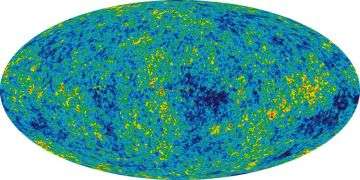
WMAP cosmic microwave fluctuations over the full sky with 5-years of data. Colors represent the tiny temperature fluctuations of the remnant glow from the infant universe: red regions are warmer and blue are cooler. Credit: WMAP Science Team

(PhysOrg.com) -- After nine years of scanning the sky, the Wilkinson Microwave Anisotropy Probe (WMAP) space mission has concluded its observations of the cosmic microwave background, the oldest light in the universe. The spacecraft has not only given scientists their best look at this remnant glow, but also established the scientific model that describes the history and structure of the universe.

"WMAP has opened a window into the earliest universe that we could scarcely imagine a generation ago," said Gary Hinshaw, an astrophysicist at NASA's Goddard Space Flight Center in Greenbelt, Md., who manages the mission. "The team is still busy analyzing the complete nine-year set of data, which the scientific community eagerly awaits."

WMAP was designed to provide a more detailed look at subtle temperature differences in the that were first detected in 1992 by NASA's Cosmic Background Explorer (COBE). The WMAP team has answered many longstanding questions about the universe's age and composition. WMAP acquired its final science data on Aug. 20. On Sept. 8, the satellite fired its thrusters, left its working orbit, and entered into a permanent parking orbit around the sun.

"We launched this mission in 2001, accomplished far more than our initial science objectives, and now the time has come for a responsible conclusion to the satellite's operations," said Charles Bennett, WMAP's principal investigator at Johns Hopkins University in Baltimore.

WMAP detects a signal that is the remnant afterglow of the hot young universe, a pattern frozen in place when the cosmos was only 380,000 years old. As the universe expanded over the next 13 billion years, this light lost energy and stretched into increasingly longer wavelengths. Today, it is detectable as microwaves.

WMAP is in the Guinness Book of World Records for "most accurate measure of the age of the universe." The mission established that the cosmos is 13.75 billion years old, with a degree of error of one percent.

WMAP also showed that normal atoms make up only 4.6 percent of today's cosmos, and it verified that most of the universe consists of two entities scientists don't yet understand.

Dark matter, which makes up 23 percent of the universe, is a material that has yet to be detected in the laboratory. Dark energy is a gravitationally repulsive entity which may be a feature of the vacuum itself. WMAP confirmed its existence and determined that it fills 72 percent of the cosmos.

Another important WMAP breakthrough involves a hypothesized cosmic "growth spurt" called inflation. For decades, cosmologists have suggested that the universe went through an extremely rapid growth phase within the first trillionth of a second it existed. WMAP's observations support the notion that inflation did occur, and its detailed measurements now rule out several well-studied inflation scenarios while providing new support for others.

"It never ceases to amaze me that we can make a measurement that can distinguish between what may or may not have happened in the first trillionth of a second of the universe," says Bennett.

WMAP was the first spacecraft to use the gravitational balance point known as Earth-Sun L2 as its observing station. The location is about 930,000 miles or (1.5 million km) away.

"WMAP gave definitive measurements of the fundamental parameters of the universe," said Jaya Bapayee, WMAP program executive at NASA Headquarters in Washington. "Scientists will use this information for years to come in their quest to better understand the universe."

Launched as MAP on June 30, 2001, the spacecraft was later renamed WMAP to honor David T. Wilkinson, a Princeton University cosmologist and a founding team member who died in September 2002.

Explore further: Dark, massive asteroid to fly by Earth on May 31

add to favorites email to friend print save as pdf

Related Stories

NASA to Probe the Universe's First Moments

Apr 29, 2010

(PhysOrg.com) -- Sophisticated new technologies created by NASA and university scientists are enabling them to build an instrument designed to probe the first moments of the universe's existence.

COBE Satellite Marks 20th Anniversary

Nov 17, 2009

(PhysOrg.com) -- NASA's Cosmic Background Explorer (COBE) satellite rocketed into Earth orbit on Nov. 18, 1989, and quickly revolutionized our understanding of the early cosmos. Developed and built at Goddard ...

Durham astronomers' doubts about the 'dark side'

Jun 14, 2010

(PhysOrg.com) -- New research by astronomers in the Physics Department at Durham University suggests that the conventional wisdom about the content of the Universe may be wrong. Graduate student Utane Sawangwit ...

Recommended for you

Dark, massive asteroid to fly by Earth on May 31

4 hours ago

It's 1.7 miles long. Its surface is covered in a sticky black substance similar to the gunk at the bottom of a barbecue. If it impacted Earth it would probably result in global extinction. Good thing it is ...

Research team explains 'Lazarus' comets

7 hours ago

Astronomers from the University of Antioquia have discovered a graveyard of comets. These once-dormant comets, dubbed by astronomers as "The Lazarus comets," are now rejuvenated.

NASA ships sensors for seafaring satellite to France

8 hours ago

(Phys.org) —Three NASA-built instruments that are integral components of the next in a series of U.S./European ocean altimetry satellites have arrived in France for integration with their spacecraft in ...

Trip into space with DiCaprio costs $1.55m

8 hours ago

Leonardo DiCaprio is going to get closer to stars of a different kind as he heads into space aboard the Virgin Galactic, and a well-heeled bidder at the Cannes Film Festival has paid 1.2 million euros (1.5 million) to be ...

User comments : 1

Adjust slider to filter visible comments by rank

Display comments: newest first

frajo
1 / 5 (1) Oct 11, 2010
Observations are not what the used to be. Just confirmations of established hypotheses like dark matter, dark energy, inflation. What has changed? Why do observations not topple anymore old, insufficient theories?

Why does nobody admit that there might be a different reason for the "missing mass" phenomenon? Does a missing theory necessarily implicate the existence of unknown elementary particles? Why not the other way round?

Why is the assumption of a "vacuum" with properties necessary to "explain" the apparent acceleration of expansion? Is semantic artistry a placeholder for a missing theory?

observations support the notion that inflation did occur, and its detailed measurements now rule out several well-studied inflation scenarios while providing new support for others.
Sounds like the inflation hypothesis has to be fine-tuned to survive.

WMAP is in the Guinness Book of World Records
A most fundamental observation.

More news stories

Galaxies fed by funnels of fuel

(Phys.org) —Computer simulations of galaxies growing over billions of years have revealed a likely scenario for how they feed: a cosmic version of swirly straws.

Source of life running out: water scientists

The majority of people on Earth people will face severe water shortages within a generation or two if pollution and waste continues unabated, scientists warned at a conference in Bonn Friday.

Dark, massive asteroid to fly by Earth on May 31

It's 1.7 miles long. Its surface is covered in a sticky black substance similar to the gunk at the bottom of a barbecue. If it impacted Earth it would probably result in global extinction. Good thing it is ...

Google eyes emerging markets networks

Google has become deeply involved in a series of projects to build and operate wireless networks in emerging markets including sub-Saharan Africa and Southeast Asia, a report said Friday.