NASA's EPOXI mission sets up for comet flyby
Sep 30, 2010 By DC Agle
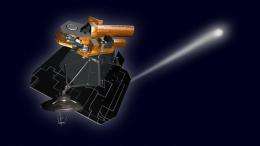
NASA's Deep Impact/EPOXI spacecraft flew past Earth on June 27, 2010, to get a boost from Earth’s gravity. It is now on its way to comet Hartley 2, depicted in this artist’s concept, with a planned flyby this fall. Image credit: NASA/JPL-Caltech

Earlier yesterday, navigators and mission controllers for NASA's EPOXI mission watched their computer screens as 23.6 million kilometers (14.7 million miles) away, their spacecraft successfully performed its 20th trajectory correction maneuver. The maneuver refined the spacecraft's orbit, setting the stage for its flyby of comet Hartley 2 on Nov. 4. Time of closest approach to the comet was expected to be about 10: 02 a.m. EDT (7:02 a.m. PDT).

Yesterday trajectory correction maneuver began at 2 p.m. EDT (11 a.m. PDT), when the spacecraft fired its engines for 60 seconds, changing the spacecraft's velocity by 1.53 meters per second (3.4 mph).

"We are about 23 million miles and 36 days away from our ," said EPOXI project manager Tim Larson of NASA's Jet Propulsion Laboratory in Pasadena, Calif. "I can't wait to see what Hartley 2 looks like."

On Nov. 4, the spacecraft will fly past the comet at a distance of about 700 kilometers (435 miles). It will be only the fifth time in history that a spacecraft has been close enough to image a comet's nucleus, and the first time in history that two comets have been imaged with the same instruments and same spatial resolution.

"We are imaging the comet every day, and Hartley 2 is proving to be a worthy target for exploration," said Mike A'Hearn, EPOXI principal investigator from the University of Maryland, College Park.

EPOXI is an extended mission that utilizes the already "in flight" Deep Impact spacecraft to explore distinct celestial targets of opportunity. The name EPOXI itself is a combination of the names for the two extended mission components: the extrasolar planet observations, called Extrasolar Planet Observations and Characterization (EPOCh), and the of comet Hartley 2, called the Deep Impact Extended Investigation (DIXI). The will continue to be referred to as "."

Explore further: Mice, gerbils perish in Russia space flight

More information: For more information about EPOXI visit epoxi.umd.edu/

add to favorites email to friend print save as pdf

Related Stories

Deep Impact correction maneuver successful

May 16, 2005

Fifty-nine days before going head-to-head with comet Tempel 1, NASA's Deep Impact spacecraft successfully executed the second trajectory correction maneuver of the mission. The burn further refined the spacecraft's trajectory, or ...

NASA's Stardust Burns for Comet, Less Than a Year Away

Feb 18, 2010

Just three days shy of one year before its planned flyby of comet Tempel 1, NASA's Stardust spacecraft has successfully performed a maneuver to adjust the time of its encounter by eight hours and 20 minutes. ...

Recommended for you

Mice, gerbils perish in Russia space flight

20 hours ago

A number of mice and eight gerbils sent into space in a Russian capsule destined to find out how well organisms can withstand extended flights perished during their journey, scientists said Sunday as the ...

Mars rover Opportunity examines clay clues in rock

May 18, 2013

(Phys.org) —NASA's senior Mars rover, Opportunity, is driving to a new study area after a dramatic finish to 20 months on "Cape York" with examination of a rock intensely altered by water.

NASA's STEREO detects a CME from the sun

May 17, 2013

On 5:24 a.m. EDT on May 17, 2013, the sun erupted with an Earth-directed coronal mass ejection or CME, a solar phenomenon that can send billions of tons of solar particles into space that can reach Earth ...

Nine-year-old Mars rover passes 40-year-old record

May 17, 2013

While Apollo 17 astronauts Eugene Cernan and Harrison Schmitt visited Earth's moon for three days in December 1972, they drove their mission's Lunar Roving Vehicle 19.3 nautical miles (22.210 statute miles ...

Bright explosion on the Moon

May 17, 2013

For the past 8 years, NASA astronomers have been monitoring the Moon for signs of explosions caused by meteoroids hitting the lunar surface. "Lunar meteor showers" have turned out to be more common than anyone ...

User comments : 0

More news stories

Heat-related deaths in Manhattan projected to rise

Residents of Manhattan will not just sweat harder from rising temperatures in the future, says a new study; many may die. Researchers say deaths linked to warming climate may rise some 20 percent by the 2020s, ...

Mice, gerbils perish in Russia space flight

A number of mice and eight gerbils sent into space in a Russian capsule destined to find out how well organisms can withstand extended flights perished during their journey, scientists said Sunday as the ...

Expectations high for next Xbox

It's almost time for a new Xbox. Eight years have passed since Microsoft unveiled the Xbox 360, double the amount of time between the original Xbox debut in 2001 and its high-definition successor's launch ...

US adviser on board of firm that sold anthrax drug

(AP)—Former Navy Secretary Richard J. Danzig, who has served as a bio-warfare adviser to the president, the Pentagon, and the Department of Homeland Security, urged the government to stockpile an anti-anthrax drug while ...