Home energy monitors may not cut electricity use
Sep 14, 2010 by Lin Edwards report
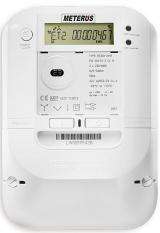
Example of a smart meter in use in Europe. Image credit: Wikipedia.

(PhysOrg.com) -- Home energy monitors (smart meters or Home Energy Management Systems (HEMS)), monitor the energy used by households and/or individual appliances within the home, and they are often recommended to encourage energy conservation. Now a new study has analyzed the effectiveness of installing the devices and discovered that savings were not sustained over the longer term.

A Dutch literature review and case study examined the energy conservation behaviors of participants in the Netherlands, to find out whether or not they sustained changes in over 15 months, which is 11 months longer than earlier studies have covered.

The researchers from Delft University of Technology wanted to find out if early reductions in were continued over a longer period. They trialed energy monitors with 304 participants over four months, and then gave them the option of retaining the monitor. Those who kept the monitor were surveyed again 11 months later.

The findings showed there were initial savings in consumption of an average of 7.8% over the first four months, but these savings were not sustained over the medium to long term.

The study also found some people were more receptive to energy saving behavior changes than others and quickly developed new habits, giving them continuing substantial savings.

The researchers concluded that more research is needed into the design and usability of HEMS, but also on social science issues and contextual factors, and that installing energy monitors alone would not necessarily reduce electricity consumption.

The paper was published in the September edition of the Building Research and Information journal. A British paper in the same issue of the journal analyzed how householders used feedback on their energy consumption provided by smart meters in the UK, and found that energy consumption was not necessarily reduced by access to the information.

Author of the British paper, Sarah Darby of the University of Oxford’s Environmental Change Institute, said feedback was considered an important factor in reducing energy demand because many people are using energy without realizing it. However, she said there is still a lot of confusion surrounding the , with some meters providing more information than others.

In the UK, smart meters with real-time electricity use displays will be installed in over 27 million homes and two million other sites during the next decade. Dr. Darby said the meters could lead to more effective electricity distribution in the future even if they did not reduce the total use of electricity because it would enable suppliers to manage loads on the system more effectively.

Explore further: User awareness key to effective energy monitoring

More information: Home energy monitors: impact over the medium-term, S. S. van Dam et al., Building Research & Information, Volume 38, Issue 5 September 2010 , pages 458 - 469. DOI:10.1080/09613218.2010.494832

Related Stories

New 'smart' electrical meters raise privacy issues

Nov 06, 2009

The new "smart meters" utilities are installing in homes around the world to reduce energy use raise fresh privacy issues because of the wealth of information about consumer habits they reveal, experts said ...

CSIRO Builds Smart Energy System

Mar 22, 2006

CSIRO technology will help to reduce black-outs and improve the reliability and efficiency of the electricity grid while reducing greenhouse emissions. It will also complement smart electricity meters promising consumers ...

Smart meters help to save money

Jul 01, 2010

How can domestic electricity customers be motivated to use energy more efficiently, let alone make more efficient use of renewable sources? One possibility is to install electronic meters to measure the electricity ...

Recommended for you

Radiation leak at Japan lab; small impact expected

4 hours ago

An atomic research lab in northern Japan has reported a radiation leak that may have affected about 50 people, though none were hospitalized and no impact was expected outside the facility, the lab's operator ...

The long road to the 2000-watt society

May 24, 2013

The vision of a society in which each inhabitant of the earth manages to consume only 2000 watts has already been around for 15 years. During this time, there has been a steady increase in environmental awareness ...

Germany must spread cost of energy shift fairly: IEA

May 24, 2013

The International Energy Agency said Friday that Germany must shield its consumers from paying too much of the cost of its ambitious switch from nuclear power and fossil fuels toward renewable energy.

Solar Kettle allows for boiling water off the grid

May 23, 2013

(Phys.org) —A company called Contemporary Energy has unveiled a new device it calls the Solar Kettle. It looks very much like a normal coffee thermos, but has flaps on one side that open to allow for collecting ...

User comments : 6

Adjust slider to filter visible comments by rank

Display comments: newest first

Eikka
5 / 5 (1) Sep 14, 2010
With a meter like that of the example, I'm not surprised.

These things are often obscure and difficult to understand, and people aren't interested in following some abstract number that means nothing to them. They simply forget about the whole meter after a few months and go back to doing their usual thing.

What they need is something akin to a big needle on the wall that points to a green bar, a yellow bar, and a red bar. If you adjust the needle to stay between the green and the yellow bar when the short term average consumption is near the long term average, people would automatically try to get the needle to go to the green bar and lower their average consumption.

Meaningful, immediate feedback gives the best result.
CreepyD
not rated yet Sep 14, 2010
I had one of these.
At first, you think, cool it's saving me money.
Then you realise how little you save and that it's just not worth it turning some things off.
e.g. my DVD recorder/tv etc, if I turn it off at the wall, I had to wait about 5 mins for it all to come back on when I wanted it.
5 mins worth of time was not worth the few pence I saved by turning it off overnight..
Just like walking 2 miles buy something 50p cheaper = Not worth it.
Eikka
not rated yet Sep 14, 2010
CreepyD: you don't save much by turning off "phantom loads" like televisions and set top boxes anyways. That problem is a problem of scale, where hundreds of households would need to plug their devices out in order to make any significant impact.

The problem is already being solved by mandating that the standby power consumption is low from the factory.

The real deal comes from things like leaving the lights on, or using hot water, or heating dinner with a microwave vs. the oven, or lowering your room temperature by 1 degrees, which will show up in your average electricity consumption much more.

Some people leave their computers running overnight so they don't have to wait 2 minutes in the morning to turn them back on. That's the sort of consumption that should be easily visible on a big needle on the wall that shows you how much you are consuming and how it relates to everything.
MIBO
not rated yet Sep 14, 2010
People need to consider the bigger picture.
For example, My PC uses several hundred watts when running, and this ultimately ends up as heat in the room where I'm working.
If the machine is switched off then the room cools down and the central heating starts running, which costs more to run as it's heating the house and is less than 100% efficient.

typically 99% of the energy used by an electrical device ends up as heat, the rest as electromagnetic interference, so switching off appliances does not always save energy, and in many cases as above results in higher energy consumption elsewhere, unless you live in an environment where you need to cool rather than heat the environment where the equipment operates.

In my case, the heat generated by the electronic equipment keeps the house warm enough to prevent freezing or uncomfortable chills.

It's more worthwhile here investing the money in more efficient equipment such as condenser dryers to avoid pumping hot air ourdoors.
Eikka
not rated yet Sep 15, 2010
MIBO: what I find is that central heating systems aren't actually that smart to monitor a single room individually. They take the "big picture" as well, and you just end up having your room 2 degrees hotter than the rest of the house, which is wasted energy.

It's much less expensive and much more sensible to make heat by gas or oil, or even if you are using direct electricity, you can use heat pumps.

You have to remember that each kWh of electricity costs 3x the energy down the line, compared to producing the same amount of heat with gas, oil or wood locally.
Choice
not rated yet Sep 17, 2010
There are many variables that were not considered in this study. The primary drivers of home energy use are heating and cooling days. Without controlling this variable, the study is just telling us: hey, home energy monitors aren't the only factor affecting home energy use.

More news stories

Yahoo, pay-TV operators among Hulu bidders

Online video site Hulu is again up for sale, with Yahoo and pay TV operators DirecTV and Time Warner Cable among the seven bidders, according to a person with direct knowledge of the matter.

Google eyes emerging markets networks

Google has become deeply involved in a series of projects to build and operate wireless networks in emerging markets including sub-Saharan Africa and Southeast Asia, a report said Friday.

Radiation leak at Japan lab; small impact expected

An atomic research lab in northern Japan has reported a radiation leak that may have affected about 50 people, though none were hospitalized and no impact was expected outside the facility, the lab's operator ...

Facial-recognition technology proves its mettle

(Phys.org) —In a study that evaluated some of the latest in automatic facial recognition technology, researchers at Michigan State University were able to quickly identify one of the Boston Marathon bombing ...

Galaxies fed by funnels of fuel

(Phys.org) —Computer simulations of galaxies growing over billions of years have revealed a likely scenario for how they feed: a cosmic version of swirly straws.