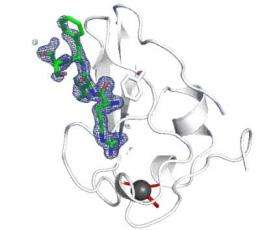
This image shows UBR-box recognition of an arginine residue at the beginning of a protein (blue) targeted for degradation. The structural integrity of the UBR box depends on zinc (grey) and a histidine residue (red) that is mutated in Johanson-Blizzard syndrome.
Reconnaissance d’un résidu d’arginine au codon d’initiation d’une protéine (en bleu) ciblée pour faire l’objet d’une dégradation. L’intégrité structurale de la boîte de dégradation de la protéine ubiquitine-ligase E3 dépend du zinc (en gris) et d’un résidu d’histidine (en rouge) qui subit une mutation dans le cas de syndrome de Johanson-Blizzard. Credit: Department of Biochemistry, McGill University. Département de biochimie, Université McGill.
Our bodies recycle proteins, the fundamental building blocks that enable cell growth and development. Proteins are made up of a chain of amino acids, and scientists have known since the 1980s that first one in the chain determines the lifetime of a protein. McGill researchers have finally discovered how the cell identifies this first amino acid - and caught it on camera.
"There are lots of reasons cells recycle proteins - fasting, which causes loss of muscle, growth and remodeling during development, and normal turnover as old proteins are replaced to make new ones," explained lead researcher, Dr. Kalle Gehring, from McGill's Department of Biochemistry.
"One way that cells decide which proteins to degrade is the presence of a signal known as an N-degron at the start of the protein. By X-ray crystallography, we discovered that the N-degron is recognized by the UBR box, a component of the cells' recycling system."
This video shows UBR-box recognition of an arginine residue at the beginning of a protein (blue) targeted for degradation. The structural integrity of the UBR box depends on zinc (grey) and a histidine residue (red) that is mutated in Johanson-Blizzard syndrome.
Reconnaissance d’un résidu d’arginine au codon d’initiation d’une protéine (en bleu) ciblée pour faire l’objet d’une dégradation. L’intégrité structurale de la boîte de dégradation de la protéine ubiquitine-ligase E3 dépend du zinc (en gris) et d’un résidu d’histidine (en rouge) qui subit une mutation dans le cas de syndrome de Johanson-Blizzard. Credit: Département de biochimie, Université McGill. Department of Biochemistry, McGill University.
The powerful technique can pinpoint the exact location of atoms and enabled the team to capture an image of the UBR box, providing insight to this incredibly tiny yet essential part of our bodies' chemical mechanics.
Aside from representing a major advance in our understanding of the life cycle of proteins, the research has important repercussions for Johanson-Blizzard syndrome, a rare disease that causes deformations and mental retardation. This syndrome is caused by a mutation in the UBR box that causes it to lose an essential zinc atom. Better understanding of the structure of the UBR box may help researchers develop treatments for this syndrome.
Citation:
Your body recycling itself -- captured on film (w/ Video) (2010, September 13)
retrieved 20 September 2024
from https://phys.org/news/2010-09-body-recycling-captured-video.html
This document is subject to copyright. Apart from any fair dealing for the purpose of private study or research, no
part may be reproduced without the written permission. The content is provided for information purposes only.