Oxygen production may have begun 270 million years earlier
Sep 09, 2010 By Bob Beale
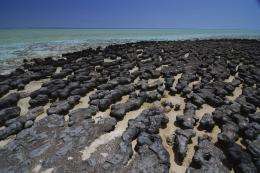
Modern stromatolites at Shark Bay, WA

(PhysOrg.com) -- Bacteria that produce oxygen may have evolved hundreds of millions of years earlier than previously thought, a new study into ancient rock formations in Western Australia suggests.

Well-preserved fossils of stromatolites in the Tumbiana Formation, in the Pilbara region, have been dated as 2.72 billion years old, more than 270 million years older than the previous oldest evidence of oxygenic photosynthesis, UNSW doctoral student David Flannery has told a symposium in Perth.

Flannery and other researchers from UNSW's Australian Centre for (ACA) and Macquarie University presented their findings at the Fifth International Archean Symposium, in a paper titled "Does the Neoarchaean Fortescue group record the earliest evidence for oxygenic ?"

They note that most scientists accept that Earth's atmosphere became oxygenated - and thus habitable for other forms of life - during a period known as the Great Oxidation Event around 2.45 and 2.32 billion years ago. Blue-green algae, or , are thought to have been the first organisms to do so, and they lived in colonies that left behind the stromatolite fossils.

But when oxygen-producing organisms first evolved and how long it took the resulting oxygenation of the atmosphere has been uncertain. The new findings may suggest the process not only started earlier but was more extended and gradual than previously thought, according to co-author Professor Malcolm Walter, director of the ACA.

"The formerly neat story of the Great Oxidation Event now seems not to be so neat after all," Professor Walter says. "The idea that the Earth's atmosphere suddenly became oxygenated about 2.45 billion years ago now seems too simple."

He cautions that the new study is still in its early stages, relying on fossilised rock structures and chemical evidence rather than definitive cellular structures: "It's early days yet and what we have found is not unequivocal evidence, but stromatolites are very distinctive and these structures are identical with those of living stromatolites we're studying at Shark Bay, in Western Australia. I'm confident enough in what we've found."

Explore further: Professor argues Earth's mantle affects long-term sea-level rise estimates

Related Stories

First Fossil-Makers in Hot Water

Mar 02, 2010

Microbe mats in Yellowstone's hot springs may be living analogs of the primordial microbe communities that constructed the oldest rock fossils on Earth.

Australia's ancient oceans: toxic and purple

Oct 06, 2005

Ancient oceans in Australia’s north were toxic seas of sulfur, supporting coloured bacteria that made the seas appear purple and unlike anything we know of in the Earth’s history, according to new ANU research.

Scientists discover first new chlorophyll in 60 years

Aug 20, 2010

(PhysOrg.com) -- University of Sydney scientists have stumbled upon the first new chlorophyll to be discovered in over 60 years and have published their findings in the international journal Science.

The rise of oxygen caused Earth's earliest ice age

May 07, 2009

(PhysOrg.com) -- Geologists may have uncovered the answer to an age-old question - an ice-age-old question, that is. It appears that Earth's earliest ice ages may have been due to the rise of oxygen in Earth's ...

Study reveals ancient rocks linked to old Earth's crust

Feb 24, 2010

(PhysOrg.com) -- A new geological study which took place in the Pilbara region of Western Australia brings us one step closer to understanding more precisely the timing of when the primordial earth crust was ...

Recommended for you

Russia evacuates drifting Arctic research station

21 hours ago

Russia has ordered the urgent evacuation of the 16-strong crew of a drifting Arctic research station after ice floe that hosts the floating laboratory began to disintegrate, officials said Thursday.

Bacterium from Canadian High Arctic and life on Mars

23 hours ago

(Phys.org) —The temperature in the permafrost on Ellesmere Island in the Canadian high Arctic is nearly as cold as that of the surface of Mars. So the recent discovery by a McGill University led team of ...

User comments : 0

More news stories

A hidden population of exotic neutron stars

(Phys.org) —Magnetars – the dense remains of dead stars that erupt sporadically with bursts of high-energy radiation - are some of the most extreme objects known in the Universe. A major campaign using ...

Century-old science helps confirm global warming

(Phys.org) —Ocean measurements taken more than 135 years ago during the scientific expedition of HMS Challenger have provided further confirmation of human-produced global warming over the past century.

Hubble reveals the ring nebula's true shape

(Phys.org) —The Ring Nebula's distinctive shape makes it a popular illustration for astronomy books. But new observations by NASA's Hubble Space Telescope of the glowing gas shroud around an old, dying, ...

The long road to the 2000-watt society

The vision of a society in which each inhabitant of the earth manages to consume only 2000 watts has already been around for 15 years. During this time, there has been a steady increase in environmental awareness ...