NASA's Magnetospheric Mission Passes Major Milestone
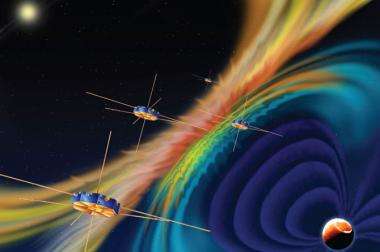
(PhysOrg.com) -- The universe is still an arcane place that scientists know very little about, but a new NASA Solar Terrestrial Probe mission is going to shed light on one especially mysterious event called magnetic reconnection. It occurs when magnetic lines of force cross, cancel, and reconnect releasing magnetic energy in the form of heat and charged-particle kinetic energy.
On the sun, magnetic reconnection causes solar flares more powerful than several atomic bombs combined. In Earth's atmosphere, magnetic reconnection dispenses magnetic storms and auroras, and in laboratories on Earth it can cause big problems in fusion reactors.
Although the study of magnetic reconnection dates back to the 1950s and despite numerous scientific papers addressing this perplexing issue, scientists still cannot agree on one accepted model.
In 2014, NASA is scheduled to launch a satellite that will greatly increase our understanding of this phenomenon when it launches the Magnetospheric Multiscale (MMS) mission, a suite of four identical spacecraft that will study magnetic reconnection in the best possible laboratory - the Earth’s magnetosphere. The spacecraft will obtain measurements necessary to test prevailing theories as to how reconnection is enabled and how it progresses.
Recently, NASA and members of an independent review board painstakingly reviewed every aspect of the MMS mission, and successfully completed the mission’s critical design review. This technical review is held to ensure that a mission can proceed into fabrication, demonstration and test and can meet stated performance requirements, including cost, schedule, risk and other system constraints.
According to MMS deputy project scientist Mark Adrian of NASA’s Goddard Space Flight Center in Greenbelt, Md., “This is the last hurdle before the spacecraft and instrument teams begin to build actual flight hardware.”
MMS was approved for implementation in June 2009 following a successful Preliminary Design Review in May 2009.
Dr. James L. Burch of the Southwest Research Institute in San Antonio, Texas, will lead the MMS science team. According to Burch, “Magnetic reconnection is a fundamental physical process that occurs throughout the universe,” says Burch. “MMS will enable us to study this dynamic process in the near-Earth space environment, where it transfers energy from the solar wind to the magnetosphere and drives disturbances known as space weather.”
Goddard is the lead Center for the mission. Engineers there will perform the required environmental testing, build the spacecraft and integrate all four sets of instruments into the MMS satellites, support launch vehicle integration and operations, and develop the Mission Operations Center which to monitor and control the spacecraft.
MMS will carry identical suites of plasma analyzers, energetic particle detectors, magnetometers, and electric field instruments as well as a device to prevent spacecraft charging from interfering with the highly sensitive measurements required in and around the diffusion regions.
Scientists and engineers at Goddard have designed and will build one of the instruments - the Fast Plasma Instrument, which will measure the ion and electron distributions and the electric and magnetic fields with unprecedentedly high millisecond time resolution and accuracy.
Currently, MMS is scheduled to launch in August 2014 from Cape Canaveral Air Force Station, FL aboard an Atlas V rocket.
More information: stp.gsfc.nasa.gov/missions/mms/mms.htm
Provided by NASA's Goddard Space Flight Center


