New pump created for microneedle drug-delivery patch
Sep 01, 2010 by Emil Venere
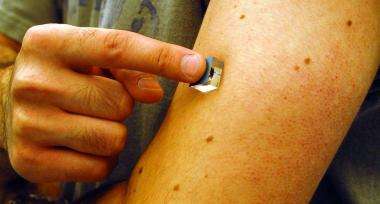
Purdue doctoral student Charilaos Mousoulis demonstrates a prototype pump for drug-delivery patches that might use arrays of microneedles to deliver a wider range of medications than now possible with conventional patches. (Purdue University photo/Birck Nanotechnology Center)

(PhysOrg.com) -- Purdue University researchers have developed a new type of pump for drug-delivery patches that might use arrays of "microneedles" to deliver a wider range of medications than now possible with conventional patches.

The current "transdermal" patches are limited to delivering drugs that, like , are made of small hydrophobic molecules that can be absorbed through the skin, said Babak Ziaie, a professor of electrical and computer engineering and biomedical engineering.

"There are only a handful of drugs that currently can be administered with patches," he said. "Most new drugs are large molecules that won't go through the skin. And a lot of drugs, such as those for treating cancer and , you can't take orally because they aren't absorbed into the blood system through the digestive tract."

Patches that used arrays of tiny microneedles could deliver a multitude of drugs, and the needles do not cause pain because they barely penetrate the skin, he said.

"It's like a bandage - you would use it and discard," Ziaie said.

The patches require a pump to push the drugs through the narrow needles, which have a diameter of about 20 microns, or roughly one-fourth as wide as a human hair. However, pumps on the market are too complex for patches, he said.

"We have developed a simple pump that's activated by touch from the heat of your finger and requires no battery," Ziaie said.

The pump contains a liquid that boils at body temperature so that the heat from a finger's touch causes it to rapidly turn to a vapor, exerting enough pressure to force drugs through the microneedles.

"It takes 20 to 30 seconds," Ziaie said.

The liquid is contained in a pouch separated from the drug by a thin membrane made of a rubberlike polymer, called polydimethylsiloxane, which is used as diaphragms in pumps.

Research findings are detailed in a paper being presented during the 14th International Conference on Miniaturized Systems for Chemistry and Life Sciences on Oct. 3-7 at University of Groningen in The Netherlands. The paper was written by electrical and computer engineering doctoral students Charilaos Mousoulis and Manuel Ochoa and Ziaie.

Researchers have filed an application for a provisional patent on the device.

Ziaie has tested prototypes with liquids called fluorocarbons, which are used as refrigerants and also in semiconductor manufacturing.

"You need a relatively large force, a few pounds per square inch, to push medications through the microneedles and into the skin," Ziaie said. "It's very difficult to find a miniature pump that can provide that much force."

Findings indicate prototypes using the fluorocarbon HFE-7000 exerted 4.87 psi and another fluorocarbon, FC-3284, exerted 2.24 psi.

Explore further: Attacking MRSA with metals from antibacterial clays

More information: www.microtas10.org/

Related Stories

Ceramic hybrid needles take the sting out of shots

Jan 07, 2008

New polymerization technology may one day take the pain out of injections and blood draws. A team of researchers at the University of North Carolina and Laser Zentrum Hannover have recently used two-photon polymerization ...

Microneedles Could Replace Syringe

Mar 10, 2008

The common needle phobia and painful injections could soon be a thing of the past, thanks to a revolutionary new drug-delivery technique developed by a team at the Georgia Institute of Technology, US. The ...

Microneedles enhance drug administration through skin

Feb 04, 2008

In what is believed to be the first peer-reviewed study of its kind involving human subjects, researchers at the University of Kentucky College of Pharmacy and the Georgia Institute of Technology have demonstrated ...

'Ferropaper' is new technology for small motors, robots

Jan 05, 2010

(PhysOrg.com) -- Researchers at Purdue University have created a magnetic "ferropaper" that might be used to make low-cost "micromotors" for surgical instruments, tiny tweezers to study cells and miniature ...

Recommended for you

Attacking MRSA with metals from antibacterial clays

14 hours ago

In the race to protect society from infectious microbes, the bugs are outrunning us. The need for new therapeutic agents is acute, given the emergence of novel pathogens as well as old foes bearing heightened antibiotic resistance.

Keeping fruit, vegetables and cut flowers fresh longer

May 15, 2013

New technology offers the promise of reducing billions of dollars of losses that occur each year from the silent, invisible killer of fruits, vegetables and cut flowers—a gas whose effects are familiar to everyone who has ...

Why don't beetles freeze in the winter?

May 14, 2013

For 37 years, Queen's University Biochemistry professor Peter Davies has been unraveling the mystery of why some organisms including insects and fish don't freeze in the winter. His research into insect antifreeze protein ...

The molecular basis of strawberry aroma

May 13, 2013

You know that summer is here when juicy red strawberries start to appear on the shelves. In Germany, this seasonal fruit has never been more popular: on average 3.5 kilos per head were consumed in 2012—a ...

A new dimension for 3-D protein structures

May 13, 2013

(Phys.org) —3D structures of biological molecules like proteins directly affect the way they behave in our bodies. EPFL scientists have developed a new infrared-UV laser method to more accurately determine ...

User comments : 2

Adjust slider to filter visible comments by rank

Display comments: newest first

Leisa
1 / 5 (1) Sep 01, 2010
Why the people like to take drug, this is not good for our health.
http://www.health...nse.html
winthrom
not rated yet Sep 01, 2010
I would hope this is a very cheap device when made in quantity because diabetics might be able to use it.

More news stories

Attacking MRSA with metals from antibacterial clays

In the race to protect society from infectious microbes, the bugs are outrunning us. The need for new therapeutic agents is acute, given the emergence of novel pathogens as well as old foes bearing heightened antibiotic resistance.

Beautiful 'flowers' self-assemble in a beaker

By simply manipulating chemical gradients in a beaker of fluid, materials scientists at Harvard have found that they can control the growth behavior of crystals to create precisely tailored structures—such ...

Making gold green: New non-toxic method for mining gold

Northwestern University scientists have struck gold in the laboratory. They have discovered an inexpensive and environmentally benign method that uses simple cornstarch—instead of cyanide—to isolate gold from raw materials ...

Alaska volcano shoots ash 15,000 feet into the air

(AP)—One of Alaska's most restless volcanoes has shot an ash cloud 15,000 feet into the air in an ongoing eruption that has drawn attention from a nearby community but isn't expected to threaten air traffic.

US seizes Bitcoin operator accounts

US authorities seized the accounts of a Bitcoin digital currency exchange operator, claiming it was functioning as an "unlicensed money service business," court documents showed Friday.

Chinese, Indian airlines face EU pollution fines

Eight Chinese and two Indian airlines face fines of up to several million euros for not paying for their greenhouse gas emissions during flights within the bloc, the European Commission said on Friday.