NGC 4696: A cosmic question mark
Aug 12, 2010
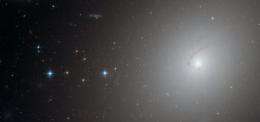
This picture, taken by Hubble’s Advanced Camera for Surveys, shows NGC 4696, the largest galaxy in the Centaurus Cluster. The huge dust lane, around 30 000 light-years across, that sweeps across the face of the galaxy makes NGC 4696 look different from most other elliptical galaxies. Viewed at certain wavelengths, strange thin filaments of ionized hydrogen are visible within it. In this picture, these structures are visible as a subtle marbling effect across the galaxy’s bright center. Credit: ESA/Hubble and NASA

This picture, taken by Hubble's Advanced Camera for Surveys, is not just a beautiful snapshot of NGC 4696, the largest galaxy in the Centaurus Cluster (galaxy cluster Abell 3526). It is also an illustration of the rich variety of objects that astronomers can see with the NASA/ESA Hubble Space Telescope.

NGC 4696 is an elliptical galaxy with a difference. Lacking the complex structure and active star formation of their spiral brethren, elliptical galaxies are usually little more than shapeless collections of ageing stars.

Most likely formed by collisions between spiral galaxies, elliptical galaxies experience a brief burst of star formation triggered as the and gas crash into each other, but which quickly leaves the young elliptical galaxies exhausted. With no more gas to form new stars from, the galaxies gradually grow older and fainter.

But NGC 4696 is more interesting than most elliptical galaxies.

The huge dust lane, around 30 000 light-years across, that sweeps across the face of the galaxy is one way in which it looks different from most other . Viewed at certain wavelengths, strange thin filaments of ionised hydrogen are visible within it. In this picture, these structures are visible as a subtle marbling effect across the galaxy's bright centre.

Looking at NGC 4696 in the optical and near-infrared wavelengths seen by Hubble gives a beautiful and dramatic view of the galaxy. But in fact, much of its inner turmoil is still hidden from view in this picture. At the heart of the galaxy, a is blowing out jets of matter at nearly the speed of light. When looked at in X-ray wavelengths, such as those visible from NASA's Chandra X-ray Observatory, huge voids within the galaxy become visible, telltale signs of these jets' enormous power.

The picture was created from images taken using the NASA/ESA Hubble Space Telescope's Advanced Camera for Surveys. A total of 5440 s of exposure through a blue filter (F435W, shown in blue) were combined with 2320 s through a near-infrared filter (F814W, shown in red).The field of view is 3.2 by 1.5 arcminutes.

Explore further: Unusual supernova is doubly unusual for being perfectly normal

Related Stories

Exceptionally deep view of strange galaxy

Feb 05, 2009

(PhysOrg.com) -- The Coma Galaxy Cluster, in the northern constellation of Coma Berenices, the hair of Queen Berenice, is one of the closest very rich collections of galaxies in the nearby Universe. The cluster, ...

Stars forced to relocate near the Southern Fish

Mar 03, 2009

About 100 million light-years away, in the constellation of Piscis Austrinus (the Southern Fish), three galaxies are playing a game of gravitational give-and-take that might ultimately lead to their merger ...

Hubble's view of barred spiral galaxy NGC 1672

Apr 03, 2007

NGC 1672, visible from the Southern Hemisphere, is seen almost face on and shows regions of intense star formation. The greatest concentrations of star formation are found in the so-called starburst regions ...

Hubble Illuminates Cluster of Diverse Galaxies

Feb 06, 2007

This image from NASA's Hubble Space Telescope shows the diverse collection of galaxies in the cluster Abell S0740 that is over 450 million light-years away in the direction of the constellation Centaurus.

Recommended for you

Three centaurs follow Uranus through the solar system

Jun 18, 2013

Astrophysicists from the Complutense University of Madrid have confirmed that Crantor, a large asteroid with a diameter of 70 km has an orbit similar to that of Uranus and takes the same amount of time to ...

Final curtain for Europe's deep-space telescope

Jun 17, 2013

The deep-space telescope Herschel took its final bow on Monday, climaxing a successful four-year mission to observe the birth of stars and galaxies, the European Space Agency (ESA) said.

Hubble spots a very bright contortionist

Jun 17, 2013

(Phys.org) —The contorted object captured by Hubble in this picture is IRAS 22491-1808, also known as the South America Galaxy. It is an ultra-luminous infrared galaxy (ULIRG) that emits a huge amount of ...

Study explains decades of black hole observations

Jun 14, 2013

(Phys.org) —A new study by astronomers at NASA, Johns Hopkins University and Rochester Institute of Technology confirms long-held suspicions about how stellar-mass black holes produce their highest-energy ...

User comments : 1

Adjust slider to filter visible comments by rank

Display comments: newest first

omatumr
2.7 / 5 (3) Aug 12, 2010
Thanks for a beautiful picture!

Oliver K. Manuel

More news stories

Metamorphosis of moon's water ice explained

Using data gathered by NASA's Lunar Reconnaissance Orbiter (LRO) mission, scientists believe they have solved a mystery from one of the solar system's coldest regions—a permanently shadowed crater on the ...

Looking at sachet water consumption in Ghana

Many of West Africa's largest cities continue to lag in their provision of piped water to residents. Filling the service gap are plastic water sachets, which have become an important source of drinking water ...

LA to give every student an iPad; $30M order

Los Angeles' school system, the second largest in the United States, is ordering iPads for all its students, handing Apple a major success in its quest to make the tablet computer a replacement for textbooks.