Researchers turn up brightness on fluorescent probes
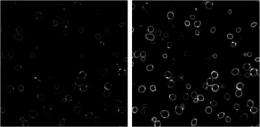
Researchers from Carnegie Mellon University's Molecular Biosensor and Imaging Center (MBIC) are turning up the brightness on a group of fluorescent probes called fluoromodules that are used to monitor biological activities of individual proteins in real-time. This latest advance enhances their fluormodule technology by causing it to glow an order of magnitude brighter than typical fluorescent proteins. The new fluoromodules are five- to seven-times brighter than enhanced green fluorescent protein (EGFP), a development that will open new avenues for research.
In a paper published online in the Journal of the American Chemical Society, MBIC researchers unveil a new class of dendron-based fluorogenic dyes called "dyedrons," that amplify the signal emitted by their fluoromodules.
"By using concepts borrowed from chemistry, the same concepts used in things like quantum dots and light harvesting solar cells, we were able to create a structure that acts like an antenna, intensifying the fluorescence of the entire fluoromodule," said Marcel Bruchez, associate research professor of chemistry and MBIC program director.
MBIC's fluoromodules are made up of a dye called a fluorogen and a fluorgen-activating protein (FAP). The FAP is genetically expressed in a cell and linked to a protein of interest, where it remains dark until it comes into contact with its associated fluorogen. When the protein and dye bind, the complex emits a fluorescent glow, allowing researchers to easily track the protein on the cell surface and within living cells. Fluoromodules are unique in that they do not need to be washed off for specific labeling, they come in a spectrum of colors, and they are more photostable than other fluorescent proteins.
To make the fluoromodules brighter, the researchers amplified the signal of one of their existing probes. They took one of their standard fluorogens, malachite green, and coupled it with another dye called Cy3 in a complex the researchers called a "dyedron." The dyedron is based on a special type of tree-like structure called a dendron, with one malachite green molecule acting as the trunk and several Cy3 molecules acting as the branches.
The two dyes have overlapping emission and absorption spectra — Cy3 typically emits energy at a wavelength where malachite green absorbs energy — and this overlap allows the dyes to efficiently transfer energy between one another. When the Cy3 dye molecules become excited by a light source, such as a laser, they immediately "donate" their excitation energy to malachite green, boosting the signal being emitted by the malachite green.
Each dyedron is approximately 1-2 nanometers and 3000 g/mol in size. The very bright, but very small, dye particles allow the researchers to expand their live-cell imaging research. Previously, when conducting microscopy experiments using fluorescent proteins, fluoromodules and fluorescent dyes, if researchers wanted to increase the brightness, they would either increase the intensity of the laser used to visualize the proteins or label the protein being studied with numerous copies of the fluorescent tag. Both methods had the potential to alter the biology of the system being studied, either through the more intense energy coming from the laser or the increased weight caused by the multiple tags added to the protein. The new approach provides a single compact protein tag with signal enhancement provided by only modestly enlarging the targeted dye molecule.
The MBIC researchers are currently using fluoromodules to study proteins on the cell surface, and hope to take the technology inside of cells in the near future. Additionally, they will be creating dyedrons for their other existing FAP/dye complexes.
Provided by Carnegie Mellon University


