Tiny fish evolved to tolerate colder temperature in three years: study
Aug 04, 2010
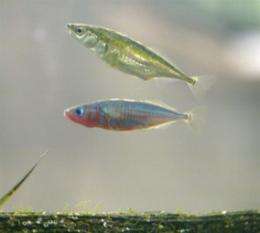
Marine male (bottom) and female (top) sticklebacks

University of British Columbia researchers have observed one of the fastest evolutionary responses ever recorded in wild populations. In as little as three years, stickleback fish developed tolerance for water temperature 2.5 degrees Celsius lower than their ancestors.

The study, published in the current issue of the , provides the some of the first experimental evidence that evolution may help populations survive effects of climate change.

Measuring three to 10 centimetres, stickleback fish originated in the ocean but began populating freshwater lakes and streams following the last ice age. Over the past 10,000 years, marine and freshwater have evolved different physical and behavioural traits, making them ideal models for Darwin's natural selection theory.

"By testing the temperature tolerance of wild and lab-raised sticklebacks, we were able to determine that freshwater sticklebacks can tolerate lower temperatures than their marine counterparts," says lead author Rowan Barrett from the UBC Department of Zoology. "This made sense from an evolutionary perspective because their ancestors were able to adapt to freshwater lakes, which typically reach colder temperatures than the ocean."

To learn how quickly this adaptation took place, Barrett and colleagues from Switzerland and Sweden "recreated history" by transplanting marine sticklebacks to freshwater ponds and found that in as little as three generations (or three years), they were able to tolerate the same minimum temperature as freshwater sticklebacks, 2.5 °C lower than their ancestral populations.

"Scientific models have suggested that climate change could result in both a general, gradual increase of average temperatures and an increase in ," says Barrett, who received his PhD last week.

"Our study is the first to experimentally show that certain species in the wild could adapt to climate change very rapidly - in this case, colder temperature. However, this rapid adaptation is not achieved without a cost," says Barrett.

"Only rare individuals that possess the ability to tolerate rapid changes in survive, and the number of survivors may not be large enough to sustain the population. It is crucial that knowledge of evolutionary processes is incorporated into conservation and management policy."

Explore further: Evolution shapes new rules for ant behavior

Related Stories

Study first to show evolution's impact on ecosystems

Apr 01, 2009

Scientists have come to agree that different environments impact the evolution of new species. Now experiments conducted at the University of British Columbia are showing for the first time that the reverse is also true.

Follow that prawn

Dec 17, 2007

A new study from the University of Leicester reveals that prawns can be used by fish species to find the best places to eat.

Recommended for you

Australia set to cull 10,000 wild horses

14 minutes ago

A controversial cull of up to 10,000 wild horses in Australia's harsh Outback reportedly began Wednesday in a bid to control the feral animals which officials say are destroying the land.

Encouraging signs for bee biodiversity

6 hours ago

Declines in the biodiversity of pollinating insects and wild plants have slowed in recent years, according to a new study. Researchers led by the University of Leeds and the Naturalis Biodiversity Centre in the Netherlands ...

User comments : 2

Adjust slider to filter visible comments by rank

Display comments: newest first

mabarker
1 / 5 (5) Aug 09, 2010
Sorry to throw cold water on this, but they're still sticklebacks. The non-darwinist would say this is indeed *one of the fastest environmental responses ever recorded in wild populations* In fact, Barrett said *this rapid adaptation is not achieved without a cost* and *the # of survivors may not be large enough to sustain the population.* This doesn't sound like upward/onward evolution to me.
Ethelred
5 / 5 (4) Aug 09, 2010
Sorry to throw cold water on this, but they're still sticklebacks.
Sorry you missed the point. No one claimed they weren't sticklebacks. But they DID evolve to handle different conditions. The test was to see if they could survive new conditions and they did.

This doesn't sound like upward/onward evolution to me.


Nothing sounds like evolution to you. However this was evolution. Sometimes species do die out. In this case the species MIGHT die out or it might survive. It would depend on more on the competitors than anything else.

Evolution is NOT about onward or upwards its about survive or go extinct.

Goodbye Ma.

Ethelred

More news stories

Australia set to cull 10,000 wild horses

A controversial cull of up to 10,000 wild horses in Australia's harsh Outback reportedly began Wednesday in a bid to control the feral animals which officials say are destroying the land.

Encouraging signs for bee biodiversity

Declines in the biodiversity of pollinating insects and wild plants have slowed in recent years, according to a new study. Researchers led by the University of Leeds and the Naturalis Biodiversity Centre in the Netherlands ...

Study says empathy plays a key role in moral judgments

Is it permissible to harm one to save many? Those who tend to say "yes" when faced with this classic dilemma are likely to be deficient in a specific kind of empathy, according to a report published in the scientific journal ...

If you can remember it, you can remember it wrong

(Medical Xpress)—Native peoples in regions where cameras are uncommon sometimes react with caution when their picture is taken. The fear that something must have been stolen from them to create the photo ...