Radio Waves: Alternative Power Source

Jul 20, 2010 by John Messina weblog
Radio Waves: Alternative Power Source
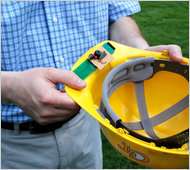
Using only radio waves for its electrical power, the SmartHat has a beeper that alerts the wearer to dangerous construction equipment nearby.
Credit: Jochen Teizer

(PhysOrg.com) -- Researchers at Duke University are harvesting ambient radio waves to power small microprocessor devices that consume very little energy. Devices such as sensors that monitor critical environmental changes can be powered from radio waves.

Dr. Matt Reynolds, an assistant professor at Duke University, heads the electrical and computer department. Matt has demonstrated a low power device that is fitted into a hard-hat. Called a SmartHat, the device sounds a beeper that warns when dangerous equipment is nearby on a construction site.

The radio waves are harvest from wireless network transmitters installed on backhoes and bulldozers; they are used to keep track of their location. The low power sensor is used to monitor the direction and strength of the and warns the hard-hat wearer if they are too close.

Matt and his associates are inventing devices that consume so little power that batteries aren’t require to run them. Ambient radio waves are sufficient to operate these devices equipped with low power microprocessors.

Powercast is a company that sells radio wave transmitters and receivers that use radio waves to operate low power devices. The company recently released a receiver for charging battery-free wireless sensors; the receiver powers modules that include microcontrollers from Microchip Technology.

Because radio waves spread and lose their energy rapidly, this technology hasn’t been explored very much. With the recent advancements in , tiny amounts of electricity can now be made to do useful work.

At Intel, Dr. Smith is exploring the use of and creating an electronic "harvester" of ambient . The harvester collects enough energy from a TV station that’s approximately 2.5 miles from the lab to run a temperature and humidity sensor. The device collects enough power to produce about 50 microwatts of power that’s sufficient to operate many sensors. In comparison a solar powered calculator only consumes about 5 microwatts.

Dr. Reynolds of Duke University stated: “We are on the cusp of an explosion in small wireless devices than can run on alternatives to battery power. Devices like this can live on and on."

Explore further: Sensitive bomb detector to rove in search of danger

More information: Powercast
Via: NY Times

Related Stories

Imec achieves breakthrough in battery-less radios

Feb 09, 2010

At today's International Solid State Circuit Conference, Imec and Holst Centre report a 2.4GHz/915MHz wake-up receiver which consumes only 51µW power. This record low power achievement opens the door to battery-less ...

MEMS device generates power from body heat

Apr 29, 2010

(PhysOrg.com) -- In an attempt to develop a power source that is compact, environmentally friendly, and has an unlimited lifetime, a team of researchers from Singapore has fabricated an energy harvesting device ...

Random Antenna Arrays Boost Emergency Communications

Feb 25, 2009

(PhysOrg.com) -- First responders could boost their radio communications quickly at a disaster site by setting out just four extra transmitters in a random arrangement to significantly increase the signal power at the receiver, ...

Recommended for you

Sensitive bomb detector to rove in search of danger

23 hours ago

European researchers have developed and tested a light-weight device capable of detecting extremely minute quantities of explosives from up to 20 metres away, providing an invaluable law-enforcement tool ...

How soon could car seats enter the 3-D comfort zone?

May 23, 2013

New 3D textiles made of recyclable polyester fibres could contribute help cars be easier to recycle. But recycling technology has yet to progress in separating seat material from other car components.

NASA: Austin, calling Austin. 3-D pizzas to go

May 22, 2013

(Phys.org) —The idea of living with 3-D printed food is neither unthinkable nor new; designers and futurists have been looking to 3-D printing as food's next frontier. In 2012, there was news that the Thiel ...

User comments : 2

Adjust slider to filter visible comments by rank

Display comments: newest first

langbaba
not rated yet Jul 21, 2010
Had a similar idea quite a few years back (still in school). The circuit I built took about 4 components and powered a small LED light while close to a RF source (CRT screen worked quite well ;-).
I always had this idea of building a thousand of these devices and connecting their output together, thus providing enough power to charge a battery ...
Yes, have a look at a basic crystal radio - that's where my ideas originally came from if I remember correctly!
trekgeek1
not rated yet Jul 29, 2010
Seems like such a low power system could have energy harvested from the motion of the human body just as easily without having an RF source nearby. Most hard hats have the outer shell and an inner "net" that sits on your head and provides a shock absorbing feature. Placing piezoelectric materials at these junctions would probably accomplish the same task.

More news stories

Drones may violate international law

(Phys.org) —As President Obama gives a speech on national security—including defending U.S. use of drones to combat terrorism—Leila Sadat, JD, international law expert and professor of law at Washington University in ...

Google eyes emerging markets networks

Google has become deeply involved in a series of projects to build and operate wireless networks in emerging markets including sub-Saharan Africa and Southeast Asia, a report said Friday.

Facial-recognition technology proves its mettle

(Phys.org) —In a study that evaluated some of the latest in automatic facial recognition technology, researchers at Michigan State University were able to quickly identify one of the Boston Marathon bombing ...

The long road to the 2000-watt society

The vision of a society in which each inhabitant of the earth manages to consume only 2000 watts has already been around for 15 years. During this time, there has been a steady increase in environmental awareness ...

Galaxies fed by funnels of fuel

(Phys.org) —Computer simulations of galaxies growing over billions of years have revealed a likely scenario for how they feed: a cosmic version of swirly straws.