Building a better safety helmet
Jul 13, 2010
Building a better safety helmet
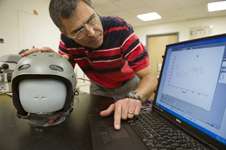
Mechanical and industrial engineering professor Sinan Muftu with the Head Impact Detection and Alert System. Photo by Mary Knox Merill.

Student researchers at Northeastern University have developed the technology for a helmet that could measure the severity of head injuries suffered by fallen skiers or snowboarders and alert first responders to the significance of the damage.

The device was developed for a senior capstone project under the direction of mechanical and industrial engineering associate professor Sinan Muftu. The team members included Cyril Blank, Matthew Jamula, Diego Nevado, Ross Parker and Tadas Vaisvila.

With the high frequency of traumatic brain injuries to athletes and soldiers on the battlefield, “there is definitely a need for these type of products,” said Vaisvila, who graduated in the spring with a degree in mechanical engineering.

Noting the seemingly minor ski accident that caused the death of actress Natasha Richardson in 2009, he added, “Our research found that there are a lot of less severe that, when untreated, can actually be worse than really bad concussions.”

After meeting with emergency medical technicians and X-ray specialists, team members designed a prototype of the head impact detection and alert system. The device included sensors for measuring acceleration relative to a freefall and an LCD screen that used a series of colors to indicate the level of impact.

The color green, for example, corresponded to a mild impact, whereas the color red indicated a severe impact and likely a life-threatening head injury. 

Team members also tested the helmet’s ability to measure the severity of head injuries against computer models, finding a “good correlation” between the two, said Muftu.

To prepare for the test, they built a prototype of a human using plastic and modeled the brain using a water-filled sack. Then, they placed the helmet on the plastic head, dropped it from a variety of heights and measured the rate of acceleration.

Over the course of the semester, the students learned a number of valuable engineering lessons, such as how to model dynamic impact using state of the art analysis tools, and how to interpret levels of acceleration based on bioengineering knowledge, said Muftu.

He and Dr. Alex Rotenberg, a colleague at Children’s Hospital Boston, are currently planning a more in-depth exploration of traumatic brain injuries, which will include building simulations of blunt force trauma to the head.

Explore further: Researchers use light projector and single-pixel detectors to create 3-D images

add to favorites email to friend print save as pdf

Related Stories

Head injuries increase after motorcycle helmet law repeal

Jun 12, 2008

Pennsylvania motorcyclists suffered large increases in head injury deaths and hospitalizations in the two years following the repeal of its motorcycle helmet law, according to a University of Pittsburgh study to be published ...

Pill ingredient could prevent brain damage after head injury

Apr 30, 2008

A common component of the contraceptive pill (progesterone) could improve the neurologic outcome for patients with severe head injuries, according to a study published in BioMed Central’s open access journal Critical Ca ...

Recommended for you

GPS solution provides 3-minute tsunami alerts

May 17, 2013

Researchers have shown that, by using global positioning systems (GPS) to measure ground deformation caused by a large underwater earthquake, they can provide accurate warning of the resulting tsunami in ...

Innovative concrete to facilitate building rehabilitation

May 16, 2013

The Structural Technology Group of the Universitat Politècnica de Catalunya, BarcelonaTech (UPC), in collaboration with the company PROMSA, is participating in the rehabilitation of the Gaudí House Museum in Barcelona's P ...

User comments : 0

More news stories

Morocco to harness the wind in energy hunt

Morocco is ploughing ahead with a programme to boost wind energy production, particularly in the southern Tarfaya region, where Africa's largest wind farm is set to open in 2014.

US seizes Bitcoin operator accounts

US authorities seized the accounts of a Bitcoin digital currency exchange operator, claiming it was functioning as an "unlicensed money service business," court documents showed Friday.

Galaxy's Ring of Fire

Johnny Cash may have preferred this galaxy's burning ring of fire to the one he sang about falling into in his popular song. The "starburst ring" seen at center in red and yellow hues is not the product of ...

Alaska volcano shoots ash 15,000 feet into the air

(AP)—One of Alaska's most restless volcanoes has shot an ash cloud 15,000 feet into the air in an ongoing eruption that has drawn attention from a nearby community but isn't expected to threaten air traffic.