Imec reports record efficiencies for large-area epitaxial thin-film silicon solar cells
Jul 13, 2010
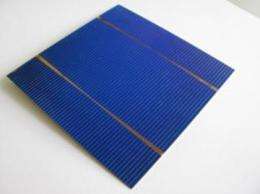
Imec large-area (70cm2) epitaxial solar cell with an efficiency of up to 16.3% on high-quality substrate.

Imec scientists realized large-area (70cm2) epitaxial solar cells with efficiencies of up to 16.3% on high-quality substrates. And efficiencies of up to 14.7% were achieved on large-area low-quality substrates, showing the potential of thin-film epitaxial solar cells for industrial manufacturing. The results were achieved within imec’s silicon solar cell industrial affiliation program (IIAP) that explores and develops advanced process technologies aiming a sharp reduction in silicon use, whilst increasing cell efficiency and hence further lowering substantially the cost per Watt peak.

Besides wafer-based bulk imec aims at developing epitaxial thin-film (<20µm) solar cells grown on low-cost silicon carriers within its silicon solar cell IIAP.. The epitaxial thin-film process on low-cost silicon carriers is generically similar to the bulk process and the epi-process can be implemented with limited equipment investment in an existing crystalline silicon solar cell manufacturing line. To improve the optical confinement of light in the active part of the cell, a buried porous Si reflector is developed.

Imec realized 20μm thick high-quality epitaxial silicon stacks both on top of a highly-doped high-quality substrate and on a low-cost, UMG (upgraded metallurgic grade)-type, multi-crystalline Si substrate. The p+-type back surface field (BSF), the p-type base and the n-type front-side emitter were grown by chemical vapor deposition. The light-trapping scheme consists of plasma texturing of the front surface in combination with an internal porous silicon Bragg reflector positioned at the epitaxial/substrate interface. The cells on the high-quality are contacted with copper plating. For the cells made on the low-quality substrates, the metallization is realized with screenprinting, which is the final step after the formation of the diffused front surface field (FSF) and the silicon nitride antireflection coating. In this way, the epitaxially grown ‘ equivalent’ substrates are fully compatible with standard industrial (bulk) solar cell processing.

“These efficiencies of up to 16.3% on high-quality substrates and of up to14.7 % on low-cost substrates show that industrial-level efficiencies are within reach for this technology;” said Jef Poortmans, director imec energy/solar program. “By implementing copper-based contact schemes, we can further increase the efficiency making epitaxial thin-film silicon on low-cost wafers an interesting industrial technology.”

Explore further: Perfectly designed microelectronics

Related Stories

Recommended for you

Pakistan adopts Chinese rival GPS satellite system

9 hours ago

Pakistan is set to become the fifth Asian country to use China's domestic satellite navigation system which was launched as a rival to the US global positioning system, a report said Saturday.

Morocco to harness the wind in energy hunt

9 hours ago

Morocco is ploughing ahead with a programme to boost wind energy production, particularly in the southern Tarfaya region, where Africa's largest wind farm is set to open in 2014.

Bernanke forecasts gains from computer technology

9 hours ago

(AP)—Federal Reserve Chairman Ben Bernanke says pessimists who are forecasting that the economy will not reap sizable benefits from the computer revolution are likely to be proven wrong.

Yahoo Japan suspects 22 million IDs stolen

12 hours ago

Yahoo Japan Corp. has said it suspects up to 22 million user IDs may have been stolen during an unauthorised attempt to access the administrative system of its Yahoo! Japan portal.

User comments : 2

Adjust slider to filter visible comments by rank

Display comments: newest first

Shootist
not rated yet Jul 14, 2010
And at $.12 kw/hr how long will it take to pay for itself?

What is its working lifetime?

Does it generate at night?

Does it generate when its raining?

Who would agree to power a nation with such temperamental energy sources as Solar and Wind?

Nuclear, coal and petroleum (inc. NatGas), in that order, are the only technologies that will keep the West from freezing, while sitting in the dark.
rubberman
not rated yet Jul 14, 2010
LMAO!! Nah, oil and nuclear aren't tempermental....

More news stories

Morocco to harness the wind in energy hunt

Morocco is ploughing ahead with a programme to boost wind energy production, particularly in the southern Tarfaya region, where Africa's largest wind farm is set to open in 2014.

US seizes Bitcoin operator accounts

US authorities seized the accounts of a Bitcoin digital currency exchange operator, claiming it was functioning as an "unlicensed money service business," court documents showed Friday.

Galaxy's Ring of Fire

Johnny Cash may have preferred this galaxy's burning ring of fire to the one he sang about falling into in his popular song. The "starburst ring" seen at center in red and yellow hues is not the product of ...

Alaska volcano shoots ash 15,000 feet into the air

(AP)—One of Alaska's most restless volcanoes has shot an ash cloud 15,000 feet into the air in an ongoing eruption that has drawn attention from a nearby community but isn't expected to threaten air traffic.