Behind-the-Scenes Tests with the Webb Telescope's Mass Simulator
Jul 12, 2010
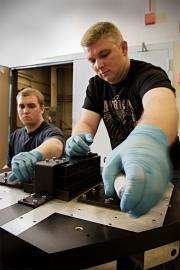
Two technicians from NASA's Goddard Space Flight Center in Greenbelt, Md., are pictured here working with a "Mass Simulator" for the James Webb Space Telescope. Credit: NASA's Goddard Space Flight Center/Chris Gunn

There are a lot of things that happen "behind the scenes" when a space telescope is being built and all of the components are being tested. In this recent photo, two technicians from NASA's Goddard Space Flight Center in Greenbelt, Md. were working with a "Mass Simulator" for the James Webb Space Telescope.

A mass simulator is used to replicate the weight and shape of an instrument and is attached to a main component of a space telescope or satellite to test the satellite's durability and sturdiness. The mass simulator is like a "dead weight" that contains no electronics or optics that the units contain. For each instrument that will fly on the , there are both mass simulators and engineering test units created.

Engineering Test Units are working models of the instruments that are used for testing and validation in laboratory tests, to ensure that they work properly.

In this photo, NASA Goddard Integration Technicians Brandon Gauss and Tony Keim are preparing the Webb telescope's Near-Infrared Spectrograph (NIRSpec) instrument mass simulator for integration onto the Webb's Integrated Module (ISIM) structure. The ISIM structure is the part of the telescope on which all of the mission’s science instruments will be mounted, so it is important that it maintain its rigidity otherwise it may affect the instruments that are attached to it) -- it maintain its rigidity to keep the instruments precisely in their places.
The engineers use these to test the strength of the ISIM by adding the simulated weight of instruments that will be mounted on it. These mass simulators are bolted to the ISIM before its next thermal test to verify the structure can safely handle the weight of the flight instruments during ISIM instrument alignment and performance verification testing. Any distortion of the ISIM would move the instruments out of focus.

The James Webb Space Telescope is the next-generation premier space observatory, exploring deep space phenomena from distant galaxies to nearby planets and stars. The Webb Telescope will give scientists clues about the formation of the universe and the evolution of our own solar system, from the first light after the Big Bang to the formation of star systems capable of supporting life on planets like Earth.

Explore further: NASA head views progress on asteroid lasso mission

add to favorites email to friend print save as pdf

Related Stories

NASA's James Webb Space Telescope gets 'SpaceWired'

Oct 25, 2007

NASA's James Webb Space Telescope will use a new advanced technology network interface called "SpaceWire" that enables the components on the telescope to work more efficiently and more reliably with each other.

Recommended for you

NASA head views progress on asteroid lasso mission

9 hours ago

Surrounded by engineers, NASA chief Charles Bolden inspected a prototype spacecraft engine that could power an audacious mission to lasso an asteroid and tow it closer to Earth for astronauts to explore.

Ecuador satellite collides with Russian space junk

9 hours ago

A small Ecuadoran satellite collided in orbit with the remains of a Russian rocket, but it is too soon to know how much damage it might have sustained, Quito's space agency said Thursday.

Forecast for Titan: Wild weather could be ahead

May 22, 2013

(Phys.org) —Saturn's moon Titan might be in for some wild weather as it heads into its spring and summer, if two new models are correct. Scientists think that as the seasons change in Titan's northern hemisphere, ...

SDO observes mid-level solar flare

May 22, 2013

UPDATE 16:30 p.m. EDT: The M7-class flare was also associated with a coronal mass ejection or CME, another solar phenomenon that can send billions of tons of particles into space. While this CME was not Ea ...

User comments : 0

More news stories

A hidden population of exotic neutron stars

(Phys.org) —Magnetars – the dense remains of dead stars that erupt sporadically with bursts of high-energy radiation - are some of the most extreme objects known in the Universe. A major campaign using ...

Hubble reveals the ring nebula's true shape

(Phys.org) —The Ring Nebula's distinctive shape makes it a popular illustration for astronomy books. But new observations by NASA's Hubble Space Telescope of the glowing gas shroud around an old, dying, ...

NASA head views progress on asteroid lasso mission

Surrounded by engineers, NASA chief Charles Bolden inspected a prototype spacecraft engine that could power an audacious mission to lasso an asteroid and tow it closer to Earth for astronauts to explore.

Controlling mood through the motions of mitochondria

(Medical Xpress)—Regulating the distribution of power in neurons is done by a system that makes the national electric grid look simple by comparison. Each neuron has several thousand mitochondria confined ...