NASA and Microsoft Provide Mars 3-D Close Encounter
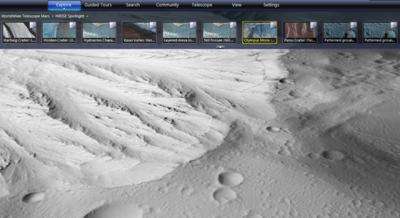
(PhysOrg.com) -- NASA and Microsoft Research are bringing Mars to life with new features in the WorldWide Telescope software that provide viewers with a high-resolution 3-D map of the Red Planet.
Microsoft's online virtual telescope explores the universe using images NASA spacecraft return from other worlds. Teams at NASA's Ames Research Center in Moffett Field, Calif., and Microsoft in Redmond, Wash., jointly developed the software necessary to make NASA's planetary data available in WorldWide Telescope.
"By providing the Mars dataset to the public on the WorldWide Telescope platform, we are enabling a whole new audience to experience the thrill of space," said Chris C. Kemp, chief technology officer for information technology at NASA Headquarters in Washington.
The fully-interactive images and new NASA data will allow viewers to virtually explore Mars and make their own scientific discoveries. New features include the highest-resolution fully interactive map of Mars ever created, realistic 3-D renderings of the surface of the planet, and video tours with two NASA scientists, James Garvin of NASA's Goddard Space Flight Center in Greenbelt, Md., and Carol Stoker of Ames.
Garvin's tour walks viewers through the geological history of Mars and discusses three possible landing sites for human missions there. Each landing site highlights a different geological era of the planet.
Stoker's tour addresses the question: "Is there life on Mars?" and describes the findings of NASA's Mars Phoenix Lander.
"Our hope is that this inspires the next generation of explorers to continue the scientific discovery process," said Ames Center Director S. Pete Worden.
The Intelligent Robotics Group at Ames Research Center developed open source software that runs on the NASA Nebula cloud computing platform to create and host the high-resolution maps. The maps contain 74,000 images from Mars Global Surveyor's Mars Orbiter Camera and more than 13,000 high-resolution images of Mars taken by the Mars Reconnaissance Orbiter's High Resolution Imaging Science Experiment (HiRISE) camera. Each individual HiRISE image contains more than a billion pixels. The complete maps were rendered into image mosaics containing more than half a billion smaller images.
"These incredibly detailed maps will enable the public to better experience and explore Mars," said Michael Broxton, a research scientist in the Intelligent Robotics Group at Ames. "The collaborative relationship between NASA and Microsoft Research was instrumental for creating the software that brings these new Mars images into people's hands, classrooms and living rooms."
NASA's Mars Reconnaissance Orbiter reached the planet in 2006 to begin a two-year primary science mission. The mission has returned more data about Mars than all other spacecraft sent to the Red Planet. Mars Global Surveyor began orbiting Mars in 1997. The spacecraft operated longer than any other Mars spacecraft, ceasing operations in November 2006.
"Microsoft has a long-standing relationship with NASA that has enabled us to jointly provide the public with the ability to discover space in a new way," said Tony Hey, corporate vice president of the External Research Division of Microsoft Research.
Provided by JPL/NASA


