Borne on the Wing: Avian Influenza Risk in U.S. Wild Songbirds Mapped
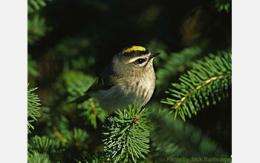
(PhysOrg.com) -- Scientists have discovered that 22 species of passerines--songbirds and perching birds--in the contiguous U.S. are carriers of low-pathogenicity avian influenza. Pathogenicity is the ability of a germ to produce an infectious disease in an organism.
The researchers report their results today in the journal BMC Infectious Diseases.
The research is supported by the joint National Institutes of Health (NIH)-National Science Foundation (NSF) Ecology of Infectious Diseases (EID) Program. At NSF, EID is co-funded by the Directorates for Biological Sciences and Geosciences.
The prevalence of influenza in waterfowl has long been known.
But the researchers' analysis of samples taken from 225 passerine species in 41 U.S. states indicates that the number of songbird species with low-pathogenicity avian influenza is greater than the number in eight other avian orders, including waterfowl.
"Avian influenza virus [AIV] is an important public health issue because pandemic influenza viruses in people have contained genes from viruses that infect birds," says Trevon Fuller, lead author of the paper and a biologist at the Center for Tropical Research at UCLA.
"Some AIV subtypes have periodically mutated from low pathogenicity to high pathogenicity forms that are lethal, for example, to poultry."
Since passerines share the same habitat as poultry, they may be more effective transmitters of this disease than aquatic birds to humans, Fuller says.
Analysis of the geographic distribution of AIV, says Thomas Smith, also a biologist at the Center for Tropical Research at UCLA and a co-author of the paper, "can identify areas where such 'reassortment' events might occur, and how high pathogenicity might travel if it enters wild bird populations in the U.S."
Modelling the number of AIV cases is important, says Sam Scheiner, NSF program director for EID, "because the rate of co-infection with multiple AIV subtypes increases with the number of cases."
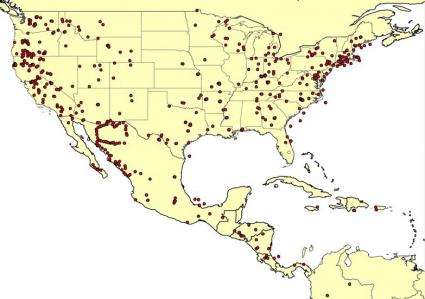
Hotspots in the contiguous U.S. for AIV cases include the Mississippi River basin, with its shallow pools of water and wetlands conducive to the spread of the virus.
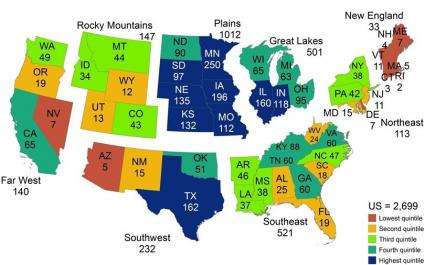
On a state scale, Minnesota is predicted to have the most cases of AIV. The virus has been introduced to Minnesota turkey farms by wild birds--some 135 times since 1968.
Emily Curd, a graduate student at the UCLA Center for Tropical Research, developed a technique to detect short fragments of influenza. It proved crucial to the research, says Smith.
Her efforts, he says, "made it possible to find the virus in the many samples collected by volunteer bird-banders."
The scientists also investigated the association between AIV cases in wild birds and 12 predictor variables--some of which measured agricultural and commercial activity--and climate.
Significant predictors of the number of AIV cases in wild birds per county were thaw date in spring; the percent of the county that is harvested cropland; and minimum temperature.
Thaw date explains the number of AIV cases because if a site thaws earlier, waterfowl may occupy an area sooner. More opportunities exist for adults to infect juveniles than if the site were covered by snow and ice until later.
The amount of harvest cropland was "highly significant," the biologists found. "Agricultural activity reduces the amount of natural habitat available to avian migrants," says Fuller. The birds become crowded together in smaller areas.
Minimum temperature also emerged as important for predicting AIV cases. AIV is known to survive for a longer time in colder conditions.
During a cool-weather 1984 outbreak in Pennsylvania, for example, the virus survived in barns for as long as 105 days.
Provided by National Science Foundation


