Student scientists and engineers develop award-winning rover (w/ Video)
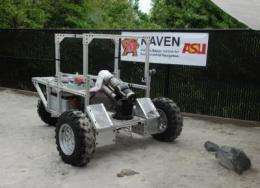
Undergraduates from Arizona State University and the University of Maryland (UMd) took first place in the 2010 Revolutionary Aerospace Systems Concepts Academic Linkage (RASC-AL) contest held June 6 to 10 in Cocoa Beach, Fla. Co-sponsored by the National Institute of Aerospace and the National Aeronautic and Space Administration (NASA), RASC-AL is one of the nation's premier astronautics design competitions for university-level engineering students. It provides them with an opportunity to design projects based on NASA engineering challenges, and provides NASA's Exploration Systems Mission Directorate an opportunity to explore new design concepts with students who will be tomorrow's leaders in space science and engineering.
RASC-AL involves separate design competitions for graduate and undergraduate teams. At the undergraduate level, team projects generally represent the products of senior capstone subjects for aeronautical engineering students at different universities. The collaboration between ASU and UMd students was a first for the annual competition.
"At last year's competition, Dave Akin, a professor in the aerospace engineering program at the University of Maryland, and I had a conversation about how much fun it would be to bring students from ASU and Maryland together to develop a joint design, rather than work on independent designs," says ASU Professor Kip Hodges, founding director of the School of Earth and Space Exploration (SESE) in the College of Liberal Arts and Sciences. Subsequent conversations led to a plan to fully integrate the senior capstone design project for SESE majors with the capstone design project for aeronautical engineering majors at UMd. Assistant Professor Srikanth Saripalli of SESE collaborated with Akin and UMd professor Mary Bowden to mentor the collaborative design project.
With the aim of providing students with a broad understanding of both the science and technology involved in planetary exploration, the ASU/UMd capstone project involved the design and testing of a mobile robot code-named RAVEN (Robotic Assist Vehicle for Extraterrestrial Navigation). This three-wheel, 330-pound (150-kg) rover can traverse 20 degree slopes and is able to travel at speeds up to 3 feet/second (1m/s). Add to that its ability to carry experiments, samples, and tools, and RAVEN would make an ideal robotic field assistant for astronaut-scientists.
"NASA is thinking hard about how best to build human and robotic teams for planetary exploration, so I'm sure that the RAVEN concept really resonated with the RASC-AL judges, who included both NASA and industry engineers," says Hodges.
Saripalli was extremely impressed by the resulting design.
"SESE students interacted extensively with aerospace engineering students from UMd on specifications for designing the rover and they also provided significant input during the design and build phase. Although our majors are trained in both engineering design and earth and planetary science, the UMd students were all aerospace engineers. RAVEN offered those students a sense of how planetary scientists define missions and how NASA applies realistic, science-based goals and constraints in their design work," Saripalli explains. "This is a great example of the fusion of science and engineering - exactly what we are teaching our students to do in SESE. Winning RASC-AL shows that we can do this integration - and do it well."
Thirteen undergraduate teams in total competed, including MIT, Harvard, Princeton, Georgia Tech, Virginia Tech, University of Colorado-Boulder, the University of Uruguay, Rutgers University, Clarkson University, Colorado School of Mines, University of Wisconsin-Madison, University of Michigan, University of Illinois, and California State University-Long Beach.
The 12 SESE and 17 UMd students who designed RAVEN mostly collaborated via social media and teleconferences.
"When I was first told what we were going to do, I wasn't sure if I was prepared," says Lauren Puglisi, an ASU senior majoring in Earth and Space Exploration. "I've worked with other engineering students at ASU in the past, but this project was the first one in which I worked with engineers from another school. ASU would come up with these great ideas for an experiment, and then find out that the instruments we wanted to use exceeded the mass and power budgets of the rover. We had to deal with engineering constraints that I wasn't used to thinking about as a scientist. Engineering and science are key components of any mission designed for exploration, so we are fortunate that we were able to work on this project while still in school."
"Collaborating with the University of Maryland students was fun - but definitely harder than I expected because we had two different approaches to almost every problem," says Ji-hyoung (Sophia) Woo, a junior majoring in Earth and Space Exploration. "ASU students looked at the science side and the Maryland students were trained as engineers but we eventually figured it out. Now I know undergraduate students are capable of building a lunar rover if we do it together."
Andrew Britton, another ASU senior majoring in Earth and Space Exploration, said he felt largely prepared to tackle the task. "Having learned about systems engineering in both SES 210 and SES 394 was a great help, and knowing about the geology of the Moon through various other SESE courses was also a great advantage," says Britton. "The most important thing that I learned from this project is that when the science and engineering come together, success is achieved from the science giving the purpose and the engineering enabling the science."
Hodges couldn't be happier that the students are getting the message that the future of scientific exploration depends on the successful melding of science and technology development.
"We designed the SESE curriculum to achieve that goal and prepare our students for professional careers that demand more than just a scientific or just an engineering mindset. The SESE students involved in the RAVEN project represent our very first senior class of majors in the Earth and Space Exploration B.S. program. We're extremely proud of their accomplishment," says Hodges. "Our rising seniors know they'll be a hard act to follow, but I can't wait to see what they come up with. Dave and Sri are so excited about the fruits of this year's collaboration that they're already brainstorming about next year's project. Maybe we're seeing the beginning of an ASU-UMd dynasty."
Provided by Arizona State University


