UF marine researchers rush to collect samples as oil threat grows
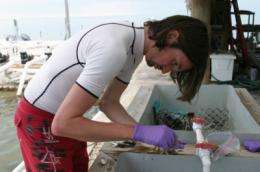
(PhysOrg.com) -- GAINESVILLE, Fla. --- In a race against time, University of Florida marine researchers are hurrying to collect underwater marine algae samples in the Florida Keys while an ever-growing Gulf oil spill steadily migrates toward Florida, already reaching the Emerald Coast in the Panhandle.
Hendrik Luesch, an associate professor of medicinal chemistry at the UF College of Pharmacy, took his research team to Long Key last week in hopes of advancing early drug discoveries that may yield cancer-fighting properties hidden in marine algae. It’s an expedition he has made annually for four years, but this year it seems there might be a limit on how long the ecosystem will yield its specimens.
According to federal and independent scientists, as much as 2.5 million gallons of oil per day are spewing from a pipe in the Gulf of Mexico that engineers have failed to seal.
“Cyanobacteria, or organisms that overgrow coral reefs, are shown to produce drug-like compounds that may be exploited for biomedical purposes such as anti-cancer drugs,” Luesch said.
The warm waters and mild year-round temperatures allow marine life to flourish in the Keys, creating a predatory environment among these organisms, Luesch said. In order to survive, marine organisms develop defense systems, sort of like a chemical survival kit. Researchers use these toxic chemicals as the basis for creating drugs that can target and fight cancers.
“It’s the biodiversity that makes the Florida Keys a hot spot for researchers,” Luesch said.
At the same time, the coral reefs are also a very sensitive ecosystem, he said. For example, the extended chill in the tropical waters last January caused sea turtles to become cold-stunned and killed more than 85 percent of reefs in certain areas, according to Cynthia Lewis, a biological scientist at the Keys Marine Laboratory in Long Key, where the UF researchers collected specimens.
Scientists in Florida don’t know what to expect, she said.
“We are concerned and watchful,” she said. “We don’t know how far the marine impact may go.”
Only two weeks earlier, Lewis and nine other scientific teams under the Florida Fish and Wildlife Conservation Commission took baseline samples on the Gulf and Atlantic coasts from Key Largo to Key West to establish pre-impact marine wildlife assessments, Lewis said.
One challenge with his research, Luesch said, is the randomness of finding an organism and the length of time it takes to isolate and test a compound for its specific drug-producing qualities. Environmental variables may change, which means the organism may change as well.
“We may find an interesting species, but it takes months of research just to isolate the active compound and analyze the properties in our lab,” Luesch said. “Attempts to re-collect often fail because we do not always see the same organism again.”
Two compounds from the oceans have been developed into drugs that are on the market today — one treats cancer, and the other is a pain reliever. Fourteen more are in clinical trials. Scientists simply don’t know how many biological organisms are in the ocean, Luesch said, but marine organisms often produce multiple compounds, and he estimates that more than 90 percent have not yet been discovered.
What does the largest-ever oil spill disaster mean to Luesch and his research?
“I am thinking what everyone else in the United States and in the world is thinking — what a catastrophe this is for mankind and especially the area in the Gulf of Mexico,” he said. “Secondly, I am concerned for the marine discovery efforts by our groups and other groups in this area.”
Provided by University of Florida


