Patchwork-like image of developing zebrafish sensory organ
Jun 15, 2010
Picture credits: Virginie Lecaudey / EMBL.

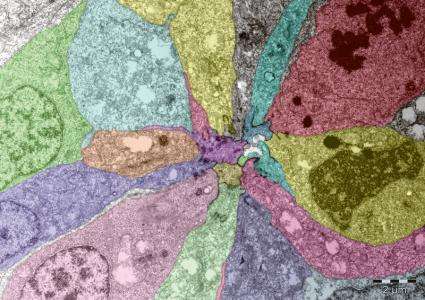
This image may bring to mind a patchwork quilt, or a picture taken from a gallery of abstract paintings, but the artisan behind it is actually Mother Nature, with a little help from scientists at the European Molecular Biology Laboratory (EMBL) in Heidelberg, Germany. Using an electron microscope, Virginie Lecaudey in Darren Gilmour’s group at EMBL captured this snapshot of the beginnings of an organ which plays a central role in how zebrafish perceive the world around them - the lateral line.

Named after its position on the flanks of adult fish, the lateral line is a series of sensory organs through which most fish detect vibrations in the water, helping them to detect predators or prey, for example. As a embryo develops, the cells that will form its lateral line have to become pointed at one end and arrange themselves around a central, unchanged cell, like cloves in a bulb of garlic, forming a rosette. This image shows one such rosette, magnified approximately 10 000 times.

The EMBL scientists discovered that if the cells can’t change shape to form rosettes, they don’t migrate properly along the embryo’s sides, and the lateral line doesn’t develop. “Surprisingly, we also found that this change in cell shape is triggered by a molecular signal that’s known to have the opposite effect in other situations” Gilmour says: “activating this same signal in a developing chick, for instance, leads to a completely different picture.”

The image is false-coloured to highlight the individual cells.

Explore further: Thailand urged to explore edible insect market

add to favorites email to friend print save as pdf

Related Stories

Scientists trace origin of shark’s electric sense

Feb 06, 2006

Sharks are known for their almost uncanny ability to detect electrical signals while hunting and navigating. Now researchers have traced the origin of those electrosensory powers to the same type of embryonic ...

Study shows how the zebrafish gets his stripe

Sep 25, 2007

Scientists have discovered how the zebrafish (Danio rerio) develops one of its four stripes. Their findings add to the growing list of tasks carried out by an important molecule that is involved in the arrangement of everything ...

Recommended for you

Researcher admits mistakes in stem cell study

7 hours ago

A blockbuster study in which US researchers reported that they had turned human skin cells into embryonic stem cells contained errors, its lead author has acknowledged. ...

Scientists discover how rapamycin slows cell growth

9 hours ago

University of Montreal researchers have discovered a novel molecular mechanism that can potentially slow the progression of some cancers and other diseases of abnormal growth. In the May 23 edition of the prestigious journal ...

Bittersweet: Bait-averse cockroaches shudder at sugar

11 hours ago

Sugar isn't always sweet to German cockroaches, especially to the ones that avoid roach baits. In a study published May 24 in the journal Science, North Carolina State University entomologists show the ne ...

User comments : 0

More news stories

White tiger mystery solved

White tigers today are only seen in zoos, but they belong in nature, say researchers reporting new evidence about what makes those tigers white. Their spectacular white coats are produced by a single change ...

Controlling mood through the motions of mitochondria

(Medical Xpress)—Regulating the distribution of power in neurons is done by a system that makes the national electric grid look simple by comparison. Each neuron has several thousand mitochondria confined ...