Japanese company develops world's first ultra-thin piezoelectric waterproof speaker
Jun 15, 2010 by Lin Edwards report

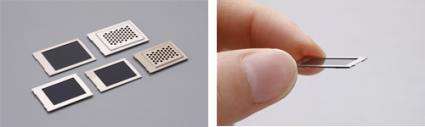
(PhysOrg.com) -- Murata Manufacturing Co., Ltd., a company based in Kyoto in Japan, has made what they claim to be the world's first ultra-thin (0.9 mm thick) waterproof piezoelectric speaker.

Mobile phones and other small portable devices that are not waterproofed can become damaged if they are exposed to water, which can erode components inside and affects the sound quality. Now the practice of waterproofing devices such as mobile phones is growing, with almost a quarter of new models announced for 2010 in Japan being waterproofed, but there are significant technical challenges to be overcome, especially in waterproofing of the speaker, which can be exposed to moisture entering via the sound output holes.

Traditional solutions such as covering sound output holes with thin waterproof sheets of treated paper not only increases costs, but also usually lead to degradation of the sound quality. Murata has responded to this problem by developing a new piezoelectric speaker that is itself waterproof to IXP7 grade, which means the sound holes do not need to be covered.

Piezoelectric make use of the mechanical resonance of piezoelectric ceramics. They can be much thinner than ordinary speakers, down to as thin as 0.5 mm. Their use can also dramatically reduce , especially in the voice band.

The new speakers do not use waterproof sheets, and the manufacturing process is cheaper and does not result in loss of because the sound holes are not covered. The design of the sound holes has also been re-engineering to avoid ingress of moisture.

The speakers could be used in devices such as mobile phones, portable music players, ebook readers, digital video cameras, and military applications. Production is already running at around one million units per month, and the speakers are available for 250 Yen each (approximately $2.70 US). They should start appearing in mobile devices in the near future.

Explore further: Sensitive bomb detector to rove in search of danger

More information: Murata's press release: www.murata.com/new/news_release/2010/0608/index.html

Related Stories

Nanotech Speakers Hold Promise for Sonar Uses

Jun 14, 2010

(PhysOrg.com) -- UT Dallas researchers have found that carbon nanotube sheets perform well as underwater sound generators and noise-canceling speakers, two highly desirable traits for submarine sonar and stealth ...

RBH Adds Five New Speakers to Their Signature Line

Sep 03, 2008

RBH has just announced that they are adding five new speakers to their Signature Line. These five new speakers were made to compliment RBH´s existing Signature Reference freestanding lineup.

Recommended for you

Sensitive bomb detector to rove in search of danger

May 24, 2013

European researchers have developed and tested a light-weight device capable of detecting extremely minute quantities of explosives from up to 20 metres away, providing an invaluable law-enforcement tool ...

How soon could car seats enter the 3-D comfort zone?

May 23, 2013

New 3D textiles made of recyclable polyester fibres could contribute help cars be easier to recycle. But recycling technology has yet to progress in separating seat material from other car components.

NASA: Austin, calling Austin. 3-D pizzas to go

May 22, 2013

(Phys.org) —The idea of living with 3-D printed food is neither unthinkable nor new; designers and futurists have been looking to 3-D printing as food's next frontier. In 2012, there was news that the Thiel ...

User comments : 1

Adjust slider to filter visible comments by rank

Display comments: newest first

PPihkala
not rated yet Jun 15, 2010
I think that should be IPX7 instead of IXP7. IPXY is standard to tell the protection against dust (X) and water (Y). IPX7 means unspecified protection against dust, but very good protection against water.

More news stories

Yahoo, pay-TV operators among Hulu bidders

Online video site Hulu is again up for sale, with Yahoo and pay TV operators DirecTV and Time Warner Cable among the seven bidders, according to a person with direct knowledge of the matter.

Radiation leak at Japan lab; small impact expected

An atomic research lab in northern Japan has reported a radiation leak that may have affected about 50 people, though none were hospitalized and no impact was expected outside the facility, the lab's operator ...

Google eyes emerging markets networks

Google has become deeply involved in a series of projects to build and operate wireless networks in emerging markets including sub-Saharan Africa and Southeast Asia, a report said Friday.

Facial-recognition technology proves its mettle

(Phys.org) —In a study that evaluated some of the latest in automatic facial recognition technology, researchers at Michigan State University were able to quickly identify one of the Boston Marathon bombing ...

Galaxies fed by funnels of fuel

(Phys.org) —Computer simulations of galaxies growing over billions of years have revealed a likely scenario for how they feed: a cosmic version of swirly straws.