US soccer robots get new algorithm for RoboCup 2010 (w/ Video)
Jun 15, 2010 by Lin Edwards report
US soccer robots get new algorithm for RoboCup 2010

(PhysOrg.com) -- The World Cup is gaining the most attention at the moment from soccer fans around the globe, but next week RoboCup, the annual world championship for soccer robots, gets underway in Singapore. RoboCup’s goal is to develop autonomous humanoid soccer-playing robots capable of beating the best human players playing under FIFA rules by 2050, and American researchers think their new robots will take that aim a step closer.

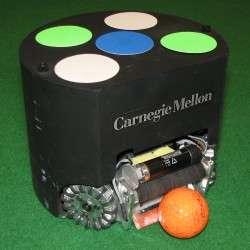
The American robots, developed at the Department of Carnegie Mellon University in Pittsburgh, use a new physics-based algorithm that takes into account ball dynamics, and enables the robots to calculate where the ball is most likely to go next instead of simply reacting to the ball or following the US team’s previous strategy of using pre-programmed plays (similar to a strategy in American football).

Stefan Zickler, who wrote his PhD thesis on the algorithm, said previous robots could not tell when they would lose control of the ball when carrying out maneuvers such as dribbling, but the new algorithm helps them make such predictions, and this gives them a distinct advantage over robots without the algorithm.

This video is not supported by your browser at this time.
Physics-Based Motion Planning for Robot Soccer Dribbling.

Zickler and colleagues tested an earlier version of the algorithm at last year’s , and their robots were highly successful until the quarter finals, when a disastrous left the robots blind and dashed their hopes of a win.

Professor of Computer Science, Manuela Veloso, believes this year’s team of five miniature robots, CMDragons, will be more successful, telling the Pittsburgh Post-Gazette she doesn’t “see any reason why we won’t win”.

This video is not supported by your browser at this time.
Physics-Based Motion Planning with Tactical Models. This video shows simulated physics-based motion planning examples in several challenging domains, including robot minigolf, robot soccer, and pool.

The mini-robots are under the control of a computer watching the action via camera above the playing field. Without the physics algorithm the computer tries to position the robots on the ball but does not make any predictions of the ball’s movement. With the algorithm this weakness is addressed, and the robots can now be moved into a position where the ball is predicted to go, which improves the skills required. The computer is able to make up to 60 decisions per second.

Carnegie Mellon will also enter a team of humanoid robots in the Standard Platform League. The humanoids walk on two feet and can speak and use landmarks to determine their positions.

The robots can also be used for other games such as mini-golf (video below), but soccer is the game of choice because of the constant changes in the environment and because of the cooperation required between players. The could also have a more practical use in helping robots fight fires, taking into account factors such as the type of trees and the effects of the wind.

RoboCup, which has been running since 1997, is the largest robotics and artificial intelligence event in the world attracting competing teams from countries such as the US, Brazil, Japan, and Iran.

This video is not supported by your browser at this time.
This video shows a goal scored by our team CMDragons at RoboCup 2009. The attacking robot uses a novel dribbling behavior which employs randomized, physics-based motion planning to make tactically sound navigation decisions while remaining in full dynamic control of the ball.

This video is not supported by your browser at this time.
This video shows an autonomous robot minigolf system that uses physics-based motion planning to automatically devise control solutions for never-before-encountered problems. Planning and control is performed by an off-board computer with a global dual-camera overhead vision system.


Explore further: Congress gets mixed advice on regulating drones

More information:
* Stefan Zickler's webpage: szickler.net/index.php?sid1=266
* www.robocup.org/
* www.robocup2010.org/
* Carnegie Mellon's Soccer-Playing Robots Get Creative With Physics-Based Planning

Related Stories

Soccer robots compete for the title

Apr 01, 2008

Robot soccer is an ambitious high-tech competition for universities, research institutes and industry. Several major tournaments are planned for 2008, the biggest of which is the 'RoboCup German Open.' From ...

Recommended for you

Congress gets mixed advice on regulating drones

May 17, 2013

(AP)—The growing use of unmanned surveillance "eyes in the sky" aircraft raises a thicket of privacy concerns, but the U.S. Congress is getting mixed advice on what, if anything, to do about it.

Makr Shakr uses three arms for drink-recipe collabs

May 15, 2013

(Phys.org) —We're told it's the wave of the future. Design, make, enjoy. Beyond home-based 3-D printers, there will be new machines and display screens and apps that will invite you to have day to day products ...

Nokia unveils metallic smartphone, stock tumbles (Update)

May 14, 2013

Nokia Corp. on Tuesday unveiled its first Lumia smartphone with a metal cover, low-light camera features and new social network apps. But the new model failed to impress investors, who sent the company's stock down more than ...

User comments : 1

Adjust slider to filter visible comments by rank

Display comments: newest first

plasticpower
not rated yet Jun 16, 2010
Very very cool!

More news stories

Congress gets mixed advice on regulating drones

(AP)—The growing use of unmanned surveillance "eyes in the sky" aircraft raises a thicket of privacy concerns, but the U.S. Congress is getting mixed advice on what, if anything, to do about it.

Makr Shakr uses three arms for drink-recipe collabs

(Phys.org) —We're told it's the wave of the future. Design, make, enjoy. Beyond home-based 3-D printers, there will be new machines and display screens and apps that will invite you to have day to day products ...

RIM unveils cheaper BlackBerry (Update 2)

Research In Motion unveiled a lower-cost BlackBerry aimed at consumers in emerging markets on Tuesday, and said it will offer its once-popular BlackBerry Messenger service on iPhones and devices running Google's ...

German energy shift faces headwinds

Tense engineers have their eyes peeled on complex colour-coded diagrams on a wall-sized screen that makes their control room look like the inside of a spaceship.

China police billions spell profit opportunity

Mannequins in riot gear, armoured cars and drones line a police equipment and "anti-terrorism technology" trade fair in Beijing as vendors seek to profit from China's huge internal security budget.

Russia retrieves mice, newts from space

A Russian capsule filled with 45 mice and 15 newts along with other small animals returned from a month's mission in orbit on Sunday with data scientists hope will pave the way for a manned flight to Mars.

Honeybees trained in Croatia to find land mines

(AP)—Mirjana Filipovic is still haunted by the land mine blast that killed her boyfriend and blew off her left leg while on a fishing trip nearly a decade ago. It happened in a field that was supposedly ...