Single-molecule manipulation for the masses
Jun 02, 2010
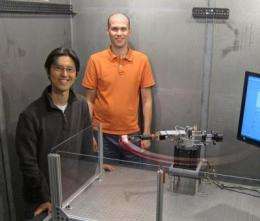
This is a picture of the Centrifuge Force Microscope with inventors Drs. Wesley Wong and Ken Halvorsen. Credit: Dr. Wesley Wong

Scientists have developed a new massively-parallel approach for manipulating single DNA and protein molecules and studying their interactions under force. The finding appears in the June 2 issue of Biophysical Journal.

The team of researchers from the Rowland Institute at Harvard University claim that their technique, which they call "single molecule centrifugation", offers dramatic improvements in throughput and cost compared with more established techniques.

"By combining a microscope and a centrifuge, forces can be applied to many molecules at once while simultaneously observing their nano-to-microscale motions," explains author Wesley P. Wong, a Principal Investigator at Rowland.

Recent technologies such as optical and magnetic tweezers and the (AFM) have enabled the mechanical manipulation of single molecules, leading to new insights in ranging from to blood clotting.

However, the tools used to perform these experiments are often expensive and can be tedious and complicated to use, limiting their use among scientists.

The Harvard researchers aimed to solve these problems by developing an instrument they call the Centrifuge Force Microscope (CFM), which uses centrifugal force to manipulate molecules.
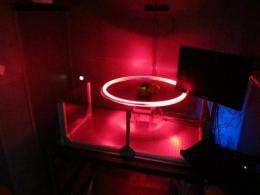
This is the Centrifuge Force Micoscope in action. Credit: Dr. Wesley Wong

Developing the instrument involved miniaturizing a and safely rotating it at high speeds while maintaining precision and control.

Experiments involve tethering thousands of micron-sized "carrier" particles to a surface and observing their motion as the sample rotates to generate the centrifugal force.

"We're really excited about this new method," says co-author Ken Halvorsen, a postdoctoral fellow. "After doing tedious single-molecule experiments for years, we thought there had to be a better way. Now, instead of doing one experiment thousands of times we can do thousands of experiments at once."

The scientists expect that the relative low cost and simplicity of the method will attract researchers who may be intimidated by the cost and technical skills required for other methods, ultimately enabling new discoveries in both health and basic science research.

Explore further: Stacking 2-D materials produces surprising results

Related Stories

Researchers solve 'bloodcurdling' mystery

Jun 04, 2009

By applying cutting-edge techniques in single-molecule manipulation, researchers at Harvard University have uncovered a fundamental feedback mechanism that the body uses to regulate the clotting of blood. The finding, which ...

Simple twists of fate

Sep 30, 2008

A novel Brandeis University study this week in PLoS Biology reports on some of the molecular gymnastics performed by a protein involved in regulating DNA transcription. Using state-of-the art tools, researchers observed the sh ...

New, unique microscope for nanotech

Dec 09, 2005

UC Davis researchers in nanotechnology, chemistry and biology now have access to one of the most advanced microscopes of its type in the world. The new Spectral Imaging Facility, opened this fall, is a combination of an atomic ...

Recommended for you

Stacking 2-D materials produces surprising results

May 16, 2013

(Phys.org) —Graphene has dazzled scientists, ever since its discovery more than a decade ago, with its unequalled electronic properties, its strength and its light weight. But one long-sought goal has proved ...

User comments : 0

More news stories

Graphene joins the race to redefine the ampere

A new joint innovation by the National Physical Laboratory (NPL) and the University of Cambridge could pave the way for redefining the ampere in terms of fundamental constants of physics. The world's first ...

Catching graphene butterflies

Writing in Nature, a large international team led Dr Roman Gorbachev from The University of Manchester shows that, when graphene placed on top of insulating boron nitride, or 'white graphene', the electr ...

Galaxy's Ring of Fire

Johnny Cash may have preferred this galaxy's burning ring of fire to the one he sang about falling into in his popular song. The "starburst ring" seen at center in red and yellow hues is not the product of ...

Morocco to harness the wind in energy hunt

Morocco is ploughing ahead with a programme to boost wind energy production, particularly in the southern Tarfaya region, where Africa's largest wind farm is set to open in 2014.