Image: Phytoplankton Bloom in the North Atlantic
May 26, 2010
Image by Jeff Schmaltz, MODIS Rapid Response Team.

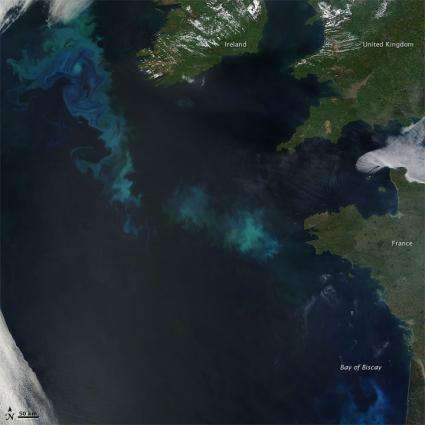
(PhysOrg.com) -- Late May 2010 brought peacock-hued swirls of blue and green to the North Atlantic. The iridescent waters formed a giant arc hundreds of kilometers across, extending from west of Ireland to the Bay of Biscay.

The (MODIS) on NASA’s captured this natural-color image on May 22, 2010. The vibrant colors are from tiny organisms, phytoplankton, that grow explosively in the North Atlantic—from Iceland to the shores of France - in the spring and summer.

Phytoplankton require nutrients to reproduce, and phytoplankton blooms are often tied to events that bring nutrients to the ocean surface, such as dust plumes. can also contribute nutrients for phytoplankton blooms. Researchers from the University of Hamburg’s Institute of Geophysics found that a 2008 eruption of the Kasotochi Volcano in the Aleutian Islands generated a massive phytoplankton bloom in the Northeast Pacific Ocean. They concluded that iron-rich ash falling on waters that are otherwise poor in iron can create conditions in which phytoplankton thrive.

MODIS acquired this image after weeks of eruptive activity at Iceland’s Eyjafjallajökull Volcano. Considering that ash plumes from that volcano closed airspace over much of Europe, one might wonder whether ash provided fertilizer for this bloom. In this case, the answer is probably no. The North Atlantic Ocean already contains plenty of iron, and these waters experience massive phytoplankton blooms every spring and summer.

Explore further: NASA's BARREL mission launches 20 balloons

More information: Langmann, B., Zaksek, K., Hort, M., Duggen, S. (2010, April 27). Volcanic ash as fertiliser for the surface ocean. Atmospheric Chemistry and Physics, 10, 3891-3899.

add to favorites email to friend print save as pdf

Related Stories

Summer Storms Could Mean More Dead Zones

Jul 11, 2008

(PhysOrg.com) -- It's summertime and people are flocking to the coasts around the country. But when summer storms arrive, it's not only beach-goers who are affected; the rains can also have an impact on living ...

Recommended for you

NASA's BARREL mission launches 20 balloons

10 hours ago

(Phys.org) —In Antarctica in January, 2013 – the summer at the South Pole – scientists released 20 balloons, each eight stories tall, into the air to help answer an enduring space weather question: ...

Power of US tornado dwarfs Hiroshima bomb

11 hours ago

Wind, humidity and rainfall combined precisely to create Monday's massive killer tornado in Oklahoma. The awesome amount of energy released dwarfed the power of the atomic bomb that leveled Hiroshima.

Origins of human culture linked to rapid climate change

18 hours ago

Rapid climate change during the Middle Stone Age, between 80,000 and 40,000 years ago, during the Middle Stone Age, sparked surges in cultural innovation in early modern human populations, according to new research.

User comments : 0

More news stories

Moore tornado a rarity, experts say

Tornados, among the most violent of atmospheric storms, rarely reach the size and brutality of the twister that swept through an Oklahoma City suburb on Monday, experts say.

Study says empathy plays a key role in moral judgments

Is it permissible to harm one to save many? Those who tend to say "yes" when faced with this classic dilemma are likely to be deficient in a specific kind of empathy, according to a report published in the scientific journal ...

Australia set to cull 10,000 wild horses

A controversial cull of up to 10,000 wild horses in Australia's harsh Outback reportedly began Wednesday in a bid to control the feral animals which officials say are destroying the land.