Toshiba Develops Optically Compensated Bend Liquid Crystal Panel for 3D Glasses
May 18, 2010

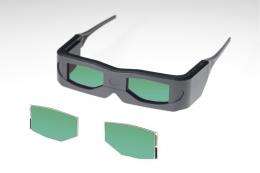
Toshiba Mobile Display has developed an OCB (Optically Compensated Bend) liquid crystal display panel for 3D glasses suitable for watching 3D television, enjoying 3D movies, or playing 3D games.

In recent years, increasing demands for more realistic images has been the catalyst for 3D displays in various applications, such as movies, TV broadcasts, games, and mobile phones. As a result, the stereoscopic display market is expected to grow rapidly.

A 3D image is created by providing slightly different images to your left and right eyes. There are two methods of separating a picture into left and right images: one uses special glasses, and the other is without glasses, called auto-stereoscopy. The with-glasses approach is applied to movies and TV, and there are two primary methods: one uses polarizing filters, and the other is based on time division. This new LCD panel employs the latter time-based, with-glasses approach.

In the time-division with-glasses method, images for the left and right eyes appear alternately, with the special glasses working as a synchronous . That is, when the left image appears, the left liquid crystal shutter opens while the right shutter closes. When the right image appears the right shutter opens while the left shutter closes. Repeating this operation at high speed allows the user to synthesize the left and right images in their brain and to recognize them as a .

If the right image is sensed by the left eye, or if the left image is sensed by the right eye, double vision occurs which is called 3D crosstalk. This phenomenon degrades the quality of the resulting image and causes eye fatigue.

In this new liquid crystal display panel, suitable for application in a pair of glasses, TMD has used OCB technology to achieve both high-speed response and a wide viewing angle while maintaining high contrast. Glasses adopting these panels feature high-speed shutter opening and closing, yielding a significant reduction in 3D crosstalk. In addition, the wide viewing angle provides vivid 3D images across a wide field of view, such as in movie theaters and living rooms. Glasses adopting these panels would allow the viewer to enjoy high-quality 3D images in comfort with minimized fatigue when watching TV, viewing a movie, or playing a game for a long time.

Toshiba America Electronics Components, Inc. will showcase this display at SID 2010 International Symposium, Seminar, and Exhibition, from May 25 to May 27, 2010, in Seattle, Washington, USA.

Explore further: Army ground combat systems adopts tool for choosing future warfighting vehicles

add to favorites email to friend print save as pdf

Related Stories

Active Shutter 3D Technology for HDTV

Sep 25, 2009

(PhysOrg.com) -- Sony and Panasonic have recently announced a new technology, called "active shutter" for producing the experience of 3D on high definition TVs. The first models are expected to be available ...

3D TV -- Without the Glasses (w/ Video)

Oct 29, 2009

(PhysOrg.com) -- Even with "active shutter" 3D technology for television sets, the wearing of special glasses is still required in order to get the proper experience. They aren't those red and blue or red and ...

Japanese group gives health tips to 3D viewers

Apr 23, 2010

A group of Japanese businesses has released a handbook advising viewers on health and safety when watching three-dimensional televisions to counter symptoms such as dizziness, nausea, and eye fatigue.

Samsung Begins Mass Producing 3D TV Panels

Jan 28, 2010

(PhysOrg.com) -- Samsung Electronics announced today that it has become the first company to commence mass production of panels for 3D LED TVs and 3D LCD TVs.

Recommended for you

Student-built innovations to help improve and save lives

May 20, 2013

Nanyang Technological University (NTU) students have developed new and practical life-saving innovations inspired from everyday problems, including improving the safety of cyclists on the roads and keeping ...

GPS solution provides 3-minute tsunami alerts

May 17, 2013

Researchers have shown that, by using global positioning systems (GPS) to measure ground deformation caused by a large underwater earthquake, they can provide accurate warning of the resulting tsunami in ...

User comments : 0

More news stories

Green conversion of heat to electricity

Soon, it will be possible to produce electricity from heat over 30 degrees emitted from a waste incinerator, refinery, or data processor. The start-up Osmoblue has just confirmed the feasibility of this new ...

Game system castAR debuts at Maker Faire

(Phys.org) —Two tech talents, formerly employees at video game publisher Valve, have been working on their own vision in the form of game-ready glasses. Their company, Technical Illusions, will seek to ...

If you can remember it, you can remember it wrong

(Medical Xpress)—Native peoples in regions where cameras are uncommon sometimes react with caution when their picture is taken. The fear that something must have been stolen from them to create the photo ...

Encouraging signs for bee biodiversity

Declines in the biodiversity of pollinating insects and wild plants have slowed in recent years, according to a new study. Researchers led by the University of Leeds and the Naturalis Biodiversity Centre in the Netherlands ...

B vitamins could delay dementia

(Medical Xpress)—Despite spending billions of dollars on research and development, drug companies have been unable to come up with effective treatments for dementia and Alzheimer's Disease (AD). Now, A. ...