Japan rocket to blast off with Venus probe and 'space yacht'
May 17, 2010 by Miwa Suzuki
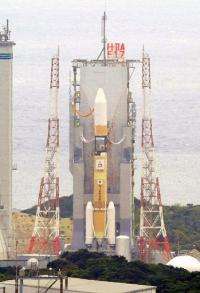
Japan's H2A rocket is set on its launch pad at the Tanegashima space centre in Kagoshima prefecture. The rocket carries the nation's first venus probe and an experimental "space yacht" propelled by solar particles that bounce off its kite-shaped sail.

Japan was set to launch its first Venus probe Tuesday, using a rocket that will deploy an experimental "space yacht" propelled by solar particles bouncing off its kite-shaped sail.

The H-IIA rocket was positioned at the Tanegashima space centre in southern Japan in fair weather Monday for its lift-off the next day at 6:44 am (2144 GMT Monday), said the Japan Aerospace Exploration Agency ().

It will blast off with the "space yacht" Ikaros -- an acronym for Interplanetary Kite-craft Accelerated by Radiation of the Sun -- which moves thanks to the pressure of sunlight particles hitting its square sail.

Ikaros, which has cost 1.5 billion yen (16 million dollars) to develop, will be the first use of the technology in deep space, as past experiments have been limited to unfolding its sail in orbits around the Earth.

The experimental spacecraft's sail, thinner than a human hair, is also equipped with thin-film solar cells to generate electricity, creating what JAXA calls "a hybrid technology of electricity and pressure".

The technology could enable space travel without fuel as long as there is sunlight, its developers say.

JAXA plans to control the path of Ikaros by changing the angle at which sunlight particles bounce off the silver-coloured sail.

Ikaros will initially be a short cylindrical shape when it is released into space, when it will extend its sail, which measures 14 metres (46 feet) on each side and 20 metres diagonally.

Its name alludes to Icarus, the figure from Greek mythology who flew too close to the sun and fell into the sea, but a JAXA official has promised that "this Ikaros will not fly into the sun".

The H-IIA rocket -- Japan's primary space , developed by JAXA and manufactured by Mitsubishi Heavy Industries -- will also launch Japan's first satellite bound for Venus.

The Venus Climate Orbiter PLANET-C, nicknamed Akatsuki, which means "Dawn" in Japanese, will work closely with the Venus Express, a satellite sent earlier by the European Space Agency.

The box-shaped probe with two solar array paddles is expected to arrive at Venus in December and observe the planet in an elliptical orbit, from a distance of between 300 and 80,000 kilometres (186 to 49,600 miles).

Venus rotates around the sun like the Earth but is closer to the sun.

It is sometimes referred to as the Earth's sister planet because it is believed to have been born in a similar process to the Earth's formation about 4.6 billion years ago and is similar in size and mass.

But the planet has a far hotter climate, around 460 degrees Celsius (860 degrees Fahrenheit), with clouds of sulfuric acid and large amounts of carbon dioxide, which is also the primary greenhouse gas on Earth.

Scientists believe a probe of the climate of will help them deepen their understanding of the formation of the Earth's environment and its future.

The H-IIA will also carry four other small satellites, developed by Japanese universities and other institutions.

Explore further: NASA's STEREO detects a CME from the sun

add to favorites email to friend print save as pdf

Related Stories

Venus Express spacecraft fires main engine

Feb 20, 2006

One hundred days after its launch to Venus, the European Space Agency's Venus Express has successfully tested its main engine for the first time in space.

Japan sends first cargo spacecraft to ISS

Sep 10, 2009

Japan early Friday launched its first cargo spacecraft to the International Space Station, aiming for a share of space transport after the retirement of the US space shuttle fleet next year.

Japan sends first cargo spacecraft to ISS

Sep 11, 2009

Japan on Friday launched its first unmanned cargo spacecraft to the International Space Station, aiming for a share of space transport after the retirement of the US space shuttle fleet next year.

Recommended for you

Mars rover Opportunity examines clay clues in rock

8 hours ago

(Phys.org) —NASA's senior Mars rover, Opportunity, is driving to a new study area after a dramatic finish to 20 months on "Cape York" with examination of a rock intensely altered by water.

NASA's STEREO detects a CME from the sun

21 hours ago

On 5:24 a.m. EDT on May 17, 2013, the sun erupted with an Earth-directed coronal mass ejection or CME, a solar phenomenon that can send billions of tons of solar particles into space that can reach Earth ...

Nine-year-old Mars rover passes 40-year-old record

May 17, 2013

While Apollo 17 astronauts Eugene Cernan and Harrison Schmitt visited Earth's moon for three days in December 1972, they drove their mission's Lunar Roving Vehicle 19.3 nautical miles (22.210 statute miles ...

Bright explosion on the Moon

May 17, 2013

For the past 8 years, NASA astronomers have been monitoring the Moon for signs of explosions caused by meteoroids hitting the lunar surface. "Lunar meteor showers" have turned out to be more common than anyone ...

User comments : 3

Adjust slider to filter visible comments by rank

Display comments: newest first

GSwift7
1 / 5 (1) May 17, 2010
"with clouds of sulfuric acid and large amounts of carbon dioxide, which is also the primary greenhouse gas on Earth"

That is wrong. What a bunch of losers. What kind of clown wrote this story? I swear these guys could write a story about a new kind of cotton underwear and find a way to sneak in a comment about global warming.

Water is the primary greenhouse gas according to NOAA and every other source I can find: http://www.ncdc.n...ses.html
MarkyMark
5 / 5 (1) May 18, 2010
I think you need to re-read the article. All it says is that Venuses atmosphere is similar to Earth's and would provide a better understanding of Earth's Climate past and future. It is you who specifically mentions Global Warming.
probes
1.5 / 5 (2) May 18, 2010
"I swear these guys could write a story about a new kind of cotton underwear and find a way to sneak in a comment about global warming."

I think this is true. The "space-yacht" would, however, be far more efficient if it was fitted with 1KW VASIMR engines.

More news stories

Galaxy's Ring of Fire

Johnny Cash may have preferred this galaxy's burning ring of fire to the one he sang about falling into in his popular song. The "starburst ring" seen at center in red and yellow hues is not the product of ...

Alaska volcano shoots ash 15,000 feet into the air

(AP)—One of Alaska's most restless volcanoes has shot an ash cloud 15,000 feet into the air in an ongoing eruption that has drawn attention from a nearby community but isn't expected to threaten air traffic.

Chinese, Indian airlines face EU pollution fines

Eight Chinese and two Indian airlines face fines of up to several million euros for not paying for their greenhouse gas emissions during flights within the bloc, the European Commission said on Friday.

Morocco to harness the wind in energy hunt

Morocco is ploughing ahead with a programme to boost wind energy production, particularly in the southern Tarfaya region, where Africa's largest wind farm is set to open in 2014.

US psychiatry gets makeover in new manual

The latest makeover to a massive psychiatric tome honored by some, reviled by others and even called the "Bible" of mental disorders is being released Saturday with a host of new changes.

New case of SARS-like virus in Saudi: ministry

A new case of the deadly coronavirus has been detected in Saudi Arabia where 15 people have already died after contracting it, the health ministry announced on Saturday on its Internet website.