Quantum dynamics of matter waves reveal exotic multibody collisions
May 14, 2010 by Sebastian Will/Olivia Meyer-Streng
Quantum dynamics of matter waves reveal exotic multibody collisions

At extremely low temperatures atoms can aggregate into so-called Bose Einstein condensates forming coherent laser-like matter waves. Due to interactions between the atoms fundamental quantum dynamics emerge and give rise to periodic collapses and revivals of the matter wave field.

A group of scientists led by Professor Immanuel Bloch (Max Planck Institute of in Garching, Germany) has now succeeded to take a glance 'behind the scenes' of atomic interactions revealing the complex structure of these quantum dynamics. By generating thousands of miniature BECs ordered in an the researchers were able to observe a large number of collapse and revival cycles over long periods of time. The experimental results imply that the atoms do not only interact pairwise - as typically assumed - but also perform exotic collisions involving three, four or more atoms at the same time. On the one hand, these results have fundamental importance for the understanding of quantum many-body systems. On the other hand, they pave the way for the generation of new exotic states of matter, based on such multi-body interactions.

The experiment starts by cooling a dilute cloud of hundreds of thousands of atoms to temperatures close to absolute zero, approximately -273 degrees Celsius. At these temperatures the atoms form a so-called Bose-Einstein condensate (BEC), a in which all particles occupy the same quantum state. Now an optical lattice is superimposed on the BEC: This is a kind of artificial crystal made of light with periodically arranged bright and dark areas, generated by the superposition of standing laser from different directions. This lattice can be viewed as an 'egg carton' on which the atoms are distributed. Whereas in a real egg carton each site is either occupied by a single egg or no egg, the number of atoms sitting at each lattice site is determined by the laws of : Depending on the lattice height (i.e. the intensity of the laser beam) the single lattice sites can be occupied by zero, one, two, three and more atoms at the same time.

The use of those "atom number superposition states" is the key to the novel measurement principle developed by the researchers. The dynamics of an atom number state can be compared to the dynamics of a swinging pendulum. As pendulums of different lengths are characterized by different oscillation frequencies, the same applies to the states of different atom numbers. "However, these frequencies are modified by inter-atomic collisions. If only pairwise interactions between atoms were present, the pendulums representing the individual atom number states would swing synchronously and their oscillation frequencies would be exact multiples of the pendulum frequency for two interacting atoms", Sebastian Will, graduate student at the experiment, explains.

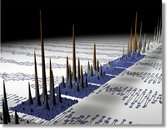
Using a tricky experimental set-up the physicists were able to track the evolution of the different superimposed oscillations over time. Periodically interference patterns became visible and disappeared, again and again. From their intensity and periodicity the physicists found unambiguous evidence that the frequencies are actually not simple multiples of the two-body case. "This really caught us by surprise. We became aware that a more complex mechanism must be at work", Sebastian Will recalls. "Due to their ultralow temperature the atoms occupy the energetically lowest possible at each lattice site. Nevertheless, Heisenberg's uncertainty principle allows them to make - so to speak - a virtual detour via energetically higher lying quantum states during their collision. Practically, this mechanism gives rise to exotic collisions, which involve three, four or more atoms at the same time."

The results reported in the journal Nature provide an improved understanding of interactions between microscopic particles. This may not only be of fundamental scientific interest, but find a direct application in the context of ultracold atoms in optical lattices. Owing to exceptional experimental controllability, ultracold in optical lattices can form a "quantum simulator" to model condensed matter systems. Such a quantum simulator is expected to help understand the physics behind superconductivity or quantum magnetism. Furthermore, as each lattice site represents a miniature laboratory for the generation of exotic quantum states, experimental set-ups using optical lattices may turn out to be the most sensitive probes for observing atomic collisions.

Explore further: A quantum simulator for magnetic materials

More information: Sebastian Will, Thorsten Best, Ulrich Schneider, Lucia Hackermüller, Dirk-Sören Lühmann, Immanuel Bloch, "Time-resolved observation of coherent multi-body interactions in quantum phase revivals" Nature, DOI:10.1038/nature09036 , May 13, 2010

Related Stories

Recommended for you

A quantum simulator for magnetic materials

8 hours ago

Physicists understand perfectly well why a fridge magnet sticks to certain metallic surfaces. But there are more exotic forms of magnetism whose properties remain unclear, despite decades of intense research. ...

Researchers forward quest for quantum computing

14 hours ago

Research teams from UW-Milwaukee and the University of York investigating the properties of ultra-thin films of new materials are helping bring quantum computing one step closer to reality.

Hydrogen atoms under the magnifying glass

May 22, 2013

To describe the microscopic properties of matter and its interaction with the external world, quantum mechanics uses wave functions, whose structure and time dependence is governed by the Schrödinger equation. ...

Making quantum encryption practical

May 21, 2013

One of the many promising applications of quantum mechanics in the information sciences is quantum key distribution (QKD), in which the counterintuitive behavior of quantum particles guarantees that no one can eavesdrop on ...

Lab sets a new record for creating heralded photons

May 20, 2013

(Phys.org) —Entanglement, by general consensus of physicists, is the weirdest part of quantum science. To say that two particles, A and B, are entangled means that they are actually two parts of an inseparable ...

Competition in the quantum world

May 20, 2013

Innsbruck physicists led by Rainer Blatt and Peter Zoller experimentally gained a deep insight into the nature of quantum mechanical phase transitions. They are the first scientists that simulated the competition ...

User comments : 3

Adjust slider to filter visible comments by rank

Display comments: newest first

Alizee
3 / 5 (2) May 15, 2010
Such observation isn't so surprising, because thanks to Heisenberg's uncertainty principle the position of individual particles remains blurred, so that the mutual collisions of three or more particles at the same moment are possible.

From quantum mechanics follows, the atoms itself remain quite tiny, though. What is colliding and penetrating mutually are the deBroglie waves of vacuum surrounding particles. Such result is consistent with famous double-slit experiment and its analogy, described here:

http://www.physor...511.html
akotlar
not rated yet May 30, 2010
What's surprising is that this also happens at macroscopic levels, with 10 trillion atom systems.

Also, I'm a little confused on this distinction between deBroglie waves & particles (as well as em wave/particle duality). Is it more correct to think matter just has fuzzy locality (so limit on location is not tight)? As far as I understand the distinction between wave & particle interaction of matter is just a mathematical convenience. It's both and neither.
akotlar
not rated yet May 30, 2010
Ok, so what creates this pocket of organization. Why do these lower pockets of entropy form if there is essentially nothing separating matter from the lowest energy state but the information to create that specific local organization.

Actually, the topic of entropy is very strange and confusing to me. I think this might be a cliche by now, but if the 2nd law of thermodynamics tells us entropy can only increase, does this mean that all of the information possible is encoded somewhere? As I asked in the preceding paragraph, what chooses which type something is, aka whether it is condensed as matter, or whether it is left as energy. For instance two colliding laser beams =\ matter.

In fact why is there in existence so many different types of energy organizations & interactions. Electromagnetic radiation interacting with magnetic fields, somehow encoded by matter, which itself is a coalescence of energy.

And what is just "energy". Is there anything that isn't electromagnetic energy?

More news stories

A quantum simulator for magnetic materials

Physicists understand perfectly well why a fridge magnet sticks to certain metallic surfaces. But there are more exotic forms of magnetism whose properties remain unclear, despite decades of intense research. ...

Engineers pioneer flat spray-on optical lens

A University of British Columbia engineer and a team of U.S. researchers have made a breakthrough utilizing spray-on technology that could revolutionize the way optical lenses are made and used.

Researchers forward quest for quantum computing

Research teams from UW-Milwaukee and the University of York investigating the properties of ultra-thin films of new materials are helping bring quantum computing one step closer to reality.

How do cold ions slide

Things not always run smoothly. It may happen, actually, that when an object slides on another, the advancement may occur through a 'stop and go' series in the characteristic manner which scientists call ...

Controlling mood through the motions of mitochondria

(Medical Xpress)—Regulating the distribution of power in neurons is done by a system that makes the national electric grid look simple by comparison. Each neuron has several thousand mitochondria confined ...