Rock and Roll: Titan's Gem Tumbler
May 11, 2010
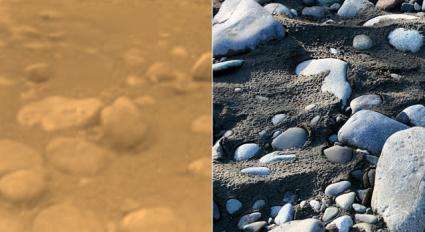
The left-hand image, obtained by the European Space Agency's Huygens probe, shows rounded rocks from the surface of Saturn's moon Titan. Huygens rode with NASA's Cassini spacecraft to the Saturn system. The right-hand image, taken by amateur photographer Sandra M. Matheson, shows river rocks on Earth. Image Credit: NASA/JPL/ESA/University of Arizona and S.M. Matheson

(PhysOrg.com) -- It appears flash flooding has paved streambeds in the Xanadu region of Saturn's moon Titan with thousands of sparkling crystal balls of ice, according to scientists with NASA's Cassini spacecraft. By analyzing the way the terrain has scattered radar beams, scientists deduce the spheres measure at least a few centimeters (inches) and maybe up to a couple of meters (yards) in diameter. The spheres likely originated as part of water-ice bedrock in higher terrain in Xanadu.

"What we believe happened in this area is a lot like what creates polished river rocks on Earth," said Alice Le Gall, a postdoctoral fellow at NASA's Jet Propulsion Laboratory, Pasadena, Calif., and the lead author of the study, which used the Cassini radar instrument. "Bouncing downstream smoothes out the edges of rocks."

As foothill residents know in southern California and other areas, sudden rains can trigger mudslides and flooding at the mountainous fringes of desert areas. Those flows can pick up boulders and debris and tumble them downstream. On Titan, the flows appear to have occurred periodically for eons, on a catastrophic scale. The process on Titan, however, involves rain made of and ethane, rather than Earth's water rain. Titan's rocks are believed to be made primarily of frozen into a hard mass about minus 180 degrees Celsius (minus 290 degrees Fahrenheit), rather than Earth's mineral rocks.

Earth-like river rocks have already been observed on Titan at the landing site of the European Space Agency's , near the equator in the borderland between the Adiri and Shangri-la regions. The landing site also showed signs of flash flooding that deposited cobblestones about 2 to 20 centimeters (1 to 8 inches) in diameter.

But the spidery channels in this southern lowland part of Xanadu looked brighter to Cassini's radar instrument than the Huygens landing area. In fact, the channels, which were scanned by Cassini in May 2008, are among the brightest features ever seen on Titan by the radar instrument.

In a paper now available online in the journal Icarus, Le Gall and colleagues concluded that the most plausible explanation for the extreme brightness of the Xanadu channels was a collection of transparent spherical sediments, packed more tightly together than the cobblestones at the Huygens landing site. The effect would be similar to bejeweling an area with light-catching rhinestones.

The spheres appear to be made of water ice - possibly doped with ammonia - that would look bright to the microwaves used by Cassini's radar. Spheres are good at sending light back in the direction it came from. This property has actually led manufacturers to use plastic spheres in reflective paints and tape, Le Gall said.

Xanadu may be an especially good gem grinder because of its broad expanse and gentle southward slope. Flows could have traveled long distances there and tumbled the chunks for hundreds of kilometers (miles). The subtle work to shape them into spheres could have come from fine grit rubbing against the rocks in the flowing methane. Or, ice may be malleable in Titan's cold temperatures, deforming plastically during the collisions rather than fracturing. The flows that transported these icy spheres probably traveled around 1 meter per second (2 mph).

"It's been really hard for a long time for people to understand why Xanadu is so bright," said Steve Wall, a radar team member at JPL. "You might not expect these kinds of geometries in a natural setting, but we believe this can explain the enigma."

The radar team plans to continue looking for other instances of small, smooth spheres in nature to increase their confidence about the explanation. They also said more study is needed on the mechanical properties of water ice at such cold temperatures.

"Here is yet another example of Titan as a world with Earth-like processes," said Linda Spilker, Cassini project scientist at JPL. "As the seasons change on Titan, maybe we'll get a chance to see methane flow through some of the river channels."

Explore further: NASA head views progress on asteroid lasso mission

Related Stories

Cassini Radar Images Show Dramatic Shoreline on Titan

Sep 19, 2005

Images returned during Cassini's recent flyby of Titan show captivating evidence of what appears to be a large shoreline cutting across the smoggy moon's southern hemisphere. Hints that this area was once wet, ...

Sights and Sounds of Titan

Jan 17, 2005

by Dr. Tony Phillips The European Space Agency's (ESA's) Huygens probe, carried to Saturn by the Cassini spacecraft, parachuted to the surface of Saturn's giant moon Titan on Friday, Jan. 14th, revealing finally what lies beneath Titan's thick orange c ...

Cassini Radar Images Sea, Islands and Mountains

May 24, 2007

On May 12, 2007, Cassini completed its 31st flyby of Saturn's moon Titan, which the team calls T30. The radar instrument obtained this image showing the coastline and numerous island groups of a portion of ...

Cassini Returns to Southern Hemisphere of Titan

Jan 12, 2010

(PhysOrg.com) -- NASA'S Cassini spacecraft will return to Titan's southern hemisphere on a flyby tomorrow, Jan. 12, plunging to within about 1,050 kilometers (about 670 miles) of the hazy moon's surface.

Huygens finds a hostile world on Titan

Dec 08, 2005

Conditions on Saturn's moon Titan, with its dense atmosphere, are similar to those on Earth early in our solar system. Pictures and spectral analysis of Titan's surface, recorded by an international scientific ...

Land Ho! Huygens Plunged to Titan Surface 5 Years Ago

Jan 14, 2010

(PhysOrg.com) -- The Huygens probe parachuted down to the surface of Saturn's haze-shrouded moon Titan exactly five years ago on Jan. 14, 2005, providing data that scientists on NASA's Cassini mission to Saturn ...

Recommended for you

Dark, massive asteroid to fly by Earth on May 31

10 hours ago

It's 1.7 miles long. Its surface is covered in a sticky black substance similar to the gunk at the bottom of a barbecue. If it impacted Earth it would probably result in global extinction. Good thing it is ...

Research team explains 'Lazarus' comets

13 hours ago

Astronomers from the University of Antioquia have discovered a graveyard of comets. These once-dormant comets, dubbed by astronomers as "The Lazarus comets," are now rejuvenated.

NASA ships sensors for seafaring satellite to France

14 hours ago

(Phys.org) —Three NASA-built instruments that are integral components of the next in a series of U.S./European ocean altimetry satellites have arrived in France for integration with their spacecraft in ...

Trip into space with DiCaprio costs $1.55m

14 hours ago

Leonardo DiCaprio is going to get closer to stars of a different kind as he heads into space aboard the Virgin Galactic, and a well-heeled bidder at the Cannes Film Festival has paid 1.2 million euros (1.5 million) to be ...

User comments : 1

Adjust slider to filter visible comments by rank

Display comments: newest first

scidog
not rated yet May 11, 2010
part of Titan's methane cycle? the wearing down of the ice puts methane back into the atmosphere where it rains out again when a saturation level is reached?

More news stories

Galaxies fed by funnels of fuel

(Phys.org) —Computer simulations of galaxies growing over billions of years have revealed a likely scenario for how they feed: a cosmic version of swirly straws.

Dark, massive asteroid to fly by Earth on May 31

It's 1.7 miles long. Its surface is covered in a sticky black substance similar to the gunk at the bottom of a barbecue. If it impacted Earth it would probably result in global extinction. Good thing it is ...

Source of life running out: water scientists

The majority of people on Earth people will face severe water shortages within a generation or two if pollution and waste continues unabated, scientists warned at a conference in Bonn Friday.

Google eyes emerging markets networks

Google has become deeply involved in a series of projects to build and operate wireless networks in emerging markets including sub-Saharan Africa and Southeast Asia, a report said Friday.