BP, US search for new fix to US oil spill
May 10, 2010 by Guillaume Decamme
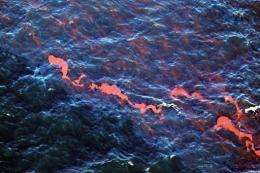
Oil is seen on the surface of the water in Gulf of Mexico. BP officials are desperately searching for a new fix to the enormous Gulf of Mexico oil spill after efforts to cap a gushing leak with a containment dome hit a perilous snag.
BP officials desperately searched Monday for a new fix to the enormous Gulf of Mexico oil spill after efforts to cap a gushing leak with a containment dome hit a perilous snag.
British energy giant BP, which owns the lion's share of the leaking oil and has accepted responsibility for the clean-up, is facing the jaw-dropping possibility that, failing a swift fix it has yet to deliver with a containment dome, the crisis could spiral into an even worse environmental calamity.
The White House also was scrambling to contain fallout from the massive disaster threatening to take a toll on President Barack Obama's political and energy agenda.
In Washington, Obama on Monday "will meet with a number of Cabinet members and senior staff in the White House Situation Room to review BP efforts to stop the oil leak, as well as to decide on next steps to ensure all is being done to contain the spread, mitigate the environmental impact and provide assistance to affected states," a White House statement said.
Meanwhile the Minerals Management Service (MMS) said it "continues to work with BP to explore all options that could stop or mitigate oil leaks from the damaged well."
The BP-leased Deepwater Horizon rig sank some 80 km (50 miles) southeast of Venice, Louisiana April 22, two days after an explosion that killed 11 workers.
The riser pipe that had connected the rig to the wellhead now lies fractured on the seabed a mile below, spewing out oil at a rate at some 5,000 barrels, or 210,000 gallons, a day.
Sheen from the leading edge of the slick has surrounded island nature reserves off the coast of Louisiana and tar balls have reached as far as the Alabama coast, threatening tourist beaches further east.
Sea life is being affected in a low-lying region that contains vital spawning grounds for fish, shrimp and crabs and is a major migratory stop for many species of rare birds.
The 2.4-billion-dollar Louisiana fishing industry has been slapped with a temporary ban in certain areas due to health concerns about polluted fish.
BP, facing a barrage of lawsuits and clean-up costs soaring above 10 million dollars a day, had pinned its hopes on a 98-ton concrete and steel containment box that it successfully lowered 5,000 feet (1,500 meters) down over the main leak.
But the contraption lay idle on the seabed as engineers furiously tried to figure out how to stop it clogging with ice crystals.
Still, if efforts fail to make the giant funnel system effective, there is no solid plan B to prevent potentially tens of millions of gallons of crude from causing one of the worst ever environmental catastrophes.
Untold damage is already being done by the 3.5 million gallons estimated to be in the sea so far, but the extent of that harm will rise exponentially if the only solution is a relief well that takes months to drill.
Admiral Thad Allen, head of the US Coast Guard, suggested they were considering what he called a "junk shot" to plug the main leak.
"They're actually going to take a bunch of debris, shredded up tires, golf balls and things like that and under very high pressure shoot it into the preventer itself and see if they can clog it up and stop the leak," Allen, who is leading the US government's response, told CBS television.
This could be risky as experts have warned that excessive tinkering with the blowout preventer -- a huge 450-ton valve system that should have shut off the oil -- could see crude shoot out unchecked at 12 times the current rate.
There are also fears the slick, which covers an area of about 2,000 square miles (5,200 square kilometers), could be carried around the Florida peninsula if it spreads far enough south to be picked up by a special Gulf current.
"If this gusher continues for several months, it's going to cover up the Gulf coast and it's going to get down into the loop current and that's going to take it down the Florida Keys and up the east coast of Florida," warned Florida Senator Bill Nelson.
"You are talking about massive economic loss to our tourism, our beaches, to our fisheries, very possibly disruption of our military testing and training, which is in the Gulf of Mexico," he told CNN.
On the dome front, clearing out the slushy crystals is easy -- the chamber just has to be raised to warmer levels, Suttles told reporters. Keeping the crystals out so that a pipe can be lowered into the dome to suck the oil to a waiting barge is another matter.
BP began drilling a first relief well one week ago, but that will take up to three months to drill -- by which time some 20 million gallons of crude could have streamed into the sea and ruined the fragile ecology of the Gulf.
(c) 2010 AFP
-
From lemons to lemonade: Reaction uses carbon dioxide to make carbon-based semiconductor,
33 comments
-
Thioridazine kills cancer stem cells in human while avoiding toxic side-effects of conventional cancer treatments,
3 comments
-
SpaceX private rocket blasts off for space station (Update),
42 comments
-
Landmark calculation clears the way to answering how matter is formed,
55 comments
-
Research team claims to have found evidence Lake Cheko is impact crater for Tunguska Event,
18 comments
-
Hypothetical desert earth
May 26, 2012
-
More human population = greater mass?
May 25, 2012
-
Conversion from aircraft bearing to normal degrees
May 23, 2012
-
Interpretation/Analysis of the Lab results(HEPA filter)
May 22, 2012
-
Has anyone here attended the The Urbino Summer School in Paleoclimatology?
May 22, 2012
-
Earthquakes: Mag 6 N. Italy and Mag 5.6 W. Bulgaria
May 21, 2012
- More from Physics Forums - Earth
More news stories
Yale study concludes public apathy over climate change unrelated to science literacy
Are members of the public divided about climate change because they don't understand the science behind it? If Americans knew more basic science and were more proficient in technical reasoning, would public consensus match ...
12 hours ago |
4.8 / 5 (6) |
29
|
Land and sea species differ in climate change response: study
(Phys.org) -- Marine and terrestrial species will likely differ in their responses to climate warming, new research by Simon Fraser University and Australia’s University of Tasmania has found.
10 hours ago |
4 / 5 (5) |
6
|
10 million years needed to recover from mass extinction
It took some 10 million years for Earth to recover from the greatest mass extinction of all time, latest research has revealed.
Space & Earth / Earth Sciences
12 hours ago |
4.2 / 5 (5) |
3
|
Sophisticated simulations predict future warming
The chances of our planet being hit by a global warming of 3 degrees Celsius by 2050 is as likely as it being hit by an increase of 1.4 degrees, new research shows. Presented in the journal Nature Geoscience, the British study ...
Space & Earth / Earth Sciences
May 22, 2012 |
3.8 / 5 (11) |
51
Kyoto Protocol architect 'frustrated' by climate dialogue
UN climate talks are going nowhere, as politicians dither or bicker while the pace of warming dangerously speeds up, one of the architects of the Kyoto Protocol told AFP.
May 23, 2012 |
3.4 / 5 (8) |
43
Stunning image of smallest possible five-ringed structure
Scientists have created and imaged the smallest possible five-ringed structure about 100,000 times thinner than a human hair and you'll probably recognise its shape.
'Unzipped' carbon nanotubes could help energize fuel cells, batteries
Multi-walled carbon nanotubes riddled with defects and impurities on the outside could replace some of the expensive platinum catalysts used in fuel cells and metal-air batteries, according to scientists at ...
Change in developmental timing was crucial in the evolutionary shift from dinosaurs to birds: study
At first glance, it's hard to see how a common house sparrow and a Tyrannosaurus Rex might have anything in common. After all, one is a bird that weighs less than an ounce, and the other is a dinosaur that ...
Computer model used to pinpoint prime materials for efficient carbon capture
When power plants begin capturing their carbon emissions to reduce greenhouse gases and to most in the electric power industry, it's a question of when, not if it will be an expensive undertaking.
T cells 'hunt' parasites like animal predators seek prey, study shows
By pairing an intimate knowledge of immune-system function with a deep understanding of statistical physics, a cross-disciplinary team at the University of Pennsylvania has arrived at a surprising finding: T cells use a movement ...
Browser wars flare in mobile space
The browser wars are heating up again, but this time the fight is for dominance of the mobile Internet.
May 10, 2010
Rank: 5 / 5 (1)
This would also set up a stagnant current zone under the now much larger funnel opening which would allow the oil flow to travel straight up, making equipment repair viewing much better.
The long tube could also be allowed to follow the current on it's way to the surface and its oil captured wherever it was easiest to attach to.
Let buoyancy do the work.
May 10, 2010
Rank: 3 / 5 (2)
Fast, simple, and workable.
I've been suggesting this to BP, the coast guard, Transocean, the state of Florida and Louisanna, etc., for the past week.
Why are we still pissing around? It can't be any more simple. If the engineers on the scene can't figure out how to do this, send me an air ticket and I'll come down to show them how.
A Larson
May 11, 2010
Rank: not rated yet
May 12, 2010
Rank: not rated yet
May 12, 2010
Rank: not rated yet
- A few thermite charges inside the dome triggered remotely . Once ignited, thermite (used to weld train rails) will burn like hell on fire. And it doesn't need air at all.
- pure Magnesium, potassium, sodium metals packages ruptured by small explosives remotely. All these metals react exothermically with water. Plenty of heat.
- a dozen of compressed air tanks with valves controlled remotely, bubbling slowly inside the dome out the pipe attachment opening, starting at depth where ice slushing will be a problem, all the way down to the bottom until oil salvaging pipe connect. You don't need a lot of out-gassing, the bubble movements will facilitate the uninterrupted flow of water through the dome opening. The ice slush at higher pressures than the pressure in the gas bubbles will expand and break up.
May 12, 2010
Rank: not rated yet
- Attach one of the deep sea type propulsion (motor-propeller) unit just under the opening of the dome and run it constantly by ship side power umbilical to break off the slush. Rip them off the Trieste or the Alvin, they would work fine at this absurd shallow depth.
- a few dozen tanks of compressed O2/air outside the dome, with remotely controlled valves pipe and an ignition circuitry to the top inside of dome, to burn the oil in situ. Once the dome is plugged by slush, release a bit of air, ignite the oil-air vapor mixture. Boom! No more blocking slush...
May 12, 2010
Rank: not rated yet