Physicist finds colder isn't always slower as electron emissions increase at temps to -452 F
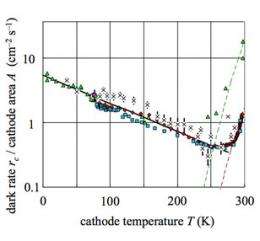
Using two different photomultipliers (denoted by triangles and squares), Meyer found that dark rate electron emission decreased as the temperature (noted above in Kelvin) decreased until about -63.4 F (220 K), when the emission rate then began increasing while temperatures continued dropping to -452 F (4 K).
(PhysOrg.com) -- Science is detective work so it was not unexpected that new questions would follow old ones as Indiana University Bloomington nuclear physicist Hans-Otto Meyer's work progressed on testing a fundamental symmetry of nature that could lead to understanding the matter-antimatter asymmetry in the universe.
At the heart of this search to uncover a violation of time-reversal symmetry by observing a permanent electric dipole moment of the neutron (nEDM) is the $25 million nEDM experiment that Meyer and 60 other researchers from 15 institutes are working on.
But while searching for a non-zero separation of positive and negative charge inside a neutron (the symmetry-violating nEDM), Meyer ran into another mystery scientists have yet to explain.
Working with highly sensitive photomultipliers intended to detect the scintillation light given off during the nEDM experiment as charged particles emerge from reactions between neutrons and a rare isotope of helium, Meyer identified new attributes to a phenomenon called cryogenic electron emission.
In a recent paper in Europhysics Letters (Vol. 89, Issue 5), Meyer presents a thorough experimental investigation of the electron emission rate in the absence of light -- called the dark rate -- in which the rate of electron emission unexpectedly increases as a photomultiplier is cooled to liquid-helium temperature.
Once the temperature hit around -64 F (220 K) and as it continued down to the lowest temperature measured during the experiment, -452 degrees F (4 K), electron emission from the cathode surface of the photomultiplier steadily increased. This is in contrast to the usual behavior of nature where processes tend to slow down as things get colder.
Meyer saw the electrons being emitted in bursts, noted that the burst duration distribution followed a power law and, as the temperature decreased, that both the rate of bursts and their size increased. Furthermore, he found that while the bursts occurred at random times, that within a given burst the emission of electrons obeyed a peculiar pattern in time.
Scientists have known about cryogenic emission for about 50 years. While other types of spontaneous electron emission without light are understood (thermal or heat, electrical field, and penetrating radiation electron emission), Meyer points out, "at this time, regrettably, a quantitative explanation of the observed characteristics of cryogenic emission is still eluding us."
"Most likely, this observation can eventually be explained within the known laws of physics, but there is always a small chance that we are seeing something new, and that this is a real discovery," he said.
Meyer suggests a trapping mechanism may be at work. How the trap is created and how it fills with or empties itself of electrons might be related to the behavior of traps in semiconductors. One clue pointing to a trap mechanism is the longer intervals between emitted electrons, from about three microseconds apart to three milliseconds apart as a given burst evolved.
A trap would hold electrons until full, then empty some electrons that become dark events measured by the photomultiplier, while others would recombine with an electron hole and thus go undetected. As fewer electrons remained, the release rate would slow.
Retired from teaching duties at the IU College of Arts and Sciences' Department of Physics and having graduated his last student two years ago, Meyer is still active in research at the IU Cyclotron Facility's new Center for Matter and Beams. He estimated continuing the experiment would cost about $500,000.
"I would be very pleased if someone younger would take up this investigation," he said.
And if someone else were to take up this mystery, a semi-retired Meyer has some thoughts on how to proceed.
"Ideally you would want to build an apparatus capable of presenting different surfaces of your choice, like copper, carbon or silicon for example, to an electron multiplier," he said. "The apparatus requires ultra-high vacuum, and the surfaces must be cooled to cryogenic temperatures. Such an experiment will tell us whether these trapping events are present only in semiconductors such as the cathode of a photomultiplier, or are of a more general nature."
Provided by
Indiana University
-
From lemons to lemonade: Reaction uses carbon dioxide to make carbon-based semiconductor,
33 comments
-
Thioridazine kills cancer stem cells in human while avoiding toxic side-effects of conventional cancer treatments,
3 comments
-
SpaceX private rocket blasts off for space station (Update),
42 comments
-
Landmark calculation clears the way to answering how matter is formed,
55 comments
-
Research team claims to have found evidence Lake Cheko is impact crater for Tunguska Event,
18 comments
-
Global temperature anomaly and photosynthesis.
31 minutes ago
-
Is the Strong Force causing any of the effects of a Black Hole?
34 minutes ago
-
Question about the Normal Force
38 minutes ago
-
Help Solving Gravitational Constant Equation
1 hour ago
-
How to isolate the mass?
2 hours ago
-
Why does a boiled egg rotates while a raw egg doesn't?
7 hours ago
- More from Physics Forums - General Physics
More news stories
Is a classical electrodynamics law incompatible with special relativity?
(Phys.org) -- The laws of classical electromagnetism that were developed in the 19th century are the same laws that scientists use today. They include Maxwell’s four equations along with the Lorentz la ...
Landmark calculation clears the way to answering how matter is formed
(Phys.org) -- An international collaboration of scientists, including Thomas Blum, associate professor of physics, is reporting in landmark detail the decay process of a subatomic particle called a kaon ...
May 25, 2012 |
4.3 / 5 (24) |
55
|
Lying in wait for WIMPs: Researchers seek to dramatically increase sensitivity of Large Underground Xenon detector
Although it's invisible, dark matter accounts for at least 80 percent of the matter in the universe. No one knows what it is, but most scientists would bet on weakly interacting massive particles, or WIMPs.
May 23, 2012 |
4 / 5 (7) |
19
|
Hawaii lab turns laser-powered bubbles into microrobots
(Phys.org) -- A team of scientists from the University of Hawaii are working on microrobots created from bubbles of air in a saline solution. The bubbles take on their title of robots as a laser ...
Sound increases the efficiency of boiling
Scientists at the Georgia Institute of Technology achieved a 17-percent increase in boiling efficiency by using an acoustic field to enhance heat transfer. The acoustic field does this by efficiently removing vapor bubbles ...
May 24, 2012 |
5 / 5 (2) |
2
Stunning image of smallest possible five-ringed structure
Scientists have created and imaged the smallest possible five-ringed structure about 100,000 times thinner than a human hair and you'll probably recognise its shape.
'Unzipped' carbon nanotubes could help energize fuel cells, batteries
Multi-walled carbon nanotubes riddled with defects and impurities on the outside could replace some of the expensive platinum catalysts used in fuel cells and metal-air batteries, according to scientists at ...
Change in developmental timing was crucial in the evolutionary shift from dinosaurs to birds: study
At first glance, it's hard to see how a common house sparrow and a Tyrannosaurus Rex might have anything in common. After all, one is a bird that weighs less than an ounce, and the other is a dinosaur that ...
Computer model used to pinpoint prime materials for efficient carbon capture
When power plants begin capturing their carbon emissions to reduce greenhouse gases and to most in the electric power industry, it's a question of when, not if it will be an expensive undertaking.
T cells 'hunt' parasites like animal predators seek prey, study shows
By pairing an intimate knowledge of immune-system function with a deep understanding of statistical physics, a cross-disciplinary team at the University of Pennsylvania has arrived at a surprising finding: T cells use a movement ...
Yale study concludes public apathy over climate change unrelated to science literacy
Are members of the public divided about climate change because they don't understand the science behind it? If Americans knew more basic science and were more proficient in technical reasoning, would public consensus match ...
Apr 28, 2010
Rank: 1 / 5 (2)
Apr 28, 2010
Rank: 5 / 5 (4)
Yes, I do believe it was
http://www.physor...719.html
Why post it again?
Apr 28, 2010
Rank: 2.3 / 5 (3)
Apr 28, 2010
Rank: not rated yet
"But while searching for a non-zero separation of positive and negative charge inside a neutron (the symmetry-violating nEDM), Meyer ran into another mystery scientists have yet to explain."
I would like to know if they found a separation of charge inside the neutron??
Apr 28, 2010
Rank: 5 / 5 (1)
Apr 28, 2010
Rank: 5 / 5 (3)
A 'Failure' to use proper temperature measurements.
Apr 29, 2010
Rank: 3 / 5 (2)
http://focus.aps....v22/st11
Apr 29, 2010
Rank: not rated yet
Apr 29, 2010
Rank: not rated yet
A glitch in the PR department of Indiana University?
Apr 29, 2010
Rank: not rated yet
The diagram does use Kelvin, so does the scien(ce)tist. It's those damned Yanks and their insistence on using the imperial measurement system that's forced the inclusion of Fahrenheit conversions.
Apr 29, 2010
Rank: 1 / 5 (1)
http://arxiv.org/abs/0802.2563
Apr 29, 2010
Rank: 3 / 5 (2)
May 03, 2010
Rank: not rated yet
That was just a cover story.
May 03, 2010
Rank: not rated yet
Maxwell, via the math, stated flat our that symmetry in the system did not exist. Heaviside shortened it and took most of the asymmetry and the mathematical explanation out - to simplify for pen and pencil based electric motor design. Lorentz removed the last bits of asymmetry, and thus cursed us to having to go over this ground for the umpteenth time...160 years later.