Image: Oil Slick Spreads off Gulf Coast
Apr 27, 2010
Image Credit: NASA/MODIS Rapid Response Team

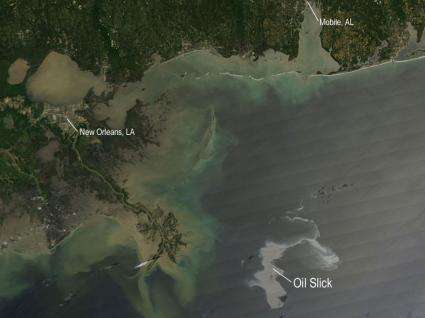
NASA's Aqua satellite captured this image of the Gulf of Mexico on April 25, 2010 using its Moderate Resolution Imaging Spectroradiometer (MODIS) instrument.

With the Mississippi Delta on the left, the silvery swirling oil slick from the April 20 explosion and subsequent sinking of the Deepwater Horizon drilling platform is highly visible. The rig was located roughly 50 miles southeast of the coast of Louisiana.

The oil slick may be particularly obvious because it is occurring in the sunglint area, where the mirror-like reflection of the Sun off the water gives the a washed-out look.

Oil slicks are notoriously difficult to spot in natural-color (photo-like) because a thin sheen of oil only slightly darkens the already dark blue background of the ocean. Under unique viewing conditions, oil slicks can become visible in photo-like images, but usually, radar imagery is needed to clearly see a spill from space.

Explore further: Heat-related deaths in Manhattan projected to rise

add to favorites email to friend print save as pdf

Related Stories

ESA's Envisat monitors oil spill

Apr 27, 2010

These ESA Envisat images capture the oil that is spilling into the Gulf of Mexico after a drilling rig exploded and sank off the coasts of Louisiana and Mississippi, USA, on 22 April.

Scientists find black gold amidst overlooked data

Feb 19, 2009

(PhysOrg.com) -- About half of the oil in the ocean bubbles up naturally from the seafloor, with Earth giving it up freely like it was of no value. Likewise, NASA satellites collect thousands of images and ...

'Major oil spill' as rig sinks off US coast

Apr 23, 2010

A blazing oil rig has sunk into the Gulf of Mexico, sparking fears of an environmental disaster two days after a massive blast that left 11 workers missing.

Recommended for you

Big pig poo problem solved

2 hours ago

An Australian led-project to turn 1.4 million tonnes of Chinese pig poo into alternative energy and fertiliser has been hailed in a national science award.

Bold action, big money needed to curb Asia floods

18 hours ago

Asia's flood-prone megacities should fund major drainage, water recycling and waste reduction projects to stem deluges and secure clean supply for their booming populations, experts said Sunday.

Heat-related deaths in Manhattan projected to rise

19 hours ago

Residents of Manhattan will not just sweat harder from rising temperatures in the future, says a new study; many may die. Researchers say deaths linked to warming climate may rise some 20 percent by the 2020s, ...

Dire outlook despite global warming 'pause': study

19 hours ago

A global warming "pause" over the past decade may invalidate the harshest climate change predictions for the next 50 to 100 years, a study said Sunday—though levels remain in the danger zone.

User comments : 0

More news stories

Cracking the ice code

(Phys.org) —What happened the last time a vegetated Earth shifted from an extremely cold climate to desert-like conditions? And what does it tell us about climate change today?

Tiny ancient bandicoot shines light on future

(Phys.org) —A 20 million-year-old fossil skull identified as a 'pocket-sized' ancestor of the bandicoot will give insights into the future of Australia's modern endangered animals.

Rise in type 2 diabetes amongst young

The number of young people diagnosed with type 2 diabetes has seen the sharpest rise over the last twenty years compared to a background of a general increase across the board, new University research has ...